Scraps of memory beginning to drift through the outlying
regions of my mind…
Memories come back to me… memories behind and within
which many things much further back in the past seem to lie.
W.G. Sebald, Austerlitz, pg. 136
Memories lie slumbering within us for months and years,
quietly proliferating, until they are woken by some trifle and
in some strange way blind us to life….what would we be without memory? We would not be capable of ordering even the simplest
thoughts, the most sensitive heart would lose the ability to show
affection, our existence would be a mere, never ending chain of
meaningless moments, and there would not be the faintest trace
of a past.
W.G. Sebald, The Rings of Saturn, Pg. 255
We live with such easy assumptions, don’t we? For instance, that
memory equals events plus time. But it’s much odder than this. Who
was it said that memory is what we thought we’d forgotten? And
it ought to be obvious to us that time doesn’t act as a fixative, rather
as a solvent.
Julian Barnes, The Sense of an Ending, pg. 69
In trying to escape the fatality of memory, he discovered with an
immense sadness that pursuing the past inevitably only leads to
greater loss. To hold a gesture, a smell, a smile was to cast it as
one fixed thing, a plaster death mask which as soon as it was
touched crumbled in his fingers back into dust.
Richard Flanagan, The Narrow Road to the Deep North, pg. 300
The talented German writer, W.G. Sebald once wrote that “we believe we can remember, but in reality, of course, memory fails us.” And, memory is often unsuccessful due simply to the vast number of events that have occurred during our lives. How do we keep track of and perhaps internally catalog these occurrences? A personal journal might help to memorialize key happenings, and to perhaps refresh our recollections if revisited. But, on our own, without prompts or aids, how much can we hold available for recall at any given moment? As Julian Barnes has written: “History is that certainty at the point where imperfections of memory meet the inadequacies of documentation.” (Barnes, The Sense of an Ending, pg. 65.)
Adding to our inability to consistently bring back, at will, specific occurrences, actions or thoughts from years before, we know that age progression can obviously also be a contributing factor. And, looking back on a lifetime full of happenings in one’s older years may not necessarily or easily yield a well-remembered and straight forward account of things. Indeed, as the English writer Anthony Burgess wrote: “As we grow older, the memories of early life brighten, those of maturity and senescence grow dim and confused.” (Burgess, You’ve Had Your Time, pg. 0.)
And, to that, Sebald could add:
The older you get, in a sense, the more you forget. That is certainly
true. Vast tracts of your life sort of vanish in oblivion. But that
which survives in your mind acquires a very considerable degree
of density, a very high degree of specific weight.
W.G. Sebald, The Emergence of Memory, pg. 54
We can ask: why do certain memories of thoughts or situations so disproportionately stand out to us over the years? And why do we fail to recollect so many other occurrences? The American short story writer Tobias Wolff felt that there was “no question that the operations of memory have a great deal of imagination in them.” He felt that otherwise we’d all remember things exactly the same. Wolff wrote that we each bring:
a peculiar sense of the past to bear; each of us is a filter. None
of us has an objective view of the past. (While) there are
historical events that are verifiable… There’s always that
subjective slant to the act of remembering things.
Tobias Wolff, “Some Thoughts on the Role of Truth in Memoir”
So, as we process recollections of our own lives, we apply a specific filter that is unique to each of us individually. As the major character in Anne Enright’s The Gathering opined:
“History is only biological—that’s what I think. We pick and choose the facts about ourselves, where we come from and what that means.” (Enright, The Gathering, pg. 162.)
We may think of history as history—a straight forward accounting of facts. Our memories, on the other hand, can often take on more of a fictionalized rendering of the facts—with a tweaking and modifying and enhancing of them in the remembering. We are probably not even aware that we are doing this. But, the personal filter we apply to our memories can make them certainly less than historical, or even factual. And, that’s probably because our personal framing of a memory makes it much more satisfying to recollect—editing out, as it were, the less pleasing aspects. Thus, in effect, we are creating our own “history”—embedding subjectivity within our memories.
Looking back into the past in search of memories can activate differing sensations for each of us. Sebald described it this way:
It’s that sensation, if you turn the opera glass around…I think all
children, when they’re first given a field glass to look through, will
try this experiment. You look through it the right way around, and
you see magnified in front of you whatever you were looking at, and
then you turn it round, and curiously, although it’s further removed,
the image seems much more precise. It’s like looking down a well
shaft. Looking in the past has always given me that vertiginous sense.
It’s the desire, almost, or the temptation that you might throw yourself
into it, as it were, over the parapets and down. There is something
terribly alluring to me about the past. I’m hardly interested in the
future. I don’t think it will hold many good things. But at least about
the past you can have certain illusions.
Sebald, The Emergence of Memory, pg. 57
Ah, that last line is another claim that when we review our past, we can have certain illusions —illusions that essentially distort our perception of reality, and that might, in fact, really cause us to misinterpret what actually took place. To place perhaps an inordinate significance where it is not warranted. In addition, the author also describes the dizzying state that he sometimes associates with recollections of the past events in his life. And how though the image we are picturing is even further removed, to him it still seems “much more precise.” Another way of describing the intensity of certain, distant memories comes from John Updike: “In memory’s telephoto lens, far objects are magnified.” (Updike, First Wives and Trolley Cars, pg. 0.)
Each time there is something that triggers a memory from long ago, it begins a journey back to our earlier days, sometimes all the way back to our youth. The information that we recall can often times be intermittent and incomplete, while conversely, some of it seems very clear, as if it were from yesterday. Paul Auster, a highly acclaimed novelist—and, a man who was born in the very same year that I was, which is to say, quite a long time ago—expressed the following thoughts about his boyhood memories:
Your earliest thoughts, remnants of how you lived inside yourself
as a small boy. You can remember only some of it, isolated bits and
pieces, brief flashes of recognition that surge up in you unexpectedly
at random moments—brought on by the smell*of something, or the
touch of something, or the way the light falls on something in the here
and now of adulthood. At least you think you can remember, you
believe you remember, but perhaps you are not remembering at all,
or remembering only a later remembrance of what you think you
thought in that distant time which is all but lost to you now.
Auster, Report from The Interior, pg. 4
I think the point he makes at the very end is important to consider regarding the objectivity, the accuracy and the completeness of our memories; are we, in fact, remembering the original memory accurately, or simply remembering a later remembrance of what we are picturing from a distant time? My cousin John, a wise man, put it this way on that very topic in correspondence to me earlier this year: “We try to think or envision what we were like in the past, but memories are unreliable, biased and misleading. Some neuroscientists, in fact,
opine that we never directly remember a past event, we remember only the last time we remembered it.” (J. Sena, 4/2/20)
So, it is most likely that each of us remembers an event from our earlier life in a slightly different iteration every time we go back to it. Perhaps, taking on new aspects or meaning, while shedding other parts of the memory. It is not unlike a version of the “telephone game”, commonly referred to simply as “telephone.” (In England, the game goes by “Chinese Whispers”, which was originally meant to denote confusion and incomprehensibility with the Chinese language in the early contacts between Europeans and Chinese people.) “Telephone”, like revisiting our memories, may lead to accruing small misconceptions along the way that can ultimately result in making a major difference in one’s recollection.
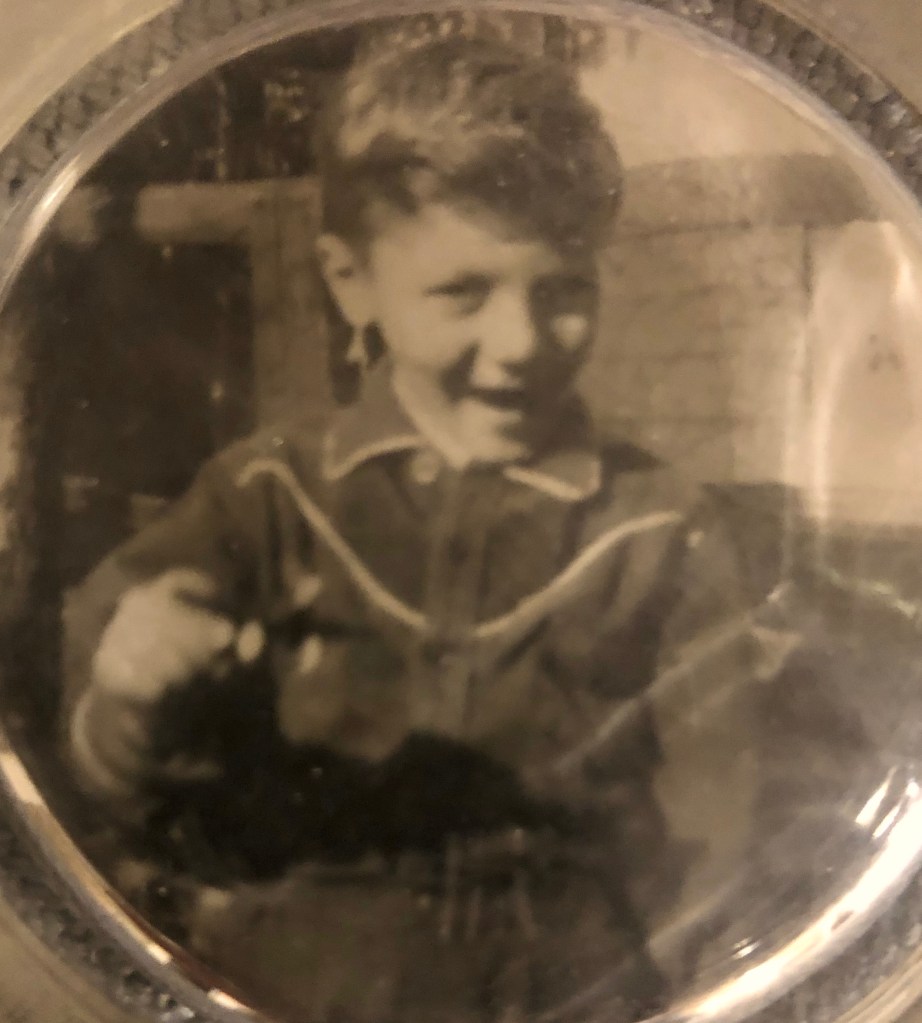
I have a memory from childhood as a small boy playing with a toy airplane. I also have a picture of myself from that era playing with that same toy airplane. So, is what I’m remembering really a memory of a memory of a memory ad infinitum of playing with that plane, or simply a memory of a memory of a memory of the photo? I guess I’ll leave that for neuroscientists and others smarter than I am to puzzle out.
The advent of the “video age” during the latter part of the 20th century allowed for what media journalist Jack Antonoff called a “kind of collective unconscious” to take hold. Tape and television technology had “unlimited potential for duplication and persuasion that imparted to viewers across the country a uniformity that was almost scary.” And then, in 1982, along came MTV— what Antonoff referred to as the “video dubbing of an entire generation.” He went on to explain what happened in this country as MTV became more and more embedded in the nation’s consciousness, and particularly with the youth:
Music Television accelerated the shift from individual perception
to mass-spooned sameness when it debuted as a national cable tv
feed to the eyes of youth… What troubled older folks (people in their
30s) from the start was the fact that all of the visuals were being
filled in for us—leaving nothing to the imagination.
Jack Antonoff, “McMemories and Playback”, Advertising Age, 9/10/84
The first interesting thing to me is that Antonoff’s friend couldn’t have been listening to “Rag Doll” in 1962, as the song was released in 1964. Evidently, the author just got that date wrong—or his friend’s memory wasn’t as infallible as he thought it was. Actually, I have a memory of my own that involves that very same song, but it took place during the summer of 1964. I had gotten my New Jersey driver’s license in April of ‘64 and acquired my first car a month or so later. It was a 1957, baby blue Ford Fairlane convertible. (I was to discover that there was a set of “bubble skirts” for the rear wheels in the trunk, but I never actually got around to using them.)
But, getting back to my memory: I can picture it as if it were yesterday—but actually, it was over 55 years ago! It was probably sometime in July and I was driving around the “Green” in Morristown. Warm summer weather, top down, cruising around the square with the radio blasting. Blasting what, you ask? “Rag Doll” say I. 17 years old, singing along with the music, attempting to be as cool as possible for a somewhat shy guy at that age.
What I do recall, though, and vividly, was the smell of the warm summertime air, the sense of enjoyment with what I was doing and the feeling that yes, perhaps I was actually, after all, a pretty cool dude—and that this was just the start of a new and exciting phase in my life. I have definitely gone back to that moment in time on many occasions and the feeling that accompanies it is one that is enveloped in positivity and promise. And, that ‘s been the consistent response for me to this particular memory over the years. Now that I think back, perhaps it served as a kind of seminal moment in my young life.
Memories, of course, are not always accurate. Sometimes a false memory is created by the brain to take the place of a repressed memory, one that is perhaps too disturbing, terrifying or tragic to confront. The brain is very vulnerable to suggestion and can insert other data where the actual information is unknown or unable to be captured. Memories can also be inaccurate based on what Elizabeth Loftus (a top cognitive psychologist) identified as the “misinformation effect.” Many times a person’s recall of various episodes becomes less accurate due to “past-event information.” This often comes into play during testimony given in court cases. Loftus writes that this can occur with the introduction of:
retroactive interference, which occurs when information presented later
interferes with the ability to retain previously encoded information.
Essentially, the new information that a person receives works backward
in time to distort memory of the original event.
B. Robinson-Riegler ,G. Robinson-Riegler, Cognitive Psychology, “Applying the Science of the Mind”, 2004, pg. 313
All of these assaults on memory basically show that the human brain is very malleable. As Loftus has written, and said in a TED talk in 2013: “Memory matters, and it isn’t a tape recorder. It’s more like a Wikipedia page—you can go in there and change it, but so can other people.” Loftus has even conducted many notable experiments in which false memories have been “implanted” in subjects. Later, they recall the memories “with the same conviction, detail and emotion as people with real memories.” (JoAnn Wypijewski, The Nation, 10/17/84.)
What should we take from all of this? Well, memory is many things: imperfect, subjective, intermittent, incomplete, many times false, malleable, prone to lying buried and undetected beneath the surface for years in the subconscious, capable of being retroactively interfered with, responsive to smell, or touch or the look of something, vulnerable to “implanted” information. So, yes, not a tape recorder; not even close, to be honest.
So, we shouldn’t expect too much from our old brain when it comes to memories—because, in most cases, they will not be the memories of something that happened exactly the way we are remembering it. But, if over the course of time that original recollection of ours has become so memorable and enjoyable due to the forces that have worked on it during our lifetimes, perhaps that is not such a bad thing. After all, are we looking for perfection, or fulfillment and affirmation from our most favorite memories? Let’s face it — there is no way that we will either recover the exact memory from years past as it actually happened, or probably even recognize it if we were able to do that.
I think the best that we can hope for is to possess an intimate recall of a key moment in time that captures much of who we are and what we are. Sometimes, what we’ve come to believe about ourselves is tied up in a personal myth. It is not so much false, as it is the legend that each of us creates for ourselves. If we look at our most prized memories as not literal, but maybe more metaphorical or practical, then perhaps that truth is the one we should ultimately embrace. Or, as George Dennison Prentice, a newspaper editor, writer and poet from the mid-1800s wrote: “Memory is not so brilliant as hope, but it is more beautiful, and a thousand times as true.” (Prentice, Prenticeana, 1860) And, finally, I’ll end with a quote referenced near the beginning of this piece: “We pick and choose the facts about ourselves, where we come from and what that means.”
———————————————————————————————————–
- “Folk wisdom dictates that odours are especially powerful reminders of autobiographical experience, an effect which has become known as the Proust phenomenon. …Interest in olfaction and memory in particular has been stimulated (by folk wisdom) concerning the power of odours to vividly remind one of particular past experiences. One often-quoted example is a literary anecdote from Proust (1922/1960) in which the author is vividly reminded of childhood experiences by the smell of a tea-soaked pastry:
And soon, mechanically weary after a dull day with the prospect of a depressing morrow, I raised to my lips a spoonful of tea in which I had soaked a morsel of the cake. No sooner had the warm liquid, and the crumbs with it, touched my palate than a shudder ran through my whole body, and I stopped, intent upon the extraordinary changes that were taking place…. I was conscious that it was connected with the taste of tea and cake, but that it infinitely transcended those savours, could not, indeed, be of the same nature as theirs.” Simon Chu, John J. Downes, “Odour-Evoked Autobiographical Memories: Psychological Investigations of Proustian Phenomena,”, Chemical Senses, Vol. 25, Issue 1, Feb., 2000
 Resonance