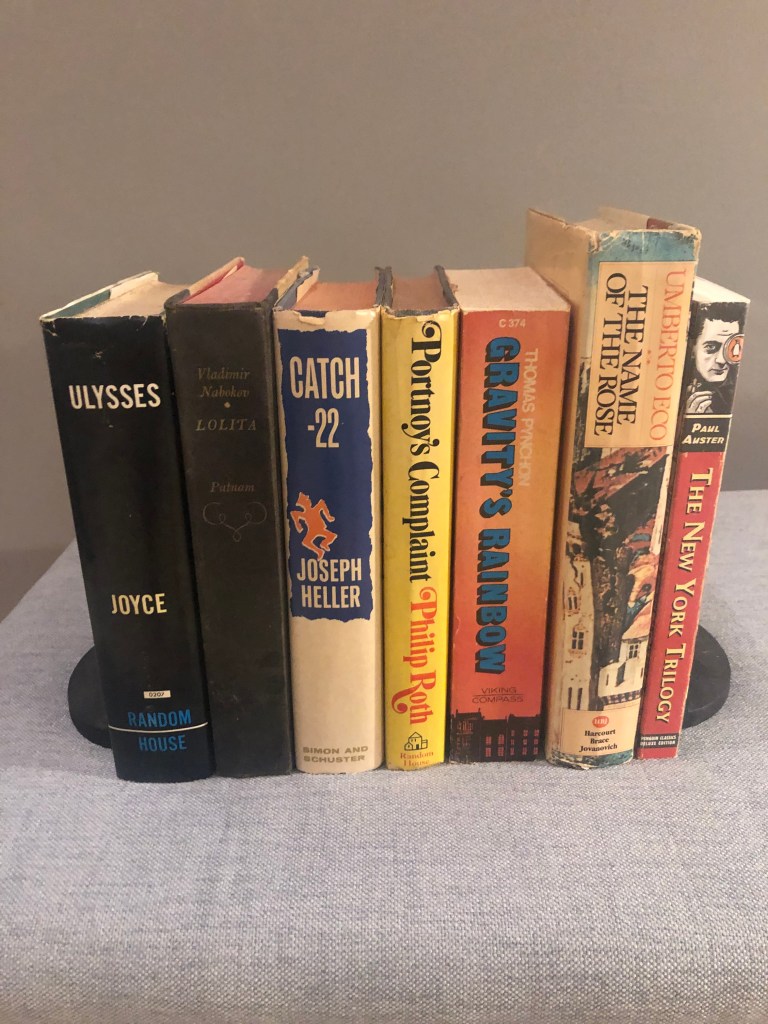
“Books are not made to be believed, but to be subjected to inquiry. When we consider a book, we mustn’t ask what it says but what it means…”
Umberto Eco, The Name of the Rose
“When the first book appeared, Socrates rejected it as inferior to conversation. When the printing press first appeared, some stubborn readers refused to permit industrial products in their libraries and hired scribes to copy printed books. When television first appeared, the end of the book was proclaimed. The same thing happened with the arrival of the CD-ROM and the e-book.*
Gabriel Zaid, So Many Books: Reading and Publishing in an Age of Abundance, pg. 9
*(NOTE: At the beginning of the twenty-first century, a million titles a year were still being produced, in thousands of copies.)
“The person who doesn’t read lives only one life. The reader lives 5,000. Reading is immortality backwards.”
Umberto Eco
“Not every book has to be loaded with symbolism, irony or musical language … but it seems to me that every book — at least every one worth reading — is about something.”
Stephen King, On Writing, pg. 201
“Something revealing about the creative nature of the act of reading lies in the fact that one reader can despair and another can laugh at exactly the same page.”
Alberto Manguel, A History of Reading, pg. 93
“And this sense, this feeling of communion, would at moments overwhelm him. At such times he had the sensation that there was only one book in the universe, and that all books were simply portals to this greater ongoing work — an inexhaustible, beautiful world that was not imaginary but the world as it truly was, a book without beginning or end”
Richard Flanagan, The Narrow Road to the Deep North, pg. 48
So many books to read, so little time. A common complaint, usually uttered in despair, by readers already ‘behind” in their reading; and, overwhelmed at the thought of so many new books still coming off the presses — books they will likely “need” to read. (BTW, a book is published somewhere in the world every 30 seconds!) For those bibliophiles among us, there is an ongoing concern about, and quest for, the next book. What is it about a book that encourages us to select and read one particular volume over another, or over many others for that matter?
Perhaps you’re an inveterate reader of the New York Times Book Review, or a good friend has strongly recommended a book to you that they have just finished, or possibly you chance upon a book in the library or local book store that catches your fancy, you quickly browse through a few pages and you’re hooked. Sometimes it is nothing more than a decision based on superficialities, such as “judging a book by its cover.” Similar to the way many wine drinkers select their vino these days, I suppose. But, in most cases, whether with a wine or a book, you’d probably want to be assured that the content was a quality product. Here’s how Alberto Manguel, in A History of Reading, describes a method he sometimes uses in selecting a new book to read:
“My hands, choosing a book to take to bed or to the reading desk, for the train or for a gift, consider the form as much as the content. Depending on the occasion, depending on the place where I’ve chosen to read, I prefer something small and cozy or ample and substantial. Books declare themselves through their titles, their authors, their places in a catalogue or on a bookshelf, the illustrations on their jackets; books also declare themselves through their size. At different times and in different places I have come to expect certain books to look a certain way, and, as in all fashions, these changing features fix a precise quality onto a book’s definition. I judge a book by its cover; I judge a book by its shape.” (pg. 125)
Though Manguel describes a variety of seemingly arbitrary ways to choose a book, he also admits that there is a randomness and a distinctly nonrational approach to how he most often decides on a new read:
“Largely my encounters with books have been a matter of chance, like meeting those passing strangers who in the fifteenth circle of Dante’s Hell ‘eye one another when the daylight fades to dusk and a new moon is in the sky’, and who suddenly find an appearance, a glance, a word, an irresistible attraction.” (pg. 20)
Stephen King, in On Writing, looks at how one might size up a potential publication by virtue of its size and its heft:
“Grab that book you were looking at off the shelf again, would you? The weight of it in your hands tells you other stuff that you can take in without reading a single word. The book’s length, naturally, but more: the commitment the writer shouldered in order to create the work, the commitment Constant Reader must make to digest it.” (S. King, On Writing, pg. 135)
Perhaps, if we consider what the writer may have given of himself or herself in terms of dedication and commitment in producing the volume, then we might anticipate the worth of such a work simply by looking at it. And, in doing so, maybe we would make a commitment of our own as the reader to give the book the rightful consideration it is due. King, ever playful, follows up with:
“Not that length and weight alone indicate excellence; many epic tales are pretty much epic crap — just ask my critics, who will moan about entire Canadian forests massacred in order to print my drivel.” (pg. 135)
Personally, I tend to agree with Manguel when he speaks of chance encounters with books. My standard practice is to track any new books currently being published by my favorite authors — those by Auster, DeLillo, Vargas Llosa, Barnes, Banville, Ford, McEwan, Cunningham — and scoop them up for a (literary) rainy day. I did the same in years past with Roth, Saramago, Marquez, Updike, Mailer and Barth. I also monitor winners and finalists for the Booker and National Book Awards. So, I am constantly re-building my personal library. Books come and books (some) go. But, books always keep coming, that’s for sure. Then, when I’m ready to begin a new book, I stare at the wall of titles on my library shelves, pull out random books, leaf through them until something inevitably jumps out at me; and, it seems, that, as Manguel put it: “suddenly I find an appearance, a glance, a word, an irresistible attraction.” This is my typical process for choosing the next book to read. Currently, there are a good 50 to 60 books in the “to-be-read” section of my personal library.
When it comes to personal libraries, the legendary Italian writer and academic, Umberto Eco, had a special connection with his. Lebanese-American scholar and essayist, Nassim Taleb, in his modern classic The Black Swan: The Impact of the Highly Improbable, discusses Eco’s unusual relationship with books:
“The writer Umberto Eco… is the owner of a large personal library (containing thirty thousand books), and (he) separates visitors into two categories: those who react with ‘Wow!, Signore professorere dottore Eco, what a library you have! How many of these books have you read?’ and the others — a very small minority — who get the point that a private library is not an ego-boosting appendage but a research tool. Read books are far less valuable than unread ones. The library should contain as much of what you do not know as your financial means…allows you to put there… Indeed, the more you know, the larger the rows of unread books. Let us call this collection of unread books an anti-library.”
One writer, commenting on Taleb’s anti-library concept, said it this way:
“The more we learn, the more we realize how much more we have not explored and understood. In the same way that we have untapped potential, the books we haven’t yet read represent our potential learning.” (Valeria Maltoni)
This thinking certainly seems to resonate with the idea of Socratic wisdom — to understand the limits of one’s knowledge and to realize that which you do not know.
I’ve made a definite decision in recent months to honestly try and prune some of the excessive overgrowth in my library. Intellectually, I understand that it’s probably practical to keep my collection of books pared down to a reasonable, manageable size; and yet, I still want to be able to add new volumes, even while continuing to excise those I ultimately deem unneeded or unwanted. But, a part of me simply loves the idea of holding on to all of my books. Why? My personal library is, in many ways, representative of who I am and what is important to me. The books I’ve selected, and held on to, and appreciated, and enjoyed, and re-consulted numerous times over the years, in my mind, ultimately make a statement about the kind of person I am, and about what I believe in, as well as my personal evolution over the years. So, from that vantage point, it’s sometimes difficult to let an integral part of yourself go. In this respect, I think that Manguel would agree with me:
“I tell myself that, every time I get rid of a book, I find a few days later that this is precisely the book I’m looking for. I tell myself that there are no books (or very, very few) in which I have found nothing at all to interest me. I tell myself that I’ve brought them into my house for a reason in the first place, and that this reason may hold good again in the future. I invoke excuses of thoroughness, of scarcity, of faint scholarship. But I know that the main reason I hold on to this ever- increasing hoard is sort of voluptuous greed. I enjoy the sight of my crowded bookshelves, full of more or less familiar names. I delight in knowing that I’m surrounded by a sort of inventory of my life, with intimations of my future. I like discovering, in almost forgotten volumes, traces of the reader I once was — scribbles, bus tickets, scraps of paper with mysterious names and numbers, the occasional date and place on a book’s flyleaf which take me back to a certain cafe, a distant hotel room, a faraway summer so long ago.” (Manguel,pg. 237)
Readers are drawn to books for a variety of reasons. We can be voracious in our reading, go non-stop and be unable to put a book down until we’ve finished it. Or, we can be the type of reader who is slower, more deliberate and who literally savors every word, phrase and idea. There are those for whom the “story” is everything; while there are others who are more intent on considering the writing style and technique of the author.
Personally, I’m that second type of reader. Before I even begin a new novel, I read as many book reviews as possible. (I print them out and save them all btw, and if you were to pick up literally any book in my library, there would be copies of book reviews falling out of each of them.) Before I even get started reading, I want to know the story, and quite frankly, I don’t mind knowing how it ends — I don’t need spoiler alerts! What I really want to be surprised by is not necessarily the basic story line or the ending, but by the caliber of writing, the turns of phrase, the philosophical nuances, I could go on. I don’t have a library card and haven’t taken a book out of a public library in over 40 years. I am fortunate to own all of the books that I read and I like to make notations in the margins. It’s probably not for everyone, but it seems to work for me.
But, no matter our specific inclination for reading, every time we do read a book, we are left with some tangible evidence of that undertaking. It might be the acquisition of a valuable insight, or rectifying a misheld belief, or gaining a new appreciation for some additional category of knowledge. But it all goes under the heading of what we get out of the reading that we do, and how it ultimately affects us.
Leo Tolstoy, the widely acclaimed Russian writer, had this to say in his 1897 book, What is Art?:
“Every work of art causes the receiver to enter into a certain kind of relationship …with him who produced … the art. …The quality at the core of art was ‘infectiousness,’ and the artist’s ability to ‘infect others.’ To transmit (a) feeling (so) that others may experience the same feeling — this is the activity of art.”
In Tolstoy’s view,
“True art consisted of “one man consciously … hand(ing) on to others feelings he has lived through, and that other people are infected by these feelings and also experience them.”
Further, the great author felt that “a real work of art destroys, in the consciousness of the receiver, the separation between himself and the artist.”
So, not only can the artist share his or her feelings with the reader, but as readers, we can begin to see ourselves in the experiences an author is describing. Stephen King thought that a reader would become more engrossed in a novel when they:
“…recognized the people in the book, their behaviors, their surroundings, and their talk. When the reader hears strong echoes of his or her own life and beliefs, he or she is apt to become more invested in the story.” (S. King, On Writing, pg. 160)
Manguel adds to that idea:
“Like every reader, Rilke was also reading through his own experience. Beyond the literal sense and the literary meaning, the text we read acquires the projection of our own experience, the shadow, as it were, of who we are. …We readers, like Narcissus, like to believe that the text into which we gaze holds our reflection.” (Manguel, pg. 36)
It has been suggested that the activity of reading is a continual building process; each phrase, passage or book we consume adds to our layers of knowledge and to our degree of understanding. Manguel described it this way:
“Reading is cumulative and proceeds by geometrical progression: each new reading builds upon whatever the reader has read before.” (Manguel, pg. 19)
In fact, he considered that even re-reading the very same book would be a different experience from the first time:
“We never return to the same book or even the same page, because in the varying light we change and the book changes, and our memories grow bright and dim and bright again, and we never know exactly what it is we learn and forget, and what we remember. What is certain is that the act of reading, which rescues so many voices from the past, preserves them sometimes well into the future, where we may be able to make use of them in brave and unexpected ways.” (Manguel, pg. 64)
In addition to all of the obvious benefits of reading, it can be said that certain books may help us to shed light on specific aspects of our own lives. The Turkish novelist, Orhan Pamuk, in The White Castle, offered this bit of insight:
“(But), if you have a book in your hand, no matter how complex or difficult to understand that book may be, when you have finished it, you can, if you wish, go back to the beginning, read it again, and thus understand that which is difficult and, with it, understand life as well.” (Pamuk, pg 23)
Gabriel Zaid, in So Many Books: Reading and Publishing in an Age of Abundance, has written that:
“Reading liberates the reader and transports him from his book to a reading of himself.”
In a similar vein, Richard Flanagan, in The Narrow Road to the Deep North, stated:
“It has been said that a good book leaves you wanting to re-read the book, while a great book compels you to re-read your soul.” (Flanagan, pg. 22)
And sometimes, on perhaps very rare occasions, when we come across that truly great book — it can have a profound effect on us. Manguel described it this way:
“And sometimes, when the stars are kind, we read with an intake of breath, with a shudder, as if someone or something had ‘walked over our grave’, as if a memory had suddenly been rescued from a place deep within us — the recognition of something we never knew was there, or of something we vaguely felt as a flicker or a shadow, whose ghostly form rises and passes back into us before we can see what it is, leaving us older and wiser.” (Manguel, pg. 303)
We obviously receive many benefits and gain advantages from reading; but, as readers, we also contribute to what has been written — by offering our own feedback, observations and interpretations. Per Manguel:
“The successive comments of changing generations of readers, tacitly implied that not one but a near infinity of readings was possible, feeding upon one another. …The books on my shelves do not know me until I open them, yet I am certain that they address me — me and every other reader — by name; they await our comments and opinions. I am presumed in Plato as I am presumed in every book, even those I’ll never read.”(Manguel, pg. 86)
Further to the point:
“No reading can ever be final. …If, in reading, there was no such thing as ‘the last word’, then no authority could impose a ‘correct’ reading on us.” (Manguel, pg. 86)
Edmund Wilson, the American writer and literary critic, has written that “No two persons ever read the same book.” The writer, Mary Pearson, commenting on Wilson’s observation, explained it further:
“Which is one of the things that makes a book so exciting. It has an infinite number of incarnations, depending on who reads it. …Others are reading it and bringing their own life experience to the words and characters and it’s becoming something different.”
Thus far, in this essay, I have already cited many quotes from Alberto Manguel’s A History of Reading. Here are a number of the observations he has made regarding the individuality that a reader — each and every reader — brings to what he or she has read:
• “A history of reading, since any such history — made up of particular intuitions and private circumstances — must be only one of many, however impersonal it may try to be. Ultimately, perhaps the history of reading is the history of each of its readers.” (Manguel, pg.22)
• “We know that the process of reading … may depend almost entirely not on its enunciators but on its interpreters for its existence, and that the role of readers is to render visible — that which writing suggests in hints and shadows.” (Manguel, pg. 39)
• “The meaning of the text is enlarged by the reader’s capabilities and desires. …This transmigration of meaning can enlarge or impoverish the text itself; invariably it imbues the text with the circumstances of the reader.” (Manguel, pg. 211)
Finally, he describes how Augustine looked at a very specific way to read:
“Neither using the book as a prop for thought, nor trusting it as one would trust the authority of a sage, but taking from it an idea, a phrase, an image, linking it to another culled from a distant text preserved in memory, tying the whole together with reflections of one’s own — producing, in fact, a whole new text authored by the reader.” (Manguel, pg. 63)
For those of you who may have read the Mission Statement for my blog, the preceding excerpt above is pretty much what my approach has been in creating each essay. Essentially, to select seminal thoughts on serious topics from a variety of sources and group them together with similar thoughts gathered from other sources, while adding personal insights regarding human nature, human tendencies and human frailties. Hopefully, the end result will be the creation of a relevant, new “text.” In my statement, I described it this way:
“In my own reading over time, I have always been intrigued to discover key paragraphs within novels and serious non-fiction that give a sense of having already existed. … A magical grouping of words that seem to have the ability to stand alone and be self- sufficient. …What seems to be common to all of the excerpts I have collected is this: they make an observation (about life, mostly) that provides an insight into — as well as attempt to capture — the essence of an idea, a concept or a point of view. And, in the course of reading enough fine literature, there will be mates to these excerpts discovered in other books, by other authors, from different eras. Not exact representations, but echoing each other.” (Fasano)
Way back at the beginning of this piece, one of the initial quotes I cited was from the author Richard Flanagan. The main character in his novel was relating an overwhelming sensation that he would sometimes have about books:
“That there was only one book in the universe, and that all books were simply portals to this greater ongoing work … a book without beginning or end.” (R. Flanagan, The Narrow Road to the Deep North, pg. 48)
So, what is the connection between and among books? How, you might ask, could there be a relationship between a book by a 17th century English author and a book from a 21st century American writer? Not sure that I’m smart enough to give you such an answer, but I’ll return a final time to Alberto Manguel, who describes what the Austrian poet Rainer Rilke may have been looking for when he read — and how that exercise was related to the bigger picture:
“He was reading the long ancestry of the book he was reading, since the books we read are also the books others have read. I don’t mean that vicarious pleasure of holding in our hands a volume that once belonged to another reader, conjured up like a ghost through the whisper of a few scribbled words on the margin, a signature on the flyleaf, a dried leaf left as a marker, a tell-tale wine stain. I mean that every book has been engendered by long successions of other books whose covers you may never see and whose authors you may never know but which echo in the one you now hold in your hand.”
(Manguel, pg. 266)
Let me sum up some of the ground we’ve covered so far: As readers, we try to take what we can from each book we read. And, as readers, we also bring to each book something of ourselves. A true history of reading may really be just the history of each of its readers. Reading is a geometrical progression where each new reading builds upon whatever the reader has read before. Reading has a way of not only imparting new information, but may also help the reader to find out more about himself and to dig deeper into his own soul. Augustine had suggested a specific way to read that involved the reader taking ideas, phrases and images from one book and combining them with ideas, phrases and images from other books to create “ a whole new text authored by the reader.”
So, finally, we arrive at the idea expressed above that “every book has been engendered by a long succession of other books”. Those books both known and unknown, cited or not. There are “echoes” from all of those other books in the book you are now holding in your hand. I’ll end this discussion of reading with a somewhat mystical observation from Umberto Eco, in which he discusses the relationship that one book has with another, and the connection that each book has to so many others. Perhaps, when all is said and done, it will be books — walls and walls of volumes — that will outlive us all:
“Until then I had thought each book spoke of the things, human or divine, that lie outside of books. Now I realized that not infrequently books speak of books: it is as if they spoke among themselves. In the light of this reflection, the library seemed all the more disturbing to me. It was then the place of long, centuries-old murmuring, an imperceptible receptacle of powers not to be ruled by the human mind, a treasure of secrets emanated by many minds, surviving the death of those who had produced them or had been their conveyors.”
(Umberto Eco, The Name of the Rose)
—————————————————————————–
 Resonance