“All good people agree, And all good people say, All nice people, like Us, are We — And every one else is They”
Rudyard Kipling, “A Friend of the Family”
“The underlying psychology of ‘us and them’ appears grounded in deep-rooted human tendencies to carve the world into groups and discriminate in favor of one’s own.”
Dominic Packer and Jay Van Bavel,“The Myth of Tribalism”
“All human beings sort themselves and other people into categories — of race, ethnicity, religion, nation, culture, class, character, status, and many, many others. They use these categories to predict other facts about strangers, and to figure out how they themselves should behave.”
David Berreby, Us & Them, The Science of Identity, preface
“Ethnocentrism is a mental habit. It is a predisposition to divide the human world into in-groups and out-groups. It is a readiness to reduce society to us and them. Or rather, it is a readiness to reduce society to us versus them.”
D. Kinder and C. Kam, Us Against Them: Ethnocentric Foundations of American Opinion
“‘Othering’ is a phenomenon in which some individuals or groups are defined and labeled as not fitting in within norms of a social group. It is an effect that influences how people perceive and treat those who are viewed as being part of the in-group versus those who are seen as being part of the out-group.”
Kendra Cherry, “What is Othering?”, December, 2020
“He was a Peuhl herdsman — a different tribe from ours — and didn’t speak our language well. Although he might have been about our father’s age, we didn’t call him by the respectable title of Ata, or papa, as we did other adults, for he was a ‘foreigner.’”
Tete-Michel Kpomassie (Kinder)
“I was not an American; I was not a man; I was by long education and continued compulsion and daily reminder, a colored man in a white world; and that white world often existed primarily, so far as I was concerned, to see with sleepless vigilance that I was kept within bounds.”
W.E.B. Du Bois
“When Mexico sends its people, they’re not sending their best… They’re sending people that have lots of problems, and they’re bringing those problems with us. They’re bringing drugs. They’re bringing crime. They’re rapists. And some, I assume, are good people.”
D. J. Trump, June 16, 2015
“Jews throughout Nazi-occupied Europe were forced to wear a badge in the form of a Yellow Star as a means of identification….The star was intended to humiliate Jews and to mark them out for segregation and discrimination. The policy also made it easier to identify Jews for deportation to camps.”
“Voices of the Holocaust,” The British Library Board
Whether we want to admit it or not, when it comes to our relationships with other human beings, we tend to make automatic, perhaps mostly unconscious, judgements about these individuals —and, even more importantly — about the group (or tribe) that they belong to. We tend to see stereotypes in others, particularly when their actions, opinions, life style or what they look like are different from our own — and, different from those of our group.
There is a technique known as “heuristics,” which psychologists refer to as “a mental short cut.” This is an approach to problem solving, that while not perfect, essentially helps “our brains to navigate the world.” While allowing us to make immediate approximations, it can also:
“lead us to make potentially damaging assumptions about other people. Racial stereotyping, for instance, comes from the belief that membership in a group defines someone on a range of characteristics, including their behavior.”
Zaid Jilani, “How to Beat Stereotypes by Seeing People as Individuals,” 8/28/19
Harvard developed an “implicit bias” test (Implicit Association Test, or IAT) that attempts to measure the particular bias levels of test takers. Though acknowledged to have its limitations, it does seem to generally confirm that most of us are implicitly biased, even if we don’t think of ourselves as being prejudiced.
However, what I think is really behind this judgement of other groups and what brings in the stereotyping is more an issue of “ethnocentrism.” The definition of which is essentially: “thinking ones’ own groups’ ways are superior to others,” or “judging other groups as inferior to one’s own.” And, in stronger terms, ethnocentrism can lead to “an attitude characterized by the glorification of one’s own group (in-group) and the defamation and discrimination of other groups.” (Ken Barger, “What is Ethnocentrism?”, Anthropology)
Down through the ages, there have been countless examples of rivalries, feuds, conflicts, wars — usually brought on initially by: our way of thinking vs. your way of thinking, or, our group vs. your group, or, our tribe versus your tribe. Essentially, Us vs Them.
From the gruesome conflicts between the medieval Scottish clans, to the Capulets and Montagues, to the Hatfields and McCoys, to the Turks and Armenians, to the Israelis and Arabs, to the Northern Ireland Unionists and IRA Nationalists, to the Rwandan Hutus and Tutsis, human civilization is replete with the often destructive and sometimes deadly consequences of the competition between opposing groups. And, all of this typically manifests itself as xenophobia, racism, religion, nationalism or political views.
Obviously, “Us vs. Them”, though a component of human behavior for centuries, has taken centerstage today in our country (but surely, around the world as well.) And, currently, much of the focus has to do with political affiliation, among other things. When the United States was in the process of being founded:
“Americans were already a multiethnic, polyglot mix of English, Dutch, Scots, Irish, French, Swedes, Italians, Germans, Greek and other. They tended to identify far more strongly as Virginians or New Yorkers than as Americans, complicating any effort to bind the new nation together with common beliefs. Early America was also an unprecedented amalgam of religious denominations, including a variety of dissenters who had been hounded from their Old World homes.”
Amy Chua & Jed Rubenfeld, “The Threat of Tribalism,” The Atlantic, October, 2018
American historian Gordon Wood writes that with the early Americans living in a society that was “already diverse and pluralistic,” the founding generation realized that the attachment uniting (them) “could not be the traditional ethnic, religious and tribal loyalties of the Old World.” Instead, as Abraham Lincoln had expressed it, nearly a century later: “The Constitution and Laws was to be America’s ‘political religion’” (Gordon Wood)The goal was to unite the countrythrough “constitutional patriotism — based on the ideals embedded in the founding document.” The original premise of the Constitution, both as a form of national religion and as an attempt to create a “tribe-transcending national identity,” has held up reasonably well during the course of our now 246-year old experiment in democracy. (Chua)
It’s notable that the founders, in particular John Adams and George Washington, even then worried about the possibility of partisan political loyalties. Adams was fearful of the emergence of “two great parties, each arranged under its leader, and concerting measures in opposition to each other.” Washington thought that the “spirit of party” was democracy’s “worst enemy” And, that it would “agitate the Community with ill-founded jealousies and false alarms, kindle the animosity of one part against another, and foment occasionally riot and insurrection.” (Chua)
Pretty prescient thinking on their part. That’s probably why you get the gig as a founding father. Well, we all know how that concern for the rise of parties worked out. Obviously, partisan divisions today are encouraging the breakdown of many of our political institutions. And, there are many reasons for this “resurgent tribalism.” They include elements such as:
“seismic demographic change, which has led to predictions that whites will lose their majority status within a few decades; declining mobility and a growing class divide; and media that reward expressions of outrage. All of this has contributed to a climate in which every group in America — minorities and whites, conservatives and liberals; the working class and elites — feels under attack, pitted against others not just for jobs and spoils, but for the right to define the nation’s identity. In these conditions, democracy devolves into a zero-sum competition, one in which parties succeed by stoking voters’ fears and appealing to their ugliest us-vs-them instincts.”
Chua)
It has become so polarized today in our society that:
“Americans on both the left and the right now view their political opponents not as fellow Americans with differing views, but as enemies to be vanquished. And, they have come to view the Constitution not as an aspirational statement of shared principles and a bulwark against tribalism, but as a cudgel with which to attack those enemies.”
(Chua)
Shadi Hamid, a senior fellow at the Brookings Institution, comments about how the left is reacting to the ongoing partisanship:
“Democrats and liberals now find themselves under considerable pressure to acquiesce to this way of looking at the world. Going against norm is simply too costly if you want to remain a member of the tribe in good standing. There is no end to this way of thinking, unfortunately, and we are all susceptible to it. In a zero-sum political struggle, anything that could conceivably undermine morale on your side is perceived as helping the other side. And the other side, the argument goes, is an existential threat.”
Shadi Hamid, “Race-Based Rationing is Real — and Dangerous,” The Atlantic, January 30, 2022
David French, a conservative political commentator and long-time Republican, basically renounced his party affiliation in 2016, for what he felt were obvious reasons. But, he indicated that he was still, and would always remain, a conservative. However, after his separation from the party, he began to see more clearly the nature of partisanship and the way that it could distort our view of the world. He stated it this way:
“To use a legal analogy, at a fundamental level, partisanship converts a person from a ‘judge’ (one who decides among competing arguments, hopefully without bias) to a ‘lawyer’ (one who steadfastly and relentlessly defends their client, almost regardless of the facts.)”
David French, “Declare Independence from COVID Partisanship,” The Atlantic, Jan. 27, 2022
The partisans, who tend to act as “lawyers,” and are convinced of their positions, “double down and deny, minimize or rationalize negative behaviors.” This behavior was obvious during the COVID debate with competing positions on the coronavirus from red and blue alike from the very beginning. Both liberals and conservatives suffered from misperceptions about the pandemic; however, according to a 2021 Gallup survey of 35,000 people, it was largely felt that “Republicans minimized the threat of Covid, and Democrats did the opposite….Republicans consistently underestimate the risks, while Democrats consistently overestimate them.” (French)
While stating that both the left and the right at times took extreme positions, French is quite honest in acknowledging that it was very harmful for conservatives to criticize vaccinations:
“Lest there be any confusion or claims of wrongful moral equivalence. I think that encouraging vaccine refusal is an order of magnitude more problematic and consequential than excessive or theatrical masking and distancing rules. But, I also think its terribly wrong to minimize the harm done to children by unnecessary and excessive school closings.”
(French)
I fully understand that shutting down the workplace affected the economy and that shutting down schools affected the educational development of children. But, if more of our citizens voluntarily took suggested precautions and followed the science early on, then perhaps some of these measures might not have been necessary. And, as far as the safety of children in a school situation, there was quite a bit of concern during the midst of the pandemic about MIS-C — multi system inflammatory syndrome, a rare but serious condition associated with COVID-19. So, I think that while he’s being fairly honest in his assessments, French shows that he’s still a part of his “tribe” when he makes reference to “excessive and theatrical masking and distancing rules.”
Don’t we have to honestly ask ourselves if it wasn’t much better to overcompensate and potentially save lives, as opposed to under compensating and risk losing more lives? After all, how often does a 100-year pandemic come along?
Perhaps there has been no greater demonstration of partisanship than in our country’s reaction to the coronavirus pandemic. During the fall of 2021, a Kaiser Family Foundation poll found that of the 25% of adult Americans who were still unvaccinated, 60% of them were self-identified republicans and 15% were self-identified Democrats. Chris Stirewalt, a politics editor formerly employed by Fox News, wondered: “How many of those ‘tens of millions’ of opponents of coronavirus vaccines and vaccine mandates are really just Biden opponents and addicts of negative partisanship?” (Chris Stireralt, “Thank Goodness for Phony Passion,” The Dispatch, Jan. 24, 2022)
Is it simply a case of sticking with your group, right or wrong? Kurt Anderson, American writer and commentator, in a similar vein, wrote:
“Whatever their reasons, millions of Americans have been persuaded by the right to… potentially sacrifice themselves and others, ostensibly for the sake of personal liberty, but definitely as a means of increasing their tribal solidarity and inclination to vote Republican.”
Kurt Anderson, “The Anti-Vaccine Right Brought Human Sacrifice to America,” The Atlantic, Jan. 25, 2022)
There is no getting away from a key reason for why so many on the right have been against following what would seem to be a reasonable, science-based approach to confronting the pandemic: Donald J. Trump. In the spring of 2020, with the virus beginning to take hold within the country, the former president’s “push to resume big rallies despite concerns he’s putting the public’s health at risk is part of a broader reelection campaign effort to turn the national debate about the coronavirus into a political fight that he frames as ‘US vs. THEM’” (Aamer Madhani, “Trump Turns Virus Conversation into US vs. THEM” AP News, June 9, 2020)
Trump actually expressed to the Wall Street Journal at the time that he thought some Americans were wearing masks not so much as a preventive measure, but as a way to show their disapproval of him. Christopher Borck, director of the nonpartisan Muhlenberg College Institute of Public Opinion, opined that “the president appears to be calculating that he can ignite resentment toward ‘the other’ and inspire his base to turn out for him in November.” He added:
“The frame of us-versus-them — the other — has been a consummate rhetorical tool for the president throughout his time in office and before as a candidate.” (Madhani)
So, while the pandemic offered a tantalizing opportunity for Americans to brandish their partisan bonafides, the us and them thing among groups has been around forever. In the early 1900s, William Graham Sumner, an eminent professor of political and social science at Yale, had produced what became a seminal book on “folkways”: (Folkways: A Study of the Sociological Importance of Usages, Manner, Customs, Mores and Morals.) Sumner felt that “the very life of society consists in making folkways and applying them.” He described it this way:
“All the life of human beings, in all ages and stages of culture is primarily controlled by a vast mass of folkways handed down from the earliest existence of the race …. There is a right way to catch game, to win a wife, to make one’s self appear, to cure disease, to honor ghosts, to treat comrades or strangers, to behave when a child is born, on the warpath, in council, and so on in all cases which can arise.”
(Kinder, intro)
Obviously, these “right ways” could differ significantly from one group to another. Sumner felt that in each case, for every folkway, members of a particular group:
“were certain that their way of doing things — their folkways — were superior to the way things were done by others. Ethnocentrism, Sumner called it: the technical name for this view of things in which one’s own group is the center of everything.”
(Kinder, intro)
Sumner further described the dynamics involved in this way:
“Each group nourishes its own pride and vanity, boasts itself superior, exalts in its own divinities, and looks with contempt on outsiders. Each group thinks its own folkways the only right ones, and if it observes that other groups have other folkways, these excite its scorn.”
(Kinder)
“Opprobrious epithets” developed from these differences: “pig-eater,” “cow-eater,” “jabberers,” etc. It reminds me of the many colorful epithets slung back and forth across the state lines of New York and New Jersey over the years. Growing up in New Jersey and living there most of my life, I had somehow assumed that such behavior was only a local phenomenon. However, on a business trip to North Dakota in the 1980s, I was initially surprised to hear a local mention his dislike of South Dakotans, along with some of the mocking epithets that were used to describe folks in the neighboring state.
Look, let’s call it what it is. There is another word out there that might actually be the most accurate term we can use, and that perhaps gets right to the heart of it all: othering. It can involve:
“attributing negative characteristics to people or groups that differentiate them from the perceived normative. It is an ‘us vs. them’ way of thinking about human relationships, looking at others and saying ‘they’re not like me.’ or ‘they are not one of us.’”
Kendra Cherry, “What is Othering?” Verywellmind, Dec. 13, 2020
Othering negates another person’s humanity and dignity and fosters the formation of prejudices. In its worst incarnation, “it can play a role in the dehumanization of entire groups of people.”(Cherry) With great influxes of immigrants during the course of our country’s history, there have been many opportunities for the othering of others. The Naturalization Act of 1790 allowed “any free, white person of good character” to apply for citizenship. The first immigrants were largely the English. During the mid-1800s, the Irish and the Germans came in droves. Eventually, there was a fierce backlash against those two groups that was instigated and promulgated by the anti-immigrant Know-Nothing Party.
Then, in the late 1800s-early 1900s, the majority of immigrants were coming from southern, eastern and central Europe. Many Italians and Jews among them. Also, at that time, The Chinese Exclusion Act was passed, barring Chinese immigrants (mostly workers in gold mines and garment factories) from entering the U.S. In the first years of the 20th century, due to concern that an influx of Japanese workers would cost white workers in California farming jobs, the U.S. and Japan signed the Gentleman’s Agreement, limiting Japanese emigration to the U.S.
The point of all of this is that members of every ethnic group that have ever come to our shores have bumped up against those who were already here — trying to gain a foothold against those who were trying to maintain their own foothold. Each new group faced an initiation: teasing, taunts, intimidation, and sometimes much, much worse. And, when actions, events and emotions end up going to the extreme in human relationships, the world experiences yet one more case of what the Scottish poet Robert Burns referred to as “man’s inhumanity to man.”
Just over 80 years ago, FDR signed an executive order, stripping people of Japanese descent of their civil rights. 120,000 Japanese-Americans, two thirds of them born in the U.S., were forcibly removed from their homes; for many years, they lived in “harsh, overcrowded conditions, surrounded by barbed wire fences and armed guards.” They lost their homes, businesses, property and savings, as well as their liberty. (WH Briefing Room, Feb. 18, 2022) None of them were charged or convicted of anything, but without due process they were imprisoned in one of ten concentration camps scattered in desolate, remote regions of the country. Simply for having “the face of the enemy.” (Japanese American Citizens League, Day of Remembrance, 2022)
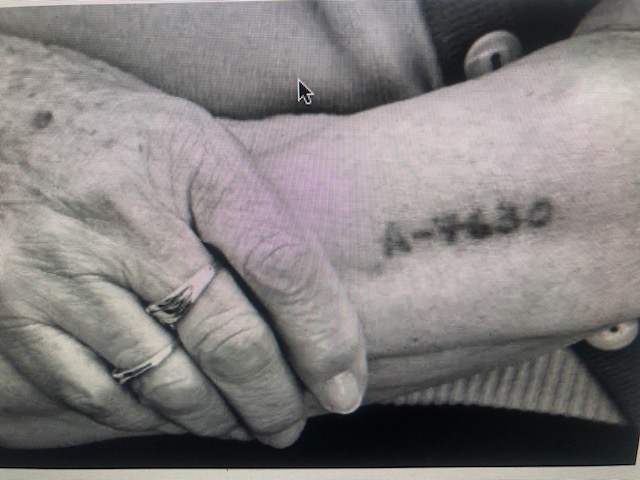
Of course, the mention of concentration camps reminds us sadly of the atrocities of the Nazi death camps during World War II. At Auschwitz, prisoners had a personal identification number tattooed on their left arm. Those numbers became a prisoner’s second name: “Being awakened in the middle of the night, they needed to be able to provide their number in German. Those who survived were unable to forget them.” (Dirk De Klein, “The Auschwitz Numbers,” History of Sorts, Nov. 6, 2017)
Antisemitism had been a long-time phenomenon in Europe. And, when Hitler assumed power as absolute ruler of the German state in 1933, he began to systematically strip Jews of property, jobs in academia, the military and civil service. Jews essentially became:
“scapegoats for everything afoul that had happened to Germany over the previous several decades: inflation economic depression, the loss of World War I, and the punitive Treaty of Versailles.”
“The Holocaust,” The National WWII Museum
Germany, and the world, should have known early on what Hitler had in mind. In a speech he gave in 1922, the future-Fuhrer declared that Jews were “clearly a race apart all others.” And, he didn’t mean it in a good way. He went on to say that:
“the Jew is not only a foreign element differing in his essential character, which is utterly harmful to the nature of the Aryan, but that the Jewish people in itself stands against us as our deadly foe and so will stand against us always and for all time.”
“Hitler on the Jews,” (1922), Alpha History
In addition, Hitler labeled the Jews as “exploiters,” “robbers,” and “destroyers of civilization.” Finally, he ended with the statement that Jews “spread as a pestilence spreads.” (“Hitler on the Jews”)
One of the most unfathomable examples of man’s inhumanity to man occurred in the East African nation of Rwanda. On gaining independence from Belgium in 1962, tensions simmered for many years between the majority Hutu tribe (85%) and the minority Tutsi tribe (14%). Ultimately, in 1994 “genocide was the culmination of decades of division and incitement of hatred towards the Tutsi by extremists in the country’s leadership, which was controlled by members of the Hutu majority group.” (Jeremy Maron, “What Led to the Genocide Against the Tutsi in Rwanda?”)
But, here is the key takeaway. There was a concentrated effort to delegitimize and dehumanize the “other”:
“A deliberate process of positioning the Tutsi as a dangerous and inferior minority group, and even less than human, set the stage for the genocide that was to come.”
(Maron)
The horrible result was:
“in just 100 days during 1994, government forces, militias and regular citizens carried out a genocide against the Tutsi social and ethnic minority population An estimated 800,000 to one million Tutsi were killed, and mass sexual violence was committed against Tutsi women and girls.”
(Maron)
What was done to Japanese-Americans, to Jews and to the Tutsis was a dehumanization of one group by another group — because they were of a different tribe, they were “the other.” And, as stated earlier, “othering can play a role in the dehumanization of entire groups of people.”
It is a way of “negating another person’s individual humanity,” and seeing them as “less worthy of dignity and respect.” (Cherry)
Of course, the black experience in this country can also attest to “man’s inhumanity to man.” During the 17th and 18th centuries, an estimated seven million Africans were kidnapped, enslaved and transported across the Atlantic to the Americas. Experiencing horrific conditions on the journey, nearly two million died en route. Over those two centuries, the enslavement of blacks in the U.S. enabled many white Americans to create personal wealth, opportunity and prosperity — literally on the backs of their slaves. And, as American slavery evolved, “an elaborate and enduring mythology about the inferiority of black people wascreated to legitimate, perpetuate and defend slavery. This mythology survived slavery’s formal abolition following the Civil War.” (“Slavery in America: The Montgomery Slave Trade,” Equal Justice Initiative)
Indeed, the enduring evil of slavery is:
“the narrative of racial inferiority that defined black people as less human than white people. This belief in racial hierarchy survived slavery’s abolition, fueled racial terror, lynchings, demanded legally codified segregation and spawned our mass incarceration crisis.”
(EJI)
As the noted sociologist and civil rights advocate W.E. Du Bois stated, he felt that he was “not an American,” and “not a man” and that as a “colored man in a white world,” the white world existed primarily to see “that I was kept within bounds.” And, at this present stage in our democracy, blacks, particularly the young ones, are still being told by white society that they must “stay within bounds.” You know, “do the right thing, know your place, don’t step out of line.” Oh, and btw, don’t get caught dead in a hoodie.
President Lyndon Johnson, back in the 1960s, made this comment to Bill Moyers; though it sounds somewhat racist, I think it was really meant to be a bit of truth telling:
“If you can convince the lowest white man he’s better than the best colored man, he won’t notice you picking his pocket. Hell, give him somebody to look down on and he’ll empty his pockets for you.”
Charles M. Blow, “The Lowest White Man,” New York Times, Jan. 11, 2018
So, in the scheme of things, it seems that many people need someone else to look down upon in order to make them feel better about themselves. Or, feel more superior, perhaps? Very unfortunate, but it does go to the core of the us vs. them phenomenon. And, it also shows how there are various levels of prejudice.
I’m reminded of a story my dad told me many years ago, during the ‘60s He was a long-time barber in Madison, NJ. And, his clientele included both blue-collar guys, as well as successful businessmen, lawyers and other professionals. One of his customers was a well-to-do man of Italian extraction. On one occasion, while sitting in the chair, he mentioned to my father that he was in the process of buying a new home. At the time, he had his eye on a nice estate residence in neighboring New Vernon Township, a wealthy enclave of affluent WASPs.
He indicated that he was getting some backlash from the well-entrenched local gentry. It seems the good folk of New Vernon Township were not so keen on having a person with Italian ancestry living among them, no matter how rich or successful he might be. The message to him and his realtor was that he wouldn’t necessarily be welcomed in the community.
What the businessman did next was not only a stroke of genius, but tells you even more about the different degrees of bias and othering. It was arranged for the realtor to show the estate home to other “potential buyers.” Soon, a late-model Cadillac arrived at the property. Exiting the vehicle were four, well-dressed, impressive looking black men. Upon hearing of this, the locals contacted the realtor and let him know that perhaps his businessman client might find New Vernon to his liking after all. The way my dad told it, they literally begged him to proceed with the purchase. Guess it gives new meaning to the term “Italian Job.” A true story, but a sad commentary on human prejudice.
Based on what I’ve presented in this essay, it would seem that when there is group solidarity, then the assumption is that it must lead to conflict. Two psychology professors, Dominick Packer and Jay Van Bavel, would beg to differ. While they note that people in every culture share the same propensity to form coalitions, it need not:
“lead inexorably toward intergroup conflict. ‘Groupishness,’ — a term some researchers use to describe humans tendency to identify with social groups — can be the source of a much wider repertoire of action, including cooperation, altruism, embracing diversity and helping people radically different from ourselves.”
Dominic Packer & Jay Van Bavel, “The Myth of Tribalism,” The Atlantic, Jan. 3, 2022
They feel that in explaining “collective behavior,” it’s important to distinguish how strongly members identify with their groups and its norms. The authors assert that:
“for every hate group, another group, such as the Red Cross or Doctors Without Borders, exists that is committed to helping others. And, the more deeply members identify with the group and its (positive) norms, the more likely they are to help people different from themselves….It also suggests how people can find common ground.”
(Packer)
Normally, when the term “tribalism,” is used, it’s usually meant to convey something toxic in collective life. Think of our current politics. We picture unhealthy dynamics within groups that include: “the suppression of dissenting voices and a cult mentality in which members seek only to affirm one another’s worldview.” (Packer)
But, sometimes — many times in fact — belonging to a group whose norms are mostly positive can actually lead to helping others from another group and finding shared purpose. Often, it happens that people from distinct groups can come together with those from other groups and unite around a common objective: like rooting for your local high school sports team or favorite pro team. Football has proven to be one of those areas. In an article dealing with the immense national popularity in this country of professional football, one of the reasons given is:
“the game’s unrivaled ability to bring people together. The nation’s most popular sport remains all-powerful in how it unifies, even during the pandemic, and when the divisions in American life seem to grow wider with each passing day. The most ardent boosters of rival politicians find themselves elbow to elbow at bars or perched together in the upper tiers of N.F.L. stadiums. And even if they don’t watch together in person, the TV and streaming broadcasts allow people with divergent views on everything else to share in a spectacular interception from the team they both love.”
Kurt Streeter, “Why Can’t We Turn Away from the NFL?” New York Times, Jan. 18, 2022
So, while many people think that tribalism, in its worse form, is inevitable, it is not. But,
“the constant invocation of tribalism may create a self-fulfilling prophecy; people come to distrust other groups and falsely believe they need to discriminate against outsiders or suppress dissenters to maintain their status within their own group”
(Packer)
As Jennifer B. Murtazashvili, professor and scholar at the Carnegie Endowment, states:
“The problem is compounded by the abuse of the term ‘tribe.’ Today ‘tribalism’ has become a basket category for our nasty state of affairs; that is, the things we believe cause our increased polarization.”
In fact, the professor, in an article in Discourse two years ago entitled “The Problem Today is Not Tribalism But It’s Absence,” extols the benefits of true tribalism. She wrote:
“Tribes — real tribes — provide a great deal of meaning, community and connection….Tribal societies are defined by their social cohesion and a sense of group interconnectedness.”
She goes on to state that the:
“real danger facing the United States now is not tribalism but factionalism. America’s founders warned us against this even before the Constitution was signed. In Federalist 10, James Madison famously wrote of these dangers. They have always been here; they are not new. The key is to have leaders who can help us overcome divisiveness and rely on one another, just as leaders within tribes must build consensus.”
The United States, unlike most European and East Asian countries, is not composed of a particular ethnic group. Our country, from its inception, was a “multiethnic polyglot mixture.” And, the founders wisely realized that Americans could not therefore be united by the “traditional ethnic, religious or tribal loyalties of the Old World.” They decided that the Constitution and Laws was to be America’s “political religion“:
“America is not an ethnic nation. Its citizens don’t have to choose between a national identity and multiculturalism. Americans can have both. But the key is constitutional patriotism. We have to remain united by and through the Constitution, regardless of our ideological disagreements.”
(Chua)
We’re not there yet. And though we still have much work to do in order to form that proverbial, “more perfect union,” we must continue to strive for the foundational ideal of the Constitution:
“An America where citizens are citizens, regardless of race or religion; an America whose national identity belongs to no one tribe.”
(Chua)
————————————————————————————————————
 Resonance