Listen to an audio version of this essay
“There are two kinds of people in the world: Italians, and those who wish they were.”
Anonymous
“There are two kinds of people in the world: Those who think there are two kinds of people in the world, and those who don’t.”
Robert Benchley, Law of Distinction
“La famiglia e la patria del cuore” (Home, family, is where the heart is.)
Italian proverb
While growing up, I was literally surrounded by Italians (and Italian-Americans). So it was natural at a young age to view everything from the perspective of “being” Italian. It was all I knew at that point. I spent the first eight years of my life at 75 North Street in Madison, NJ. North Street, South Street, East Street and Myrtle Avenue comprised the main “Italian” section in town. But, I didn’t realize until a lot later just how homogeneous a society our little neighborhood was. It pretty much consisted of a single ethnic group. People who sought the comfort of living with neighbors who came from the same, basic background, with the same, basic beliefs. You knew everybody and everybody knew you. And, almost everyone seemed to somehow be related, if only distantly.
And let me explain right up front: when I say we were “Italians,” it meant that our parents and grandparents may have been born in Italy, even if our generation was not. We didn’t distinguish. We just considered ourselves “Italians.” And, that’s how I’ll use the term moving forward.
We had a neighborhood store, which was referred to as “Fuliman’s;” most likely, it was a bastardization of “Philomena’s”. Penny candy, licorice sticks, cracker jacks, small paraffin “bottles” with some kind of sweet, probably toxic, drink in them. I remember the proprietor taking some items off of the top shelf with a metal “grabber,” and I can picture strips of fly paper hanging down from the ceiling.
The store was just a block away, down the street from where we lived. And, a block in the other direction was the North Stars, an Italian-American club. My father, known in town as “Mike the Barber,” could be found playing cards there on a Friday night with his buddies. Sometimes, he’d also go to the Forum Club, another spot frequented by many of the blue-collar guys in town. So, my dad had his moniker (when we ordered pizza, it was “a large cheese pie, half sausage, half pepperoni, for ‘Mike the Barber.’ ”) But, there were many other Italian men in town who also had nicknames: Butter Maione, Dynamite Dan Russo, Jiggs Mantone, Mushroom Head Maioron, Matches Caporaso, Sharkey Giordano — and many more.
When I was seven, my parents decided that they would buy their own house in a new development about a half mile away. It was definitely a case of “movin’ on up” — out of the comfortable confines of Grandma’s house on North Street (where we were renting), to an almost middle class existence at 4 Oxford Lane. It’s not as if my parents had suddenly come into money, but they had saved for years to get a place of their own, and finally achieved it. As far as being a part of the middle class, I found out later that my dad never earned more than $10,000 in a year. Yet, he sent me to Seton Hall University and gave both of my sisters very nice weddings.
We moved to the new house when I was eight. And, for a while I actually thought that the Fasanos of Oxford Lane really were a middle class family. If so, we were probably just grabbing for the first rung of the ladder. When I got to middle school at age 12, I began to realize how the other half lived. I met a lot of new people, many of these kids coming from the affluent “hill section” of town. I could see right away that most of them had means, as well as a lot of confidence. I began to understand that the world was a lot bigger than what I had experienced on North Street; and, even more eye opening was that the majority of my new peers had a big head start on their futures. The money, the connections, the homes they lived in. Even at a young age, a voice inside of me was asking: “How do I compete with all of this moving forward?”
I honestly have to say that this new situation had a profound impact on me. My confidence was affected, since I now considered myself to be somewhat inferior to many of my new classmates. The previous year, in sixth grade, I had been president of the class, editor of the newspaper and captain of the safety patrol. But, just four months later, I was in a private battle to figure out who I was —- and, more important — what my future might be. (My, how the mighty have fallen.)
So, while Christopher Columbus had discovered America, I was discovering a new world of my own. And, while it was certainly disconcerting at first and threw me off course for awhile, I think that my strong, close-knit family upbringing — and yes, my Italian mother — helped me to eventually right the ship. As I got older, I realized how much my mother was always there for me. I was her “baby,” and her only son, so that may have had something to do with it. But, essentially, she was just such a good, decent person whose family was very important to her.
And, while I always thought that my mother was pretty open-minded, back when I was dating Cathy in the ‘60s, I’m sure Ma was still concerned that the girl I was planning to marry was not “Italian.” But, fortunately, she ended up growing to love and respect my future wife. My mother was even overheard at a family gathering, commenting about Cathy: “She’s a nice girl, even though she’s not Italian.”
Though I grew up with a strong sense of my heritage, and while much of my childhood experience would undoubtedly resonate with other Italians — my story does not necessarily reflect the very typical conservative way that many of my friends were raised at the time. So, in that regard, I’m not in any way attempting to make the definitive statement about growing up Italian, but simply sharing one version.
As I think back on it, I realize that my dad was the reason why my childhood was a bit different from that experienced by many of my neighborhood friends. Though Pop had a very strong influence over the family dynamics, he did it in a quiet way. He was not the domineering type who laid down the law and made you afraid. No, he was a softy at heart. Also, while he was born in Italy (Pozzuoli, near Naples), coming to this country when he was 9 or 10 years old, and while he was proud of his Italian heritage, he also embraced being an American. ( It reminds me of a similar sentiment that my Uncle Frank Sena expressed to me many years ago. Though he felt strongly about his ancestry, he told me that he wanted to be considered an “American,” rather than a “hyphenated-American.”)
As far as my father was concerned, I think that deep down he realized the benefits of being an American citizen. He saw the opportunity to improve his life and wanted that for himself and his children. But, as a family, we still did things and acted in a way that set us apart as “Italians:”
• We spoke with hand gestures;
• Some of our relatives had plastic slipcovers on their furniture and a second kitchen in the basement;
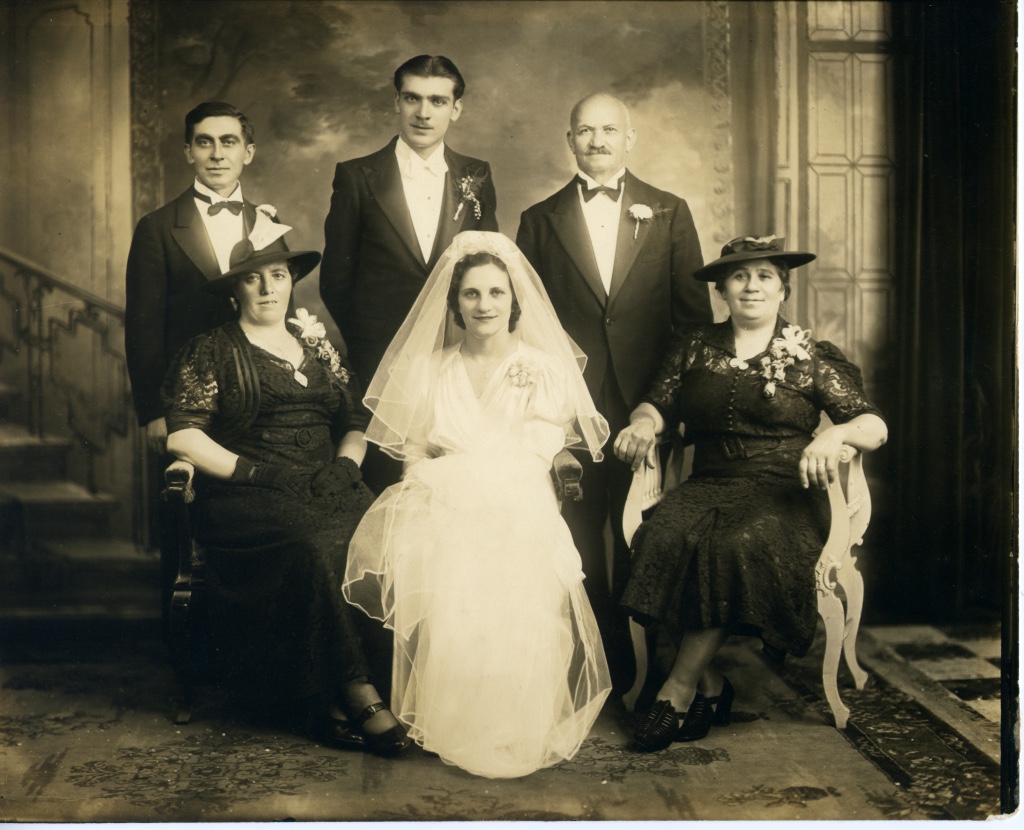
• At weddings, we gave the bride and groom money (“a-boost”) instead of a gift;
• After the marriage ceremony at the church, the wedding party would drive through the neighborhood, tossing almond candies out the car windows — which we kids scooped up off the street and ate;
• Meals on holidays and special occasions consisted of so many courses that we had to take a break between them;
• Easter was a time for special pastries and desserts: ricotta cheese pie, Easter bread, Ferrara cookies, struffoli honey balls, seven layer cookies, Uncinetti cookies, etc;
• We visited relatives on Palm Sunday and exchanged strips of palm, with the greeting of “pa chin don” (health for a hundred years). We sometimes made small crosses from the strips, which usually ended up behind the ubiquitous crucifixes in our bedrooms;
• While we didn’t go all in on the “Seven Fishes on Christmas Eve” tradition, my mother did prepare baccala for Christmas eve;
• “Mangia!” (eat up): When you were having a meal at a relative’s house, they would implore you to eat more. My Uncle Frank Marabella used to go so far as to put a full plate in front of you, so you had no choice;
• If there was a major falling out with a family member or friend, it was often topped off with the declaration: “You’re dead to me!”
• My cousin “Francesca”, the black sheep of the family, was a big-hearted, over-the-top, ostentatious Italian. She was a talented costume jewelry sales person, and as we used to say about her: “She could sell you a snowball in Alaska.” Over the years, for some unknown —but not unsuspected — reason, she and her husband moved numerous times from one apartment to another. Eventually, her listing in our address book had many, many cross outs. And, btw, with each move, she acquired fancy new furniture, drapes and accessories — whether she could afford them or not.
• Despite the popularity of the “Jersey Shore” TV series, for the most part our relatives did not resemble the cast members — not even cousin Francesca on her worst day. Pretty often in our community though, you did run into those stereotypical Italians who gave us all a bad name. The type who were crude, coarse, judgmental, gossipy and loudmouthed. The kind of person who if they didn’t have bad taste would have no taste at all. There are various descriptors for these uncouth, clueless Italians: Choochone, Gavone, Gridule, Mamaluke. Stunad, etc.
• Oh, and did I mention superstitions?
As positive as she was in most respects, I think my sainted mother was sometimes just waiting for the other shoe to drop. One day, my sister Dolores and her then-boyfriend-eventual-husband Ed (both in their late 20s) had taken their bicycles out for a ride. About five minutes after they left, the town sirens went off, which indicated that either a house fire or an accident of some kind was in progress. Ma immediately dispatched my father to scour the neighborhood and see if the cyclists were okay. They were. I remember that planning baby showers for expectant mothers in our family was always done holding one’s breath, if done at all. That perhaps if you just assumed all would go well with the pregnancy and birth, it might bring bad luck. I can also recall many times inviting my parents to come to our house for a visit. And if the date was for a time say two weeks or more hence, my mother would sort of commit, but she’d always say: “we’ll see.”
But, when it comes to irrational beliefs, the “evil eye” puts the super into superstition. I can remember as a young boy my grandma checking to see if someone had given grandpa the “malochio,” commonly known in our world as the “evil eye.” She did a simple test of dropping three drops of olive oil in a bowl of water. If the oil moved into the shape of an eye, then you had been cursed. Essentially, the evil eye is a “look” given by one person to another, out of envy or jealously. This “overlooking” may be accompanied by a seeming compliment, but it is not sincere. At times, the evil eye could cause headaches or stomach aches. To try and rid yourself of the curse, you were told to say a series of specific prayers.
And to ward off the evil eye, people would sometimes wear an amulet shaped like a horn (“cornetto”), or make the horn hand sign by extending the pinky and index finger, and keeping the others folded back. You could also tie a red ribbon over the threshold of your home to protect you from envious people. My mother gave me a red ribbon to hang in my very first car. And we have given each of our sons a red ribbon when they got their first car.
To some this whole business of the evil eye (or, “maloik” as if was called for short) may seem like just a major case of ethnic paranoia. But the concept was certainly accepted by Italians of my parents’ and grandparents’ generations, and was a definite part of tradition when I was growing up. I remember a story from the old days that I heard many times over the years. Seems that there was a particular Italian woman in the neighborhood (I never learned who she was) who had the ability to give someone “the eyes” at will. In this case, it was to her husband, who she learned had been cheating on her. When she knew that he would be seeing his “mistress,” the woman would cast a curse on her husband, giving him severe stomach aches, and ruining his romantic trysts.
It was thought by many in the neighborhood that this woman had “witchly” powers. On one occasion, my maternal grandfather was trying in vain to locate some very important legal documents. Now, Grandpa was a very intelligent, thoughtful and organized person. For him to have misplaced something so significant was very unusual. And though he searched and searched, literally taking apart his desk and emptying out the drawers, the hunt was not successful. Finally, in desperation, he asked Grandma to pay a visit to the “witch,” to see if she could help him locate the documents. When Grandma returned, she had specific instructions for exactly where to find them in in the desk. And, with one more look, they turned up — in a drawer that grandpa had already rummaged through a number of times!
So, what else are Italians known for you ask? Well, I guess that due to certain, undeniable, historical facts, as well as movie depictions (“The Godfather,” “Goodfellas,” etc.), it is assumed that we’re all gangsters. In actuality, most of the big-time, real life gangsters have been Sicilians. And, the Italians in our neighborhood were basically descended from Naples and the vicinity around it. They were “Napoli donz”.
Italian-Americans living in the United States come from three distinct sections of Italy: the North, the South and Sicily. Generally speaking, Northern (Milan, Verona, Venice) and Southern (Naples, Salerno, Bari) Italians tended to look down on Sicilians. But, then again, the Northerners were also prejudiced against the Southerners as well. In fact, there’s an old saying repeated by Northern Italians that “South of the River Po, Italy is no more.” Considering how far north the River Po is located, that means they consider 80% of the country as not really being a part of Italy. (Anthony Barbuto, “The Stereotypes of Italians — in the Minds of Italians”)
Sicily has historically been an impoverished region. In the 9th Century AD, dark-skinned Moors entered and dominated Palermo and other major cities on the island. With the inevitable race-mixing that occurred, other Italians (particularly those from the north) tended to look upon Sicilians as people of color.
During the early 1900s there was a wave of Italian and Sicilian immigrants entering the US. There was a fee levied in order to enter the country. Many from Sicily could not afford the charge and attempted to sneak into the country without proper documentation. So, immigrants “without papers” became known by their initials: WOP. And also, because of their dark complexion, they were labeled Guineas (derived from “Guinea Negro”) by Northern Italians, who considered themselves to be Anglo. And, while we’re at it, let’s throw in the stigma of La Cosa Nostra (the Mafia), which was born in Palermo in the mid-1800s. Because of this history, many still assume that if you are Sicilian, then you must be related to the mob. (Rita Rizzo, “Why are Italians Prejudiced Against Sicilians?”)
Obviously, all of this smacks of “tribalism,” which as some of you may recall, was the subject of my last essay in March. A classic case of Us vs. Them. The In-group vs. the Out-group. Othering. Judging other groups as being inferior to your own. Unfortunately, it’s as old as time. Oh, well…
So, a wee bit of disclosure here: on both sides of my family, there was indeed some small-time, non-violent gangsterism. Take cousin Francesca, who I mentioned earlier. Her husband Mario was a really nice guy, the type you’d like to share a drink with, hail-fellow-well-met. He loved to spend money (like his wife), and lots of it. But, I could never for the life of me ascertain what he did for a living. However, every once in a while, he’d have “deals” on clothing, accessories and appliances that he shared with the family. After a while, we began to put two and two together. It did seem more than a coincidence that every time you read or heard about a truck load of goods being heisted from Port Elizabeth, cousin Mario would soon show up with new wares to offer. At one point, knowing that Cathy and I were planning to get engaged, he offered us a “really good deal” on a 1.5 carat diamond engagement ring. My future wife said “absolutely not!” She didn’t want to begin our marriage with a stolen ring. I agreed.
On the other side of the family was cousin Rocco from Brooklyn. I remember one time as a young boy, visiting his home in Sheepshead Bay. While we were there, Rocco took us down to his basement, which was loaded with new TVs and other appliances. It looked like a small electronics store. And what is interesting is that the house had no garage. So, all of the items came and went through the front door. (Somehow I think the local police were in on the venture.) So, family-wise, not really gangsters, but definitely a few, small time hoodlums.
I’ll end with a question that I heard my father ask of many other Italians over the years:
“What did Washington say when he crossed the Delaware?”
After a brief pause, Pop would answer his own question something like this: “Mme faccia, mo tengo nu dann.” The rough (sanitized) version of which is: “I’m freezing and I don’t have my long underwear.” Though I heard my dad ask this question many times, I never realized that it was an Italian thing, and that it was more widespread among Italians than I knew.
Evidently, the joke originated with Italians in New Jersey. Over time, other versions of a response to this question emerged. Here are some that I uncovered on the internet:
“Oh, Martha, Martha, wish you were here tonight
Oh, Martha, Martha, no pasta-fazool tonight
Oh, Martha, Martha, don’t wait up for me tonight
Oh, Martha, Martha, no tarantella tonight”
“Keep going, Please don’t stop!
These rowboats are only rented until six o’clock
It’s against the rules to be rowing in the dark
We’ve got to get these boats back to Central Park”
“Martha baked these pizza pies and now they’re cold as ice
We’ll sell them to the Indians at only half the price
Please row a little faster, boys, I’ve got no time to kill
Tonight I’m posing for my picture on the dollar bill.”
To sum up:
“On the day of glory, that’s what Georgie told his crew.
Some may doubt the story, but to those of you who do.
Just ask Giuseppe the barber while he trims and cuts your hair
He’ll tell you just what Georgie said when he crossed the Delaware.”
And if Giuseppe doesn’t know the answer, I’m sure that “Mike the Barber” does.
——————————————————————————————————-
Click below to listen to an audio recording of this essay
 Resonance