“Step on a crack, you’ll break your mother’s back.”
(Anonymous)
“Superstition: A belief or way of thinking that
(Webster’s Dictionary)
is based on fear of the unknown and faith in magic
or luck.”
“The three good-luck superstitions polled that the
largest share of Americans say they believe in are
making a wish while blowing out birthday candles
(28%), seeing a shooting star (28%), and saying
‘bless you’ when someone sneezes (27%).”
(Today.yougov.com, lifestyle, 5/10/22)
“The three bad-luck superstitions believed by the
(Today.yougov.com, lifestyle, 5/10/22)
greatest share of people in the US include walking
under a ladder (21%), broken mirrors (21%),
and the number 666 (21%).”
“Some people may have temperaments or traits
(Stuart Vyse, Believing in Magic: The Psychology of Superstition, page73)
that increase their likelihood of being superstitious,
but superstitious behavior, like most behavior, is
acquired through the course of a person’s life. We
are not born knocking on wood; we learn to do so.
We are not innate believers in astrology; we become
believers.”
“All people have their blind side — their superstitions.”
(Charles Lamb, “Mrs. Battle’s Opinions on Whist,” Essays of Elia, 1823)
“There is in every miracle a silent chiding of the
(John Donne, Sermon, No. 47, 1627)
world, and a tacit reprehension of them who require
or who need miracles.”
“Superstition is to religion what astrology is to
astronomy, the mad daughter of a wise mother.”
(Voltaire)
“In all superstition, wise men follow fools.”
(Francis Bacon, “Of Superstition,” Essays, 1625)
“I’m not superstitious, but I am a little-stitious”.
(Michael Scott/Steve Carell, “The Office”)
In various polls taken over the years, it seems most people don’t necessarily feel that they are superstitious. From what I’ve seen, it typically amounts to about 20% or so of poll responders who consider themselves to be in this category. I don’t know about you, but to me, those numbers feel inaccurate. If we think about the incidence of superstitious thinking in our own lives and in the lives of our friends, relatives and acquaintances, it seems counter-intuitive that only about 1/5 of the population engage in such behavior. Indeed, in a ”world where the fruits of science are all around us, why do so many people appear to put their faith in magical forces.?” ( Stuart Vyse, Superstition: A Short Introduction, pg. xviii))
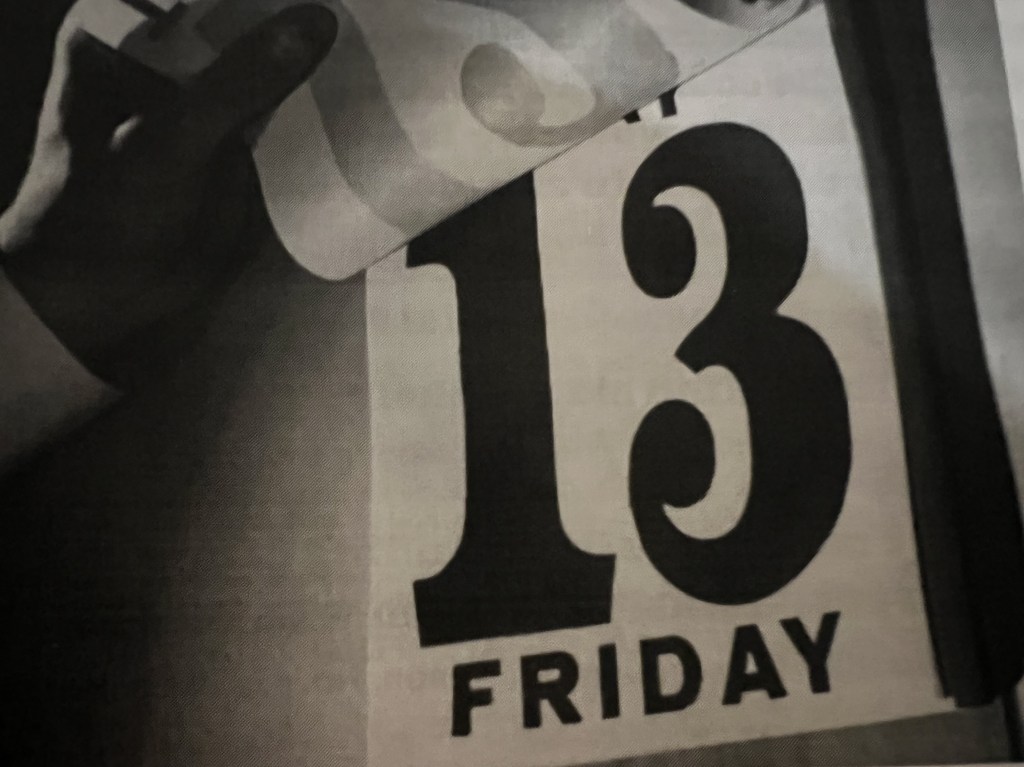
Certainly, most of us would avoid sitting in Row 13 on an airplane, or checking into a room on the 13th floor of a hotel, if they even exist anymore. (But, of course, if floor 14 follows floor 12 on your elevator ride, you probably shouldn’t check into a room on that floor either, since in reality, it’s actually the 13th floor of the hotel!)
Thinking back to when my business partner and I were in the process of selling our commercial building — and it was taking an extremely long time with more than one potential deal after the other falling through at the last minute. It was beginning to get frustrating and we kept trying to think of what else we might do to help us get a deal done. So, of course, we purchased a plastic statue of St. Joseph and buried it in the front yard. A few months later, the building did finally sell, but it had already been on the market for six months at that point, so it probably was due to happen at some point anyway. But, it couldn’t hurt, right? And who knows, maybe Saint Joe really helped.
Back in the time of inquisitions and witch trials, it was quite dangerous to express forbidden beliefs that were not in agreement with more-accepted world views. And even today, there are surprisingly still a number of places in Asia, Africa and the Middle East, where the holding of “wrong” religious views can get people fined, jailed or even executed. In most places these days, if you abide by unusual or weird beliefs, you might be subject to some teasing or looks of disbelief, but times have changed and the availability of scientific and technical information gives us an advantage:
“In the pre-enlightenment world of superstition, the challenging and often disputed task was to
draw a line separating permitted beliefs from
forbidden ones. Now that science is the dominant
standard, the line is drawn between ways of thinking
that are closer to being categorically different.”
(Vyse, Introduction, pg 87)
It seems paradoxical and irrational that superstition still exists in the modern world, particularly since we have such an increased understanding of the universe, nature and disease. According to Stuart Vyse, author and noted expert on superstition: “there is some evidence that superstitious belief is waxing rather than waning.”
And, the results of this survey show that belief in superstition is certainly not waning:
- “Stepping on a crack can result in an injury to themselves or to their mother.” (One in four people believe this.)
- “Black cats crossing your path is bad luck.” (One in four people believe this.)
- “The number 13 is bad luck.” (One in four people believe this.)
- “Opening an umbrella indoors is bad luck.” (One in four people believe this.)
- “If you spill salt, you need to throw a pinch over your left shoulder to counter evil.” (One in four people believe this.)
- “Breaking a mirror is bad luck.” (One in three people believe this.)
- “Ancient Egyptian tombs hold a curse for anyone who disturbs them.” (One in two people believe this.)
- “The number 7 is a lucky number.” (More than one in two people believe this.)
- “You can ‘jinx’ yourself by discussing a future event or outcome before it happens.” (One in two people believe this.)
- “Negative thoughts can cause bad things to happen.” (More than one in two people believe this.)
(PsychTests AIM Inc. 10/29/15, Queendom, “Results of Paranormal Beliefs Test, 14,958 people)
Though being superstitious is something that most humans experience no matter their situation, or where they live, or what their place of origin is, certain countries have superstitions that are more closely related to their culture or ethnicity. In my research, I’ve come across various polls in regard to which particular country is the most superstitious. There are as many takes on that as you might expect. One survey that I found from hellotravel.com ranks India as the place with the most magical thinking.
INDIA: One belief cited is the boiling of milk on a stove so it overflows, bringing good energy and symbolizing prosperity and abundance. ( So, I guess no problem with spilt milk?) Another taboo is to never cut hair or nails on a Saturday, as that would enrage Lord Shani (Saturn) and bring bad luck. And, certainly do not sweep after sunset, because that’s when Laxmi, the Goddess of Wealth and Prosperity is said to visit homes. Sweeping will drive her away, and any hope you have of acquiring wealth.
CHINA: In China, which happens to be number two in this survey, female swimmers attach a tea bag to the front of their swimsuits to bring good luck. And, of course Feng Shui, an ancient Chinese traditional practice, claims to energize forces to harmonize individuals with their surrounding environment.
GREECE: Similar to Italy, in Greece there is the “evil eye.” It’s known as “mati,” and it happens when someone looks at you with jealously or envy. Also spitting — yes, spitting — is an inherent part of the Greek culture, and doing so is supposed to chase away bad luck. Oddly enough, even babies are spit on by their loved ones. And, if someone compliments a baby, there will be immediate spitting three times to ward of mati.
U.S.: There are so many superstitions in the United States that we’re all very aware of. Of course, one is believing that rain on your wedding day is good luck; also, spilling salts, breaking a mirror and the number 13 are all things to avoid. Considering that we are a country with such highly-developed technology and information, and with a generally sophisticated and educated populace, how is it that our citizens still engage in the realm of magical thinking on so many subjects?
PHILIPPINES: For those in the Philippines, spreading salt on the floor is a good way to make your unwanted guests go away. And, on New Year’s Day, all the windows are opened wide to encourage good fortune to come into the house.
NEW ZEALAND: A lot of superstitions in New Zealand are related to sailing and the ocean. For example it’s bad luck to change the name of a boat. If you do a re-naming ceremony, you have to officially christen the boat again. Losing a hat overboard is an omen that the trip will be a long one. Women are bad luck on board because they distract the crew, which angers the sea and causes treacherous conditions as revenge. Figureheads on ships were often female, perhaps because the vessel is always referred to as “she;” and, since women weren’t allowed on board, the figurehead represented the sole female on the ship.
JAPAN: In the Land of the Rising Sun, there is a number that is considered unlucky, but it’s not “13,” it’s “4.” And, unlike the feeling in the US and some other countries that a black cat crossing in front of you is unlucky, that’s just the opposite in Japan — a sign of good luck.
EGYPT: Egyptian superstitions include things such as making certain to finish a beverage to the last drop when visiting a friend, particularly if there is a single young woman living in the house — otherwise bad luck would follow her and she would never get married. (But then, I guess we’d have to ask her if marriage was the preeminent goal in her life.) Also, Egyptians tend to be afraid of black animals, particularly black cats and crows. Black cats are considered evil because of a belief that devils live and exist in cats’ bodies. In addition, it’s never a good idea to leave shoes upside down when removed. This is considered insulting to God and could bring on inauspicious events in one’s life. And don’t forget about disturbing an ancient Egyptian tomb and having a curse released upon you.
FRANCE: For the French, placing a baguette or loaf of bread upside down on a table will invite famine into the house. When out and about, if you step on dog poo with your right foot, it brings bad luck, but should you step on dog poo with your left foot, it is said to bring you good luck. Personally, stepping on dog poo with either foot doesn’t seem like any kind of good luck to me. The French believe that you should never light three cigarettes with the same match, or it will bring bad luck. This sentiment comes from WWI trenches, when soldiers were lighting smokes in a fox hole. Lighting the first cigarette alerts the sniper, lighting the second cigarette tells the sniper how far away the target is, and the third person waiting to get a light is seen and easily shot.
MEXICO: Finally, in this survey of the superstitions of various countries, we have Mexico. It is said that if your palm itches, don’t attempt to scratch it. The itching just means money in your future. Also, be sure to put a broom upside down behind a door, as this will ward off unwanted visitors and negative energy. This might even keep the in-laws away! In addition, it is recommended that a person should eat 12 grapes before midnight on New Year’s Eve and make a wish for each month of the year.
When it comes to superstition and religion, the Catholic church has a very specific point of view. The catechism of the Catholic Church lists “superstition” as a potential violation of the First Commandment (You know, “having no other gods before me.”)It defines it as a “deviation of religious feeling and of the practice this feeling imposes.” (The Observer, Father Kenneth Wasilewski)
It is the Catholic religion’s view that the difference between a sinful superstition and simply a routine that someone goes through from force of habit, is the significance attached to the action taken. It’s when a person is convinced that doing (or not doing) certain things in a certain way will affect a particular outcome. So then, not just a simple, repeated ritual, but an action taken in the belief that is has the power to achieve a favorable outcome:
“Superstition can be sinful under the First Commandment because it begins to view activities in and of themselves as having power that God never gave them. While this can be morally problematic when it comes to things like sporting events, this is especially important when it comes to our religious practices.”
(Fr. Wasilewski)
Even appropriate religious practices can take on a superstitious element depending on how they are approached. For instance, according to Catholic teaching, even praying can be done in a superstitious manner. One might believe that just saying a prayer has the power to force God’s hand. By saying the prayer means nothing bad will happen and not saying the prayer means something bad will happen. Essentially, in the eyes of the Church:
To attribute the efficacy of prayers or sacramental signs to their mere external performance, apart from the interior dispositions that they demand, is to fall into superstition.”
(Catholic TV, “Feeling Nervous on Friday the 13th. Here’s Why Catholics Aren’t Superstitious”)
Let’s face it, almost anything can be turned into pious superstition:
“…even church attendance and participation. If I just show up Sunday morning or join the right ministry team, God will bless my life.Others might even join the church’s leadership, hoping that being a professional Christian will ensure the blessings of God. None of these activities is bad. In fact, they’re quite excellent and beneficial — unless they’re approached as acts of pious superstition.”
(the gospel coalition)
This last quote is not just a Catholic thing, but something that basically all Christian denominations would agree with. But, it’s interesting to note that even among Christians, there is some difference of opinion about what actually constitutes superstition, and very certainly there are major differences in that regard among the world’s various religions:
“Often one person’s religion is another one’s superstition. …Roman Catholic veneration of relics, images and the saints is dismissed as superstitious by many Protestants; Christians regard many Hindu practices as superstitious; and adherents of all ‘higher’ religions may consider Australian Aboriginal peoples’ relation to their totem superstitious. Finally, all religious beliefs and practices may seem superstitious to the person without religion.”
(britanica.com/superstition)
Jonathan Swift, the Anglo-Irish satirist, (who eventually became an Anglican cleric and Dean of St. Patrick’s Cathedral in Dublin), and therefore was most probably not an atheist or an agnostic, still questions the “miracles” that religion seemed to require in order to sustain itself — much like a non-believer might do:
“Religion sees to have grown infant with age, and requires miracles to nurse it, as it had in its infancy.”
(Jonathan Swift, Thoughts on Various Subjects, 1711)
And, just the way that actions taken in the name of religion can move into the realm of superstition — based on intent and the significance given to them — superstition itself can also sometimes cross a line into another category. In this case, perhaps exceeding the bounds of merely being a cultural belief or common routine and become an obsession, to become Obsessive Compulsive Disorder. That, folks, would be a conversation unto itself. So, I won’t even attempt to deal with the topic any further today. I guess, though, that I’d consider OCD to be superstition on steroids, something where a very common behavior experienced by most individuals advances to a level where intrusive thoughts and obsessions evoke extreme anxiety. Again, that’s a subject for another day, or perhaps a visit to your therapist.
WARNING!!!!!
Okay, so full disclosure coming: As I enter into this next section, I’ll be dealing with superstition in sports. I know not all of you are sports fans. And — I’ll be quite honest here—- I always thought, or kind of surmised, that the non-followers would mostly be females. But, because I didn’t want to blunder into and embrace a seemingly-intuitive-but-substantially-incorrect-assumption, I did some quick google research. I’m glad I did, because it doesn’t take long to find out that there are almost the same percentage of woman who love and follow sports as there are men. So, from now on when thinking about sports and demographics, the dividing line for me will not be so much between women and men, but between those who follow sports and those who don’t. Great, now that we’ve covered that issue, I’d still suggest to the typical non-sports followers among you that you peruse this section on sports superstitions. After all, athletes are people too, and are just as likely as you and me to fall under the spell of some magical thinking. Therefore, I’d suggest that you throw caution to the wind and perhaps you’ll come across some interesting and quirky new information that you might want to share at cocktail parties. Ice breakers? Those awkward moments when there’s an obvious lull in the conversation? (Do people even have cocktail parties anymore?) For those of you who are still determined to avoid the sports stuff despite my protestations and my reasoned and very convincing argument, then fine, have it your way. I’ll advise you a bit further along in the essay when it’s safe to go back in the water, you can stop skipping paragraph after paragraph of my limpid, luminous prose and begin reading again…
FOOTBALL: Superstitions are liable to pop up in every situation that humans are involved in, and the world of sports is no different. Take football players, for instance. Brian Urlacher, a pretty decent linebacker for the Chicago Bears in the early 2000s, made sure to eat two chocolate chip cookies before each game. Another talented linebacker, the great Lawrence Taylor of the NY Giants, always got a haircut before an important game — whether he needed one or not. LT’s coach, Bill Parcells, would stop at the same two shops for coffee every morning on the way to work. And his office was famously filled with a series of brass elephants, with tusks facing the door. His Italian mother started the tradition, giving her son his first elephant when he became the Giants coach. Evidently, Bill’s rituals must have paid off: in his eight years as head coach of the NY Giants, his team won over 61% of its games, two Super Bowls and Parcells ending his coaching career by being inducted in the NFL Hall of Fame.
Jake Elliot, an extremely successful placekicker for the Philadelphia Eagles, has a very specific pre-game ritual that he goes through before every game; however, he has never really shared the particulars and they remain a closely-guarded secret. But, whatever he’s doing, it really seems to be working. This season, he was successful on 30 of 32 field goal attempts — completing 94% of his kicks! Tom Brady, the GOAT, used mantras and special stones for good luck before games. And finally, we have Patrick Mahomes, another very successful quarterback and one who may ultimately be in the conversation as the next GOAT; he says that he wears the same pair of red underwear that his wife Brittany gave him. He started wearing them each game in his first year in the league, and since it turned out to be a pretty successful season, he’s kept up with the routine.
BASKETBALL: As you might guess, basketball players are not immune to superstitious thinking either. Steve Nash, an all-star point guard who spent most of his career with the Phoenix Suns, was one of the best at the position of his generation. Before each free throw at the foul line, Nash licked his fingers and took three “practice throws” without the ball. Must have worked: for his career, he hit on 3,060 of 3,384 free throws, for a 90.43% success rate. NBA league average for free throws is just 70%.
The great Michael Jordan, perhaps the best to ever play the game, had success in college before he became a pro. He won the national championship with the North Carolina Tar Heels in 1982. He believed that the shorts he wore that day were lucky. So, during his entire career, he continued to wear his college practice shorts under his NBA uniform for good luck. At the time, NBA players were actually wearing “short-shorts”, but in order for Jordan to cover up his Tar Heels practice shorts, he needed to wear longer Bulls shorts to cover them up — so he is actually often credited for creating the style of wearing longer shorts in the NBA.
Of course, if you’ve seen LeBron James play, you’re aware that he has a trademark ritual of throwing chalk up in the air and clapping his hands before game tip-off. In addition he’s been known to have secret handshakes with each individual player on his team — and he does that every game!
Finally, the Louie Carnesecca sweater story! Carnesecca was the head basketball coach at St John’s University from 1965 to 1992. In 1985, the Johnies were having a great season. They had already beaten rival Georgetown (with Patrick Ewing), and were ranked #1 in the country, and set to play the #2 Hoyas again. The Redmen (changed in recent years to the more appropriate “Red Storm”), were on a 13-game winning streak that had begun in a game at Pittsburgh. On that evening, Carnesecca had a cold. He wore a sweater to keep warm — a brown pullover with broad red and turquoise stripes. Once they won that night, Louie kept wearing it as long as his team continued to win.
I remember watching some of those games. It was certainly not a great looking sweater. Even Looie said it was ugly. All in all, the sweater “won” 16 of 18 games — that’s right, the great coach (who had an overall record of 526 and 200 in his 24-year career), gave all of the credit to the ugly sweater. BTW, after two blow-out losses to Georgetown at the very end of the season, the sweater was finally retired…
HOCKEY: Hockey superstitions have been around for a long time. Growing “playoff beards” started with the successful New York Islander teams of the 1980s. On the way to winning four Stanley Cups during that decade, team members would not shave their beards from the beginning of the playoffs through the end of the Stanley Cup Final.
How about the celebration of a “hat trick” (one player scoring three goals in a game)? When that third goal is scored, fans toss their hats and caps on to the ice. This may have started with a Chicago Black Hawks player, Alex Kalita, who found a rather expensive hat in a Toronto department store that he really liked but couldn’t afford. The store owner told Kalita that he could have the hat for free if he scored three goals in that night’s game against the Maple Leafs. He actually scored four!
And then there’s a long-time hockey superstition that is perhaps the most sacred: Do not touch the Stanley Cup until after you’ve won it, because if you do it’s bad luck and you will never win it. This is pretty much accepted as gospel by most of the players, even today.
GOLF: One of the first superstitions that many golfers have learned over the years is that you should never keep extra golf balls in your pocket. That will inevitably bring bad luck because since they’re so accessible, you’re probably bound to use them. Also, is you’ve been performing well on the course, don’t wash anything — your putter, a lucky ball, golf shoes. And then there’s Tiger Woods. For years he would wear an iconic red Nike shirt on Sundays (Woods was sponsored by the sneaker company for 27 years, but that agreement has ended.) The speculation has been that red makes him stand out on the course, it’s a color of strength and aggression — and Tiger himself has said that his mom says it’s his “power color.” It definitely dates back to his days at Stanford and Junior golf. Of course, he very recently introduced his own new brand: “Sun Day Red.”
BASEBALL: It would seem that no sport lends itself to superstition more than baseball; with its 162-game schedule, there are many more opportunities for omens, good/bad luck charms and rituals to be invoked — either to stave off loss, hitless streaks and other potential adversity.
I remember watching Yankee games as a young boy in the late 50s/early 60s while the legendary Casey Stengel was still their manager. When he would go out to the mound during the game to talk with or remove a pitcher, he made sure never to step on the chalk (foul line) or it might negatively affect the game’s result. There were even a few times when Case would seem to forget that the line was there, realized it at the last second and had to hop over it. Another common baseball superstition: for certain, no teammate on the bench would speak to their pitcher if he was in the midst of tossing a shutout; or, mention the word. Even the announcers respected this, as well.
And then there was Wade Boggs, a third baseman and one of the game’s greatest hitters. A career batting average of .328, was the American League batting champion five times, over 3,000 career hits and elected to the Baseball Hall of Fame. His superstition involved eating chicken before each game. Or, as Boggs himself described his pre-game ritual:
“Sometimes it’s better to be lucky than good. That’s why I do things to create luck, like eating the chicken and running my sprints at 7:17 before night games. I want to
(New York Times)
feel lucky. I want to feel that if I hit a ball to the shortstop, it’s going to hit a rock and go over his head.”
Articles consulted/excerpted for the above sports superstitions section:
•. Dominic Lobianco, “Unusual Hockey Rituals of the Rink.”
- Dave Raffo, UPI Archives,” Those Superstitious Giants,”12/27/86
- UPI Archives, “Louie Carnesecca,” 3/20/85
•. ACCESS/INTIX, “The Wide World of Sports … Superstitions.”
• Bleacher Report, “Strange NBA Superstitions You Have to Read to Believe.”
OKAY, THE SPORTS SECTION IS OVER AND DONE
WITH, FEEL FREE TO START READING AGAIN…
I’ve reviewed the various superstitions embraced by the different ethnic groups. Having grown up in an Italian-American household, I was exposed at an early age to a lot of the traditional beliefs regarding superstitions. As a matter of fact, I’ve already dealt with this issue in an earlier blog essay — (“Cannolis, Agita and the Evil Eye: Growing Up Italian-American.” April 13, 2022). Rather than re-invent the wheel, I’ve picked up the following excerpt from that piece. You may recall it, or forgotten it, or just never gotten around to reading it. Either way, I think you’ll enjoy it.
As positive as she was in most respects, I think my sainted mother was sometimes just waiting for the other shoe to drop. With Ma, it wasn’t “no new is good news,” but rather “no news is bad news.” Unfortunately, she was an anxious person and always feared the worst. One day, my sister Dolores and her then-boyfriend-eventual-husband Ed (both in their late 20s) had taken their bicycles out for a ride. About five minutes after they left, the town sirens went off, which indicated that either a house fire or an accident of some kind was in progress. Ma immediately dispatched my father to scour the neighborhood and see if the cyclists were okay. They were. I remember that planning baby showers for expectant mothers in our family was always done holding one’s breath, if done at all. That perhaps if you just assumed all would go well with the pregnancy and birth, it might bring bad luck. I can also recall many times inviting my parents to come to our house for a visit. And if the date was for a time say two weeks or more hence, my mother would sort of commit, but she’d always say: “we’ll see.”
But, when it comes to irrational beliefs, the “evil eye” puts the super into superstition. I can remember as a young boy my grandma checking to see if someone had given grandpa the “malochio,” commonly known in our world as the evil eye. She did a simple test of dropping three drops of olive oil in a bowl of water. If the oil moved into the shape of an eye, then you had been cursed. Essentially, the evil eye is a “look” given by one person to another, out of envy or jealously. This “overlooking” may be accompanied by a seeming compliment, but it is not sincere. At times, the evil eye could cause headaches or stomach aches. To try and rid yourself of the curse, you were told to say a series of specific prayers.
And to ward off the evil eye, people would sometimes wear an amulet shaped like a horn (“cornetto”), or make the horn hand sign by extending the pinky and index finger, and keeping the others folded back. You could also tie a red ribbon over the threshold of your home to protect you from envious people. My mother gave me a red ribbon to hang in my very first car. And we have given each of our sons a red ribbon when they got their first car.
To some this whole business of the evil eye (or, “maloik” as if was called for short) may seem like just a major case of ethnic paranoia. But the concept was certainly accepted by Italians of my parents’ and grandparents’ generations, and was a definite part of tradition when I was growing up. I remember a story from the old days that I heard many times over the years. Seems that there was a particular Italian woman in the neighborhood (I never learned who she was) who had the ability to give someone “the eyes” at will. In this case, it was to her husband, who she learned had been cheating on her. When she knew that he would be seeing his “mistress,” the woman would cast a curse on her husband, giving him severe stomach aches, and ruining his romantic trysts.
It was thought by many in the neighborhood that this woman had “witchly” powers. On one occasion, my maternal grandfather was trying in vain to locate some very important legal documents. Now, Grandpa was a very intelligent, thoughtful and organized person. For him to have misplaced something so significant was very unusual. And though he searched and searched, literally taking apart his desk and emptying out the drawers, the hunt was not successful. Finally, in desperation, he asked Grandma to pay a visit to the “witch,” to see if she could help him locate the documents. When Grandma returned, she had specific instructions for exactly where to find them in the desk. And, with one more look, they turned up — in a drawer that grandpa had already rummaged through a number of times!
So whether you believe in superstitions or not, I think you’re about to be the beneficiary of some very good luck — that’s because this very, very long essay of mine, both massively researched and well-intentioned, is drawing to a close! Soon, quite soon, you will have concluded this journey into superstition with me and can resume living your life and getting on with the important things that are of concern to you.
Theodore Roosevelt once wrote:
“There is superstition in science quite as much as there is superstition in theology. And it is all the more dangerous because those suffering from it are profoundly convinced that they are freeing themselves from all superstition.”
I believe the reason that superstitions are still so prevalent in our world is because all humans, be they ministers, scientists or our next door neighbors, have a tendency to try and find certainties in the world. As Stuart Vyse wrote:
“The most likely thing that can be said about the future of superstition is that it will always be with us. …Although human civilization has eliminated many of the uncertainties faced by ancient peoples, countless important life events are still beyond our control, and when there is uncertainty, magic finds a welcome home.”
In an earlier essay that I wrote about human error, my contention was that “To be human is to be erratic.” In a similar fashion, I would venture that “To be human is to be superstitious.” So, if most of us are at one end or the other on the superstition spectrum, and it’s certainly a common feature of human nature — is that really such a harmful thing?
Well, I never thought so, but I raise the question just to make my discussion on this topic a bit more complete. You know that I’ve already touched briefly on OCD, which is a psychopathology that goes quite beyond mere superstition. And, while I said previously that I wouldn’t get into OCD in this essay, I will cite the case of the famous 18th century literary figure Samuel Johnson, who appeared to have suffered from obsessive compulsive disorder. Evidently, his disorder took the form of “checking rituals” e.g., repeatedly checking lights and locks. Somehow, that behavior, in and of itself, doesn’t seem that strange to me. I mean, aren’t there plenty of you out there who, like me, make sure to check the knobs on the stove burners at least a few times before going to bed at night? Or, don’t you often have to move an item on your desk a few inches to the left or right so that it’s not covering up another item? Or possibly, there must be some things that you have to touch a certain number of times? Amirite? Come on now, be honest. Listen, I really don’t think I’m full-fledged OCD. Okay, may OOCD —Occasionally OCD!
What I will say about superstition potentially being harmful is this: If we were to look at magical thinking as an unhealthy preoccupation, then we might want to apply certain standards as to when that behavior begins affecting a person’s way of life in a negative or destructive fashion. If certain superstitious beliefs begin to reduce the quality of life in the following ways — socially, financially, physically or emotionally/cognitively — it is no longer mere superstition, but something more harmful that would most likely require an intervention of some kind.
Well, dear readers. I’ve said all that I want to say, care to say, have to say or even have the ability to say on the subject. But, I will leave you with some final thoughts. Even though people do often recognize that superstitions are silly and irrational, they will still engage in them. And, the unspoken belief might just be: “I don’t want to take a chance.” American psychologist, Jane Risen has suggested a theory based on the premise that we have two mental processing systems:
“… a quick-acting intuitive system and a more deliberate rational system. According to Risen, when thinking about superstition, our intuitive mind often wants to go along with it, but our rational side wants to correct our intuitions and move us to reject magical thinking. However, people often acquiesce to their intuitive brain and give in to superstition. When we know it’s Friday the 13th, we may decide it’s not a good day to trade on the stock market, despite understanding there is nothing to back up the superstition.”
(Vyse, Superstition: A Short History, pg. 114)
Essentially, I think superstition is so much a part of the human condition that we often engage in a little bit of magical thinking quite easily without really noticing it. And, that tendency will probably not disappear any time soon. In certain circumstances, people are often susceptible to making a quick, seemingly intuitive decision that, more or less, amounts to a back-up plan, a plan B, a belt-and-suspenders, throw-everything-at-it approach to ensure “success” in what we are hoping, and sometimes praying, to achieve. It’s about not wanting to “take a chance,” at missing out, by leaving out anything that may help to assure our good luck, or give us a higher percentage probability that we can make something happen.
However, it doesn’t really work that way, folks, in terms of increasing the likelihood of a sought-after result. But, mankind has undoubtedly been prone to engaging in superstitious behavior for much of human history. And, that will almost certainly continue. The great American actress, Helen Hayes, had written these words in 1987:
“We may be living in the twentieth century, in resplendent sophistication. But, deep down, most of us find ourselves still in the Stone Age of superstition.”
(Helen Hayes, “Psycho-Logic, “ Loving Life, 1987)
——————————————————————————————————–
 Resonance