“Quod ali cibus est allis fuat acre venenum.’’
(‘’What is food for one man may be bitter poison to
others.”). (Titus Lucretius Carus, Ist Century BC)
“It is an old axiom, and well said, that Beauty is in the
eye of the beholder.” (Margaret Wolfe Hungerford)
“Different strokes for different folks.”
(Coined by urban blacks in the 1950s, popularized by Muhammad Ali, 1966)
“East is East, and West is West, and never the twain
shall meet.” (Rudyard Kipling)“Whereby that old moth-eaten proverb is verified, which says: ‘One man’s meate is another man’s
poyson.” (Thomas Middletown, Jacobean playwright, 1604)
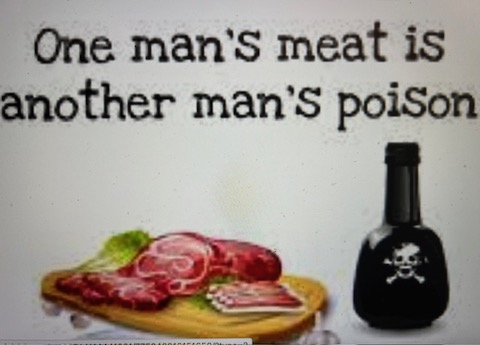
“One man’s meat …” You know the rest. The phrase has been uttered by many of us over the years, in multiple circumstances and situations. It can simply mean that people like different things. Or, what might be good for one person may be bad for another. Or, what appeals to one group might not appeal to another group. Or, what’s good luck for one may be misfortune for another. How about a person possessing a skill in a certain discipline which is impossible for another person to duplicate? Maybe there’s a certain type of food that someone desires and raves about, but is found distasteful by someone else. How about food that may be essentially healthy for me, but, in fact, may cause harm to you (do you hear me, shellfish)? My feeling is that it may have to do with subjective preferences and experiences, as well as our personal perception of what is good for us and what is not. Of what will benefit us and what will not.
I’m going to cite a few specific situations that should help in spelling out examples of the essay’s theme. In the early months of 1945, the United States was still at war with Japan, a war which had begun with the Japanese sneak attack on Pearl Harbor on that “day that will live in infamy” — December 7, 1941. In February of 1945, the Battle of Iwo Jima took place, which was an extremely bloody battle. From April until June 1945, the Battle of Okinawa had been fought. The results from Okinawa were much worse than Iwo Jima: 14,000 US troops had died (along with 70,000 Japanese soldiers and 150,000 civilians.) The US considered invading Japan, but it had been estimated at the time that a ground invasion of Japan would be too costly in terms of American lives.
The United States, by way of the secret “Manhattan Project,” had been developing the atomic bomb with some urgency. Indeed, the major activity of the project took place in three years (1942-1945). In early June of 1945, the Interim Committee, a high-level secret group that advised President Truman on nuclear issues, recommended using the atomic bomb against Japan. US military planners conducted a series of studies to estimate American casualty levels if America were to invade Japan: 267,000 to 800,000 deaths, with 1.2 to 4 million casualties. (Study.com, “The Bombing of Nagasaki in WW II, History, Facts and Aftermath” T. D’Silva and C. Prokes)
So, Truman made the decision to bomb Japan instead of launching an invasion, in order to potentially save the lives of thousands of American soldiers. What did that mean for the citizens of Hiroshima and Nagasaki? When the 10,000-pound uranium bomb was dropped on Hiroshima.
“tens of thousands of people were burned to death or buried alive by collapsing buildings or bludgeoned by flying debris. Those directly under the bomb’s detonation point, or hypocenter, were incinerated, instantaneously erased from existence. The true death toll — estimates have ranged between 100,000 and 280,000 — will never be known.”
(National Geographic, “The Elusive Horror of Hiroshima,” Leslie Blume, Aug 5, 2020)
So, here’s my second example of the one man’s meat meme. And it’s from the realm of politics. When I first began my blog, almost four years ago, I pretty much promised that I wouldn’t allow my essays to devolve into something blatantly political and partisan. I wasn’t even going to wander close to the topic of politics. Those of you who know me — and particularly those who have come across my FB rants — know very well where my political passions lie. But, I have wanted the arguments I’ve made over the last several years, on a variety of topics, to be based on making a case that very much relied on facts. Okay, with perhaps a little bit of my personality and life experience thrown in to give it a tad more humanity. But, definitely no overt partisanship. I’d like to describe how one set of political opinions can be radically different from another set of political opinions — particularly when those opinions refer to the very same politician — Donald John Trump.
Why do conservatives, particularly MAGAs, love the former president? There is a widely-held feeling in the electorate that the “system is broken.” It is said that majorities of Republicans feel:
“jaded with the systems that make up American life. Namely, the economy, politics and the media. That means that Trump, who has long promised to ‘drain the swamp,’ is a conduit for widespread anti-establishment sentiment.”
(Ipsos, “Why Are Republicans All in on Trump?”, January 19, 2024)
So, if you’re a Trump devotee, what power would you want him to have in order to deal with swamp draining and fixing the system? Obviously, to begin with, probably fewer constraints. Trump likes to project as a “strong man,” a la Putin and Orban, etc., and most of his supporters indicate that they’d like “a strong president who can rule without checks or balances from other branches of government.” In fact, a Reuters/Ipsos poll from earlier this year found that many Republicans feel “the country is in crisis. And needs a strong president who should be allowed to rule without too much interference from courts and Congress.” (Ipsos)
Consider also that many Republicans feel Trump was sent by God. Plus, despite all of the indictments (91) against him for federal and state crimes, instead of losing support among his followers, they have doubled down on backing him. His followers have been told by Trump (and have believed him) that his problems with the law prove that “Biden’s Justice Dept,” as well as the “deep state,” are out to get him and stop him from becoming president. There are, without a doubt, those who love Trump and will support him without question. No matter what he says, how he acts or what he does.
So, that’s one side of the equation. Now, there’s another side to this, there always is. That would be liberals and Democrats who look at Trump as an anathema. They see him as:
“an egotistical narcissist, conspiracy theorist, ethically challenged businessman, misogynist, phenomenal blowhard and former Democrat — found guilty by a court of sexual abuse, twice impeached as President of the United States, and unwilling, unable, or both, to accept that he lost the 2020 American presidential election, of which the disgusting attack on the Capitol in 2021 was the most visible manifestation. Now he seeks a second term. How could America possibly be safe once back in his hands?” (Conservativehome.com, “The Cons and Pros of Trump,” Paul Goodman, January 22, 2024)
In addition to the above-mentioned criticisms, there are some who think that Trump’s conduct and policies during his time in the oval office prove that:
“he represents the greatest threat to global stability, largely because the fate of liberal democracy would be entrusted to a leader who attacks its fundamental principles. Trump’s disdain for the rule of law, unwillingness to accept electoral defeat, and affinity for autocrats like Russian President Vladimir Putin and Chinese President Xi Jinping are anathema to free and open societies. How could NATO operate effectively under a US president who seeks to undermine it? How could European countries trust a US administration that fails to support Ukraine against Russia?” (Project Syndicate, Chris Patten, “Another Trump Presidency is the Biggest Threat to Liberal Democracy,” January 2, 2024)
America expanded its global influence after WW II and persuaded much of the world to embrace the principles of liberal democracy. With the growing assertiveness of China and Russia right now it wouldn’t be an exaggeration to say that the rules-based international order might not survive a second Trump term.
And, I’ll end this segment with the opinion of a random, but typical, online (anti-Trump) commenter, in response to another commenter who had just proudly stated that Trump had done a “great job” as president:
“Just WHY do you think he did a ‘great job as president?’ What do you think he actually did? As far as the rest of us in the world are concerned, he did nothing of importance. He spent most of his time watching TV, playing golf and writing nonsensical comments on the internet, while doing virtually nothing in terms of his actual presidential duties. And even then he managed to insult all of America’s allies, while praising her foes— Russia, China and North Korea. So, I ask again: why do you think he did a ‘great job’ as president?”Well, there you have it. One man, two widely divergent views. This kind of thing happens all the time, all throughout life. So, why not in politics, too? And, whatever side you’re on in this little exercise, just consider that as certain as you are that your point of view is obviously the correct one in this situation, and that those folks on the other sideline are bat-shit crazy, confused and scum of the earth, I can assure you that they’re thinking the very same things about you right now. There seems to be no easy way to explain how such incompatible, irreconcilable and antithetical ideas about a single person could exist simultaneously in the universe. Obviously, my friends, it’s just another case of “one man’s meat is another man’s poison.”
“One man’s meat is another man’s poison” has inspired many variants and take-offs over the years. Here are some that I’ve come across in my research:
- “One man’s gravy is another man’s poison” (Adams Family Correspondence, 1776)
- “One man’s meat is another man’s croquette”. (Restaurant version. Lewis & Faye Copeland, 10,000 Jokes, Toasts and Stories, 1939)
- ‘’One man’s medicine is another man’s poison”
- “One man’s drink is another man’s poison”
- “One man’s joy is another man’s sorrow”
- “One man’s poison ivy is another man’s spinach” (George Ade, American humorist, satirist, moralist)
- “We are so confused about good and evil that one man’s saint is another man’s monster”
(Howard Fast, The Outsider, 1984) - “One man’s meat is a cow’s death” (Forbes, 1984)
- “Use money, use entrapment, find their vulnerabilities. Again, it’s as old as Babylon. One side’s patriotism is another’s perfidy.” (Sydney Schanberg, New York Newsday, 1994)
- “One man’s sacred cow is another’s Big Mac” (Ad for Global Guardian Trust, New York Times, 1995)
- “One man’s trash is another man’s treasure” (Usually refers to items that appear worthless to one person, while they may have enormous value to someone else — think flea markets, yard sales, thrift shops, etc.)
- “One man’s wart is another man’s beauty mark” (Timothy Regan, Corning, Inc. trade official, New York Times, 1993)
- “One man’s ceiling is another man’s floor” (Paul Simon, song title, 2018)
- “One man’s poetry is another man’s poison” (Oscar Wild, when asked to comment on some verses written by his friend, Lord Alfred Douglas. This was during the trial of The Crown vs. Oscar Wilde, in 1895.)
- “One man’s meat is another man’s poi(s)son” (Melbourne Punch, Melbourne, Victoria, Australia. A reference to fasting during lent, and a play on the word “poison” by substituting “poisson,” the French word for “fish”.)
- “Poisson sans boisson (wine) est poison” (Translates to : “Fish without drink is poison.”
(Random House Dictionary of America’s Popular Proverbs and Sayings, Gregory Titelman, pg 258, 2000)
I’d like to explore several other variants of “one man’s meat is another man’s poison.” Obviously this phrase can simply describe the fact that certain foods liked or enjoyed by one person may be found distasteful to another. But, there is also a deeper meaning that is sometimes at play: “So deep that it’s rooted in your DNA. Yes, your DNA, or more specifically your genes will tell you which food can be healthy for you and which can be a poison.” For instance, Broccoli, cauliflower and cabbages are certainly considered healthy vegetables, but if you suffer from hypothyroidism or an under active thyroid gland, you should probably avoid cruciferous veggies, as they may block the thyroid gland’s ability to utilize iodine, which is essential for normal function. Similarly, grilled foods are generally considered healthy (particularly when not cooked in fat). However, sometimes charring, burning or grilling foods over high temperatures can produce heterocyclic amines (HCAs); these compounds can damage genes and raise the risk for cancers such as colorectal cancer. A preventive genetic test can alert you to genetic risk factors you may have, and allow you to modify your diet in response. (S. Babu, “One Man’s Food is Another Man’s Poison,” mapmygenome, October 16, 2022.)
Of course, another food item that has been known to be a “poison” to some, particularly young children, is peanut butter. PB is a protein-packed spread that is popular around the world. It’s a great source of copper, a mineral that helps maintain bone health, immune function and health of blood vessels. Some research even suggests that getting enough copper in your diet reduces the risk of osteoporosis and heart disease. Peanut butter contains omega-6 fatty acid, which is known to lower bad (LDL) cholesterol and increase good (HDL) cholesterol. (WebMD, Health qnd Diet Guide, PSachdev, MD, August 13, 2023)
However, peanut allergy has become very common over the last several decades, particularly for children, and can lead to severe allergy attacks. For some, even tiny amounts of peanuts may cause a serious reaction that can even be life-threatening (anaphylaxis). The peanut allergy occurs when someone’s immune system mistakenly identifies peanut proteins as something harmful. So, yes, this is a very real example of “one man’s peanut butter is another man’s poison.” (Mayo Clinic, Diseases and Conditions)
Finally, here’s a case where one man’s meat can also be his poison. Have you ever heard of Alpha-gal Syndrome? No? Well, me neither. Come to find out that it’s a serious, potentially life-threatening allergic condition. AGS is also called alpha-gal allergy, red meat allergy or tick bite allergy. It’s not caused by an infection, but symptoms occur after people eat red meat, or are exposed to other products containing alpha-gal. AGS reactions can include: hives or itchy rash, nausea or vomiting, heartburn or indigestion, cough, shortness of breath or difficulty breathing, drop in blood pressure, dizziness or faintness, severe stomach pains. AGS reactions can be different from person-to-person. In the most severe reactions, anaphylaxis is possible. Obviously, when it comes to AGS reactions, “One man’s meat is that same man’s poison.” (CDC, Ticks, Alpha-gal)
I feel as though we’ve come full circle. What have we learned? Seriously, I still feel (as I did at the start of this essay) that this “one man’s meat” thing has a lot to do with subjective preferences, as well as how we personally perceive what’s good for us and what’s to be avoided. I’ve also always theorized — and I know I’ve mentioned it before because I do tend to repeat myself — that each of us is born predisposed to be good or not good at something, to have or not have an interest in certain subjects, and to have or not have a taste for particular foods. Is this true for most people? I’m not completely certain, but it’s what I’ve always believed. And, if you were to ask me for “proof,” I’d probably tell you that it’s in a category that I call “mystical.” It’s kind of where I end up assigning all of my opinions/decisions that come from the “gut.”
So whether it’s:
“Everyone to their own taste,” or
“To each his own,” or
“Different strokes for different folks,” or
“Beauty is in the eye of the beholder,”* or
“It’s not my cup of tea,”
…these statements more or less suggest that we can all look at the same thing and see it differently from another; so, pick your poison.
And, let me leave you with this quote:
“American philosophers tell us that truth is relative and morality is matter of taste, no different really from preferring asparagus over beets. Judges, following close behind, instruct democratically elected legislatures that in making public policy, they may not choose between competing conceptions of the good. After all, one persons decency is another’s perversion.” (Letters to the Editor, New York Times, 1989.)
As a wise man once said: “There’s no accounting for taste.”
————————————————————————————————————
*Shakespeare , in Love’s Labours Lost , expressed it this way: “ Beauty is bought by judgment of the eye.” Perhaps a less well known version of the line came from Miss Piggy, who uttered: “Beauty is in the eye of the beholder, and it may be necessary from time to time to give a stupid or misinformed beholder a black eye!”
 Resonance