Click to listen to a recording of this essay
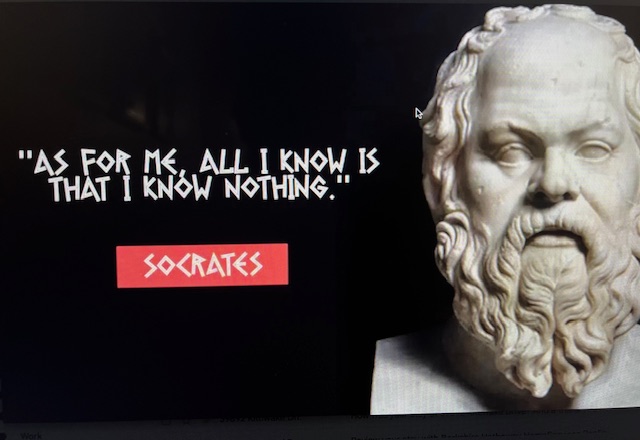
“Awareness of ignorance is the beginning of wisdom.”
(Socrates)
“To know that we know what we know and to know that we do not know what we do not know, that is true knowledge.”
(Nicolaus Copernicus)
“The more I read, the more I acquire, the more certain I am that I know nothing.”
(Voltaire)
“The Dunning-Krueger Effect is a cognitive bias in which people wrongly overestimate their knowledge or ability in a specific area. This tends to occur because a lack of self-awareness prevents them from accurately assessing their own skills.”
(Psychology Today)
“The opinion of 10,000 men is of no value if none of them knows anything about the subject.”
(Marcus Aurelius)
“Ignorance more frequently begets confidence than does knowledge.”
(Charles Darwin)
“It is sometimes understood in popular culture as the claim that ‘Stupid people are too stupid to know they are stupid’” (Robert D. McIntosh, psychologist)
“All I know is I don’t know nothin’, All I know is I don’t know nothin’ at all, People talk, but they don’t say nothin’, All I know is I don’t know nothin’ at all”
(Song lyrics, Machine Gun Kelly, 2020)
Let’s be honest, we’ve all come across people in our lives who act as if they know more than they really do. Sometimes, they may actually understand, in their heart of hearts, that they are only pretending to be knowledgeable about a certain topic. But, in many cases, they are not even aware of their lack of knowledge. They simply do not know what it is that they do not know. This inclination is commonly referred to as the Dunning-Kruger effect — a concept based on a 1999 paper by Cornell psychologists David Dunning and Justin Kruger. Basically defined as “the tendency of people with low ability in a specific area to give overly positive assessment of this ability.” (Wikipedia)
I intend to dig into the D-K effect some more, but I’ll digress a bit first. I’m reminded of a time many years ago, when I was a young college student majoring in English at Seton Hall University. One of my early courses (Continental European Lit) was taught by Dr. A. Sarot. Sarot was a warm and engaging prof; somewhat portly, distinguished in his own way. And, he tended to give his students some leeway in their classroom comments. That is to say if a student wanted to contribute, then Sarot was willing to let him or her have their say, even if they were a bit off base with their facts or their interpretations. He evidently thought that it was more important that his students took an active part in class than if they were completely correct in their opinions.
In Sarot’s class, I saw the Dunning-Kruger effect in action and it had to do with a guy named Williams. Don’t think I knew his first name. We were all kind of referred to by our last names in class: Williams, Fasano, Kozlowski…. But, as I remember him, Williams had a penchant for raising his hand in response to literally every question that the professor threw out to the class. And, based on most of his responses, it seemed to me that Mr. Williams didn’t always, or even usually, have a thoughtful, measured response to the query. As a matter of fact, I often wondered if he even understood what was being asked. It seemed like he actually was offering responses in search of a question, instead of vice versa. His “contributions” didn’t appear to advance the discussion or provide any useful, new information or insights. But yet, he persisted. And, he spoke confidently as if he were an expert. Seriously, the guy was not even aware of what he didn’t know. (I sort of admired him in a way for his supreme confidence, since at that stage in my life I tended to shy away from speaking in class, even though I usually had something worthwhile to contribute.). At any rate, our boy Williams was a textbook case of the Dunning-Kruger effect, some 30 years before those eminent psychologists gave it a name.
Now, there are many reasons why people tend to assume they know things that they actually don’t — and speak confidently about them; it’s simply those with a low ability at a task overestimating their ability. There are a number of reasons why people exhibit this behavior:
• Lack of Awareness: individuals may not realize the extent of their ignorance on a particular topic.
• Overconfidence: Some people have a tendency to be overconfident in their own abilities and knowledge.
• Social Pressure: In some situations individuals may feel pressure to appear knowledgeable or competent even if they are not.
• Desire to Be Perceived as Knowledgeable: People often want to be seen as intelligent and informed by others.
• Confirmation Bias: People tend to seek out information that confirms their existing beliefs and opinions.
• Fear of Appearing Ignorant: Some individuals may be afraid of admitting that they don’t know something … to avoid feeling embarrassed or vulnerable.”
(Quora: “Why do people assume they know things that they don’t, and speak about it like they know what they’re talking about?”)
Essentially, it may come down to wanting to see themselves in the best light possible. As this commenter on the Quora site suggested:
“Why do people like to talk about things they know absolutely nothing about? To feel good about themselves. Some people just have an absolute need to show their strength, no matter what. Simply saying ‘I don’t know’ would be unacceptable to them, and would place them inferior to the questioner. Accepting they’re not well versed in a field would make them feel vulnerable, and they can’t accept that. It’s all really very annoying. There is absolutely nothing wrong with accepting you don’t know something. It opens up the doors to knowledge, and nothing quite equals an open-minded curiosity about the world.”
Almost as if in response to the above comments, my cousin Robin, a smart and thoughtful person, had recently posted her opinion on this very topic when she stated: “If I don’t know something, I have no problem saying: ‘I don’t know.’ And if I don’t, I will READ to find out…”
Evidence of those influenced by the D-K effect is quite apparent throughout our entire society. When it comes to finding out information about topics such as medical conditions, successful marriages, investments or political opinions, many people these days turn to the internet to inform themselves. In fact, an article in the Daily Mail a few years ago asked the question : “Do you think with Google? People who use the search engine to find answers think they’re smarter because they mistake the internet’s knowledge for their own.” This insight comes from a study by Adam Ward, a marketing professor at UT Austin School of Business. Also noted: “An inflated sense of intelligence can lead to poor decision-making or doubling down on misinformation.” (Daily Mail)
Ward’s findings suggest how Dunning-Krugers get their ammunition. And once people get used to relying on the internet for their “knowledge,” they tend to get an exaggerated belief in their capability about what they can do in the future without relying on Google:
“Using Google to answer general knowledge questions artificially inflates peoples’ confidence in their own ability to remember and process the information and leads to erroneously optimistic predictions regarding how much they will know without the internet. … When information is at our fingertips, we may mistakenly believe that it originated from inside our heads.”
(Daily Mail, Adam Ward, Proceedings of the National Academy of Sciences.)
A study found that 89% of US citizens turn to Google before their doctor. One physician’s assistant in North Carolina says that she spends much of her time with patients explaining what they didn’t have, versus talking about what they actually do have. According to the study, patients indicated that they want to find out the severity of their health condition before going to the doctor. Health professionals don’t mind you googling some research after you’ve been diagnosed with something new, say high blood pressure. In those cases, a patient can find out how to deal with their condition and take a proactive approach. Obviously though, it’s better to be informed by your doctor, instead of misdiagnosing yourself and causing unnecessary anxiety. (WECT)
Another area where the Dunning-Kruger effect rears its ugly head is in the business world. There have been countless, high-level situations where an executive’s previous successful career achievements suggest that he or she would be overwhelmingly successful in taking over and guiding the future activities of a major corporation in a totally different sector. That thinking has been proven a fallacy in a number of cases. Certainly, the saga of Elon Musk comes immediately to mind. In considering his time as CEO of Tesla Motors — a car company that he was an early investor in, but not one of its founders — you’d have to admit that the corporation has been relatively successful during his reign. However, sales are down 8% year-to-date. The Chinese automaker BYD had a 21% increase over last year. Due to the competition, Tesla has had to steadily cut prices and profit margins have been squeezed.
Twitter is yet another matter. It would seem that Musk’s Twitter relationship proves my point. After he acquired the social media company in October, 2022 for $44 billion, he managed to scare away subscribers and advertisers by the thousands. Because of his strained relationship with the advertising community and his failure to maintain the reputation and on-line security of Twitter (re-branded “X”), Musk has seen the corporation’s revenues plunge by 40% in recent months. And, he single-handedly destroyed a supremely popular site for information and entertainment. Maybe not exactly the Peter Principle, but perhaps the Elon Effect? Buying yourself up to your level of incompetency?
WARNING: POLITICAL OPINIONS TO FOLLOW: Those of you who have followed my blog and have read some or all of the 30 essays I’ve published over the last four years are aware that I have strenuously resolved not to use my pieces as a soapbox to proselytize for the causes, policies or candidates that I might personally believe in. I’ve only wanted to convince you, dear readers, as to the strength of my opinions that were soley based on objective, non-partisan facts. Certainly, my offered “insights” over the years are the result of my own, long-held beliefs; but, I have at all times attempted to be as fair and unbiased as possible. Up to this point in my blog history, I have kept my powder dry. But, no more. This deep into the age of Trump, I feel I must employ the most obvious, the most glaring example of the Dunning-Kruger effect: the dangerous tendency of MAGÅ supporters to believe that they know more than they actually do.
Many of us have asked the $64 million question, the question that continues to perplex the sanest of us, the question with no apparent answer:
How could 74 million Americans have voted for Donald Trump in the last presidential election — with many millions still in thrall to him? And then, of course, the follow-up questions that come tumbling out just behind that one :
•. How could any reasonably intelligent, even minimally intelligent, individual not agree to the fact that Joe Biden won the presidency in 2020, with DJ Trump the loser?
•. How could the MAGA base not believe that trump was the cause of the Jan 6, 2021 insurrection of the US Capitol building?
•. How could republican voters not believe the republican governor of Georgia who had a recording of trump asking for “11,280 additional votes” to overturn the popular vote and illegally steal that state’s election from Biden?
Certainly, while most of the MAGA base are simply unaware of what they don’t know about political events, there are many of trump’s followers who engage in what conservative opinion writer (and staunch Trump critic) Peter Wehner calls “motivated ignorance”. Essentially, this refers to “willfully blinding oneself” to facts. It’s choosing not to know. I guess it’s one thing to go blissfully far afield to disregard and deny what is obviously, actually, easily verifiable as the truth. Most people, for whatever reason, choose to do that from time to time. But, sometimes, and particularly in the case of the republican base, it can have harmful, even deleterious, effects. According to Wehner:
“What matters is the degree to which one embraces it, and the consequences of doing so. In the case of MAGA world, the lies that Trump supporters believe, or say they believe, are obviously untrue and obviously destructive. Since 2016, there’s been a ratchet effect, each conspiracy theory is getting more preposterous and more malicious.” (Wehner, “The Motivated Ignorance of Trump Supporters,” The Atlantic, June 16, 2024)
A random, on-line comment on this topic that caught my eye: “A Fox viewer will defend their favorite channel like religious zealots defend their faith. Reality and facts are nothing more than heresy against doctrine.”
So again, while it is a mistake for folks to spout information that’s incorrect, and to even double down on it due to lack of knowledge, it’s yet another thing altogether to “half-sincerely” convince themselves to continue sharing views that they certainly know to be false. To Wehner:
“it is more than an intellectual failure; it is a moral failure, and a serious one at that. It’s only reasonable to conclude that such Trump supporters have not made a good-faith effort to understand what is really and truly happening. They are choosing to live within the lie, to invoke the words of the former Czech dissident and playwright Vaclav Havel.” (Wehner)
So, if we allow, as described above, that many in the MAGA base are “intentionally avoiding evidence,” (Wehner), there are still so many who actually do not know what it is they do not know. As political author Timothy J. Redmond has asked: “What happens when hyper-partisanship, irrational beliefs, science/history illiteracy and baseless fears overwhelm a voting population?” Well, first of all, in addition to “blind loyalty to a party or politician, social media madness, the declining popularity of fact-based journalism —there is the ongoing failure in schools to teach critical thinking skills.” (To be fair, it can’t be measured very easily, and there’s not even a consensus as to its definition.)
The D-K effect phenomenon is nothing new. The great philosopher Socrates may have been among the first to cite examples of what we’ve come to know as Dunning-Kruger; he found that:
” although many people had particular skills and areas of expertise, they all tended to think they were more wise about other matters, too — such as what policies the government should pursue.— when they clearly were not. He concluded that the oracle was right in a limited sense: he, Socrates, was wiser than others in this one respect: that he was aware of his own ignorance.”
(“Socratic Wisdom: The Awareness of One’s Own Intellectual Limitations,” Emrys Westacott)
Part of the legacy that Socrates has left for us is his understanding of the limits of a human being’s knowledge:
“This awareness goes by two names that seem virtually opposed to one another: ‘Socratic ignorance,’ and ‘Socratic wisdom.’ But there is no real contradiction here. Socratic wisdom is a sort of humility: it simply means being aware of how little one really knows; how uncertain one’s beliefs are; and how likely it is that many of them turn out to be mistaken.”
(Westacott)
How then, to avoid the Dunning-Kruger effect?
“To avoid falling prey to the Dunning-Kruger effect, people can honestly and routinely question their knowledge base and the conclusions they draw, rather than blindly accepting them. As David Dunning proposes, people can be their own devil’s advocate, by challenging themselves to probe how they might possibly be wrong.”
(Psychology Today, “Dunning-Kruger Effect.”)
Also, to maybe seek out those with true expertise, or continue to study a specific subject, and always question what you know.
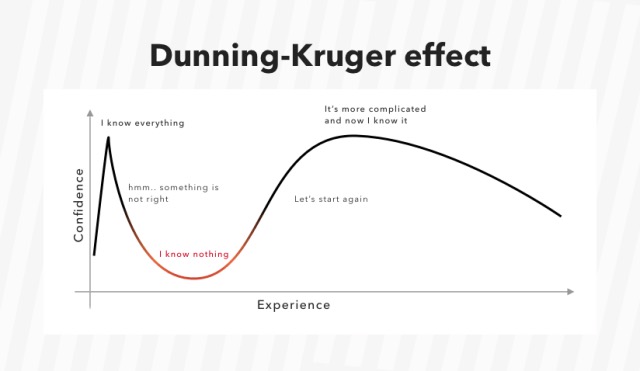
Interestingly enough, some researchers have uncovered an opposite effect to D-K, particularly for high performers: their tendency to underestimate their skills. This is often referred to as “imposter syndrome,” or, the feeling that “one is undeserving of success. People who have imposter syndrome are plagued by self-doubts and constantly feel like frauds who will be unmasked any second.” (Psychology Today, “Dunning-Kruger Effect.”) Don’t mistake this for humility. That would come from confidence. This is more a result of a lack of self-confidence. But, I digress…
So, perhaps there is some neutral ground in this discussion: where we rigorously question ourselves about what might be the limits of our knowledge in certain areas — where we might acknowledge what it is that we don’t know. And, on the other hand, where we are ready to confirm and be confident in the specific knowledge that we are offering to the world. And finally, to always embrace and practice Socratic ignorance as an honest way to acquire new wisdom in our lives.
I’ll leave you with a recent FB post from my cousin, Robin, that I alluded to earlier. She thinks deeply and honestly on many subjects. I feel it pretty much sums up what I’m talking about, and with obvious humility:
“If I don’t know something, I have no problem saying: ‘I don’t know.’ And if I don’t, I will READ to find out. Sometimes my whole day is filled with being side-tracked because I didn’t know something(especially things of an historic or medical nature) and had to stop what I was doing and do research.
Most of the time it’s very troubling, but there are times when I am pleasantly surprised.
We don’t know everything and we keep learning until the day we pass from this life to the next. And on that day, we’ll know everything.
Of this I am certain…
—————————————————————————————————–
Click below to listen to an audio recording of this essay
 Resonance