No matter how often I tell myself that chance happenings of this kind occur far more often than we suspect, once we all move, one after the other, along the same roads mapped out for us by our origins and our hopes, my rational mind is nonetheless unable to lay the ghosts of repetition that haunt me with ever greater frequency.
W.G. Sebald, The Rings of Saturn, pg. 187
Several months ago, I published an essay entitled: “Synchronicity: Serendipity, or Fate?” Some of you may have read it; it’s still available if you’d care to. During the intervening time since the original essay, some additional, seemingly synchronistic instances have come to my attention that I feel are worth sharing. In addition, I realized that I had neglected to include in my original discussion on synchronicity what is probably the best example of that phenomenon that I’ve ever experienced.
First, I’ll begin with America’s pastime—baseball. Branch Rickey, the influential general manager of the Brooklyn Dodgers in the 1940s (who signed Jackie Robinson), once famously said: “Baseball is a game of inches.” I’d suggest that in the case of a few examples I’ll cite, it is sometimes also a game of “coincidences.”
During the NLCS playoffs in October, the Atlanta Braves held a commanding three games to one lead after game four. All they had to do in game five was to continue playing the way they had up to that point, control the game, cement the win and move on to the World Series against the winner of the Yankees/Tampa Bay Rays series. But, as they say, between the idea and the reality falls the shadow.
Will Smith, Dodger catcher, came to bat in the sixth inning of a close game. The Braves pitcher? Just a guy by the name of Will Smith. Two men on base, two outs and the Braves were winning 2-1. It was a big moment in the game, and the series. The Dodgers were facing elimination this day if they lost. Well, there was no doubt who would be victorious in that historic encounter. * You could count on it. You could place money on it: Will Smith, of course.
* (This would be the first time that a pitcher and batter with the same name would face each other in the postseason.)
Will Smith (the Dodger) proceeded to hit a three-run homer off of Will Smith (the Brave). It was a fateful at bat and lead to a decisive playoff series win when the Dodgers went on to take game six the next day. They then, of course, moved on to meet the Rays in the World Series and beat them to become World Series champions for the first time since 1988.
I’ll stick with the game of baseball—and coincidences. I’d like to offer the somewhat strange case of the Canseco brothers and the very similar injury they both suffered within days of one another in 1989. Baseball fans of a certain age will remember Jose Canseco, who was the more famous of the Canseco twins. He was 1986 Rookie of the Year, the MVP in 1988, a six-time all star and a World Series champion twice. He was also a prolific power hitter with 462 lifetime homers that were mostly aided by performance-enhancing drugs. Along with Mark McGuire, another steroid user, they combined for a few years in Oakland to be the dynamic, home run-hitting duo known as the “Bash Brothers.”
Jose’s twin brother (older by two minutes) Ozzie, on the other hand never made it big, or really at all, in the major leagues. Though roughly the same size and build as his famous brother, Oz wasn’t able to come anywhere near matching Jose’s ability and output.
In March of 1989, at the Oakland A’s first spring intra squad game, Ozzie suffered a fracture of the hamate bone in his left hand. He never hit the ball that day, just the act of swinging lead to the injury. X-rays showed a clean break, indicating that surgery would be necessary.
Only a few days after Ozzie suffered the stress fracture, Jose injured the hamate bone in his left hand. Same hand, same injury, both brothers swung and missed, neither hitting the ball on their swings. A write up in the Los Angeles Times called it “an eerie coincidence.” While Ozzie had surgery immediately, Jose’s stress fracture was not diagnosed right away. Or, perhaps more correctly, it was misdiagnosed. Because after a bit of rest, he was sent down to the minors to try and rehab the injury by testing it under game conditions and just working through it.
For some reason, instead of Jose going down to play for the triple-A club in Tacoma, WA, team management decided to send him to the double-A team in Huntsville, AL. That’s the team that Ozzie was playing for at the time, and he happened to be coming back off the injured list and was reinstated just in time for the two brothers to play together for a couple of games.
During the second game, Jose cracked a sharp single and felt something snap in his left hand. With the resulting pain being quite intense and with only minimal movement in the hand, it was determined that surgery was the next step. The operation was performed in Huntsville by hand specialist, Dr. Bill Green. As it turned out, this was “the same surgical team that had performed the same operation on the same bone of the same hand of identical twin Ozzie, in the same hospital.”
Orthopedic experts will tell you that the hamate bone is typically broken when someone uses their hand to break a fall. Surgery is often called for since the hamate rarely heals on its own. The A’s team physician realized what a strange coincidence it was for the Canseco brothers to have suffered the same injury, and at roughly the same time. His comment: “It makes you hear music out of the ‘Twilight Zone.’”
Some people ventured the thought that perhaps there was a genetic weakness that both Cansecos were born with that caused the similar injuries. Barbara Crandall, professor of pediatrics and genetics at UCLA thought that “identical twins having identical injuries has more to do with their identical jobs than it does with genetics.” She felt that the cause was more “environmental—what they were exposed to. There are genetic diseases that affect bones, but they affect multiple bones. You don’t get this kind of thing. They both play baseball. That would seem to explain it.” Cue Rod Serling’s entrance…
One additional discussion of synchronicity and baseball. And, I’ll begin with: August 2nd, 1979. It was the day I heard the news that Thurman Munson, the talented and inspirational captain of the New York Yankees, had died. I remember where I was when I learned the horrible news the same way that I remember where I was when I first heard news reports on November 23, 1963, June 6, 1968 and September 11, 2001.
Munson was not only a great baseball player, but a great family man as well. He learned to pilot his own plane so that he could fly home to Canton, Ohio to be with his family on off days. On August 2nd, while practicing landings at the local airport, he came in a bit short, didn’t make it to the runway and crashed. He died at the scene. At the time of his death, the Yankee catcher was 32. By coincidence, I happened to be 32 at the time. The great American novelist Paul Auster was also 32. Auster had written about Thurman in his autobiography: “Munson was the first Yankee captain since Lou Gehrig. (My) grandmother had died of Lou Gehrig’s Disease, and (my) grandfather’s death would come quickly in the wake of Munson’s death.”
So, some slight, coincidental connections in regard to Thurman Munson. But, there is more. I’ll introduce Bobby Murcer into the story. He was the projected heir apparent to Mickey Mantle, and though a fine ballplayer, he never became the next Mantle. Murcer and Munson were Yankee rookies in 1969 and fast friends. They played together for seven years before Bobby was traded to San Francisco in 1976.
He spent three and a half years with the Giants before he was traded back to the Yankees on June 6, 1979, reuniting with his old buddy. Five weeks after that, Munson would be dead and Murcer was delivering a eulogy at his funeral. The team attended the funeral and then flew home from Canton, heartbroken. They were to play a nationally-televised game on ABC’s Monday Night Baseball. The game would end up becoming one of the most famous in Yankee history, and came to be known as the “Bobby Murcer Game”. The date was August 6, 1979.
The team was emotionally drained from their captain’s tragic death and attendance at the funeral. They had heavy hearts, but Munson’s wife Diane urged them to play, telling Bobby: “Thurman never quit when he was hurt; you can’t quit either.”
The Yankees trailed the Orioles 4-0 in the seventh inning, but Murcer hit a three-run homer—his first since re-joining the team two months earlier. In the ninth inning, still trailing 4-3, Bobby came to the plate with two runners on base. He lined a double into the left field corner and two runs scored to win the game. This turned out to be one of the most emotional games the Yankees had ever played.
What stands out to me is that after being away from the Yankees for over three years, Murcer not only came back in time to reunite with his good friend, but to eulogize him at the funeral, and then to literally take over and win a game singlehandedly that many saw as a tribute to their lost captain. It’s notable that in the first 30 games back with the Yankees, Murcer only had five RBI’s. In this game against Baltimore, he drove in five runs in three innings. Murcer’s wife, Kay, said later that Bobby “just felt that something happened and what came over him was sort of magical.”
After retiring from baseball in 1983, Murcer would go on to be a Yankee broadcaster for a quarter of a century. He died on July 12, 2008 of a brain tumor. They held a memorial service for him on August 6, 2008—the 25th anniversary of Bobby Murcer Day at the Stadium (after he had retired). And, the 29th anniversary of the “Bobby Murcer Game”. More than just a few coincidences in all of this.
I’d like to shift synchronistic gears at this point and relate some of the more meaningful coincidences I’ve experienced in my life that occurred over a great number of years. These particular “connected” events have to do with the great American aviator, Charles A. Lindbergh.
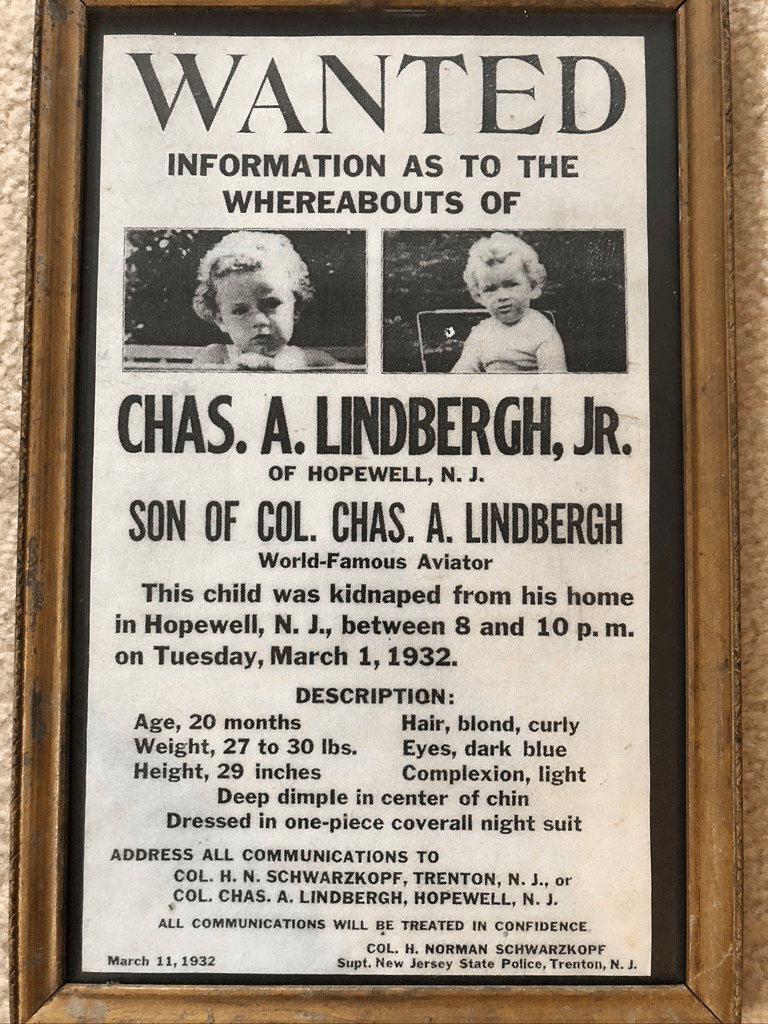
In 1971, Cathy and I purchased our first home in Califon, NJ. It was a “Craftsman” style home from the early turn of the century. At the end of the driveway, behind the house, was a spacious, two-story, 1,500 square foot barn with a big loft area. Not long after we had moved in, I made quite a find up in the second floor loft: an antique grain bin in pretty good shape. And, within the piece were stacks of local and national newspapers containing coverage of the 1935 Lindbergh kidnapping trial—which came to be known as the “Trial of the Century.” I poured through the papers over time; they were rich with specific details of the case, the trial and the participants, including the jury members. Eventually, I learned that a relative of a previous owner of our house had been a member of the jury—Marie Pill’s sister, Rosie.
After my original interest in examining what I’d found, I put the box of old newspapers away and pretty much forgot about them. We lived in Califon for seven years and then built a new home in Union Twp. The box of Lindbergh newspapers came out of storage and got moved along with everything else. When our next move was to Bridgewater in 1983, the now almost forgotten box of newspapers of course came along for the ride.
After 13 years in Bridgewater, we decided to move back to Hunterdon County, and this time we wanted a very old home, possibly something from the 1800’s. But, before we even started the process of searching for a home, Christmas 1996 was upon us. As was our tradition, we had been cutting down a Christmas tree each year since the second year of our marriage — and that Christmas was no exception.
We were looking for a new tree farm and found one in Hunterdon County, about ten minutes outside of Flemington. It was a drizzly, rainy day, but we managed to cut down a tree and strap it to the top of the car before heavier rain came. We were unfamiliar with the area, never having been in this part of the county previously. In the course of trying to find our way back home, we noticed Peacock’s General Store, which was located right around the corner from the tree farm.
Since we were a bit wet and chilly from our tree-cutting excursion, we decided to stop inside for some hot coffee. It was a charming and comfy spot and we chatted for awhile with the owner, Sarah Peacock. Cathy, a great map reader (way before Google Map and Waze) had noticed an area called “Wertsville”on her map. “Is this Wertsville?,” she asked. “Yes it is, Sarah laughed. “And, don’t blink or else you’ll miss it”.
After our coffee and a treat, we ended up driving around the general area for a while and then headed home. I do remember remarking to my wife what a neat place that store was and how it’d be cool to hang out in there, or sit on the front porch in better weather if we had lived closer. We drove home, set up our tree, decorated for the holidays and began getting ready for the family to visit. We pretty much forgot about the little store.
Once Christmas and New Year were behind us, we started looking forward to the spring and beginning our search for a new home in earnest. We had put our current home on the market in late February with a great and knowledgeable realtor, Helen Hoff, with whom we immediately established a wonderful rapport. She even assisted us in searching for a new place in Hunterdon County. We explained to Helen exactly the type of old house we were looking for. In order to make the process easier, she allowed Cathy to search through her realtor listings and make xerox copies of the homes she was interested in so that Cathy could then investigate various homes and areas to see if we wanted to explore any of them further.
One day in early March when I got home from work, Cathy said: “I found a really nice old house, and you’ll never guess where it was. Remember that quaint general store where we had coffee after cutting our Christmas tree? The house is right next door to Peacock’s. I rode out there, stopped by and even looked in the front windows—the place is vacant. It seems really neat. I’m going to tell Helen we want to go see what it’s like inside.”
Fast forward a bit. We saw the place, we loved it, we put in an offer, we purchased it. And, we became the proud owners of the shaker style farmhouse at 6 Lindbergh Rd. Yes, that Lindbergh. We came to learn eventually that the home where the Lindbergh baby was kidnapped was just three and a half miles farther up the road. I remember moving day in May of 1997. It was a pretty long day, actually going into the early evening. At one point, one of the young guys in the crew was carrying a box and stopped to ask me where it should go. It was marked “Lindbergh Newspapers.” He glanced at the wording on the box and said to me: “Lindbergh Newspapers, Lindbergh Road.” And I said: “Yes, it was the same Lindbergh.”
It turned out to be a warm, wonderful house and we spent 21 very happy years there. Not too long after we had moved in, I decided to transform the old barn behind the house into a “man cave”—back when that term was fairly new. I built a bar, ordered a new pool table and set about decorating the place. There were four walls in the 300 plus square foot space that needed some kind of enhancement. Two walls ended up featuring practically all of the New York sports teams paraphernalia that I had collected for years. One wall was devoted to bar and breweriana stuff and the last wall had photos, framed newspaper front pages and vintage pieces related to Charles Lindbergh. And, at the very top of that wall, I hung a small, engraved, bronze plate that read: “Lindbergh Game Room.”
About a month after I had begun decorating the man cave, we left for a planned, ten-day, 30th anniversary trip to Ireland. We embarked in the evening from New York and arrived the next morning in Shannon. When we deplaned and walked into the terminal, I immediately noticed a sign that designated the area as “The Lindbergh Room.” Evidently, after his successful flight to Paris in 1927, Lindbergh made a series of celebratory flights to various European cities. Shannon was one of those. It’s certainly possible that we were treading on exactly the same ground that the great aviator had passed through over seventy years before us. Just as we now lived in a house that Lindbergh probably passed by many years before.
The old house on Lindbergh Road was definitely a wonderful place to live. We enjoyed the community and eventually joined the East Amwell Twp. Historical Society. We had been asked to become a part of the group by its president, Jim D., who lived three and a half miles up the road—basically across from the driveway of the old Lindbergh home; After the baby was kidnapped, Anne Lindbergh refused to live there any longer, and turned the property over to the state of NJ to be used for children. It ultimately became a halfway house for young boys.
Getting back to Jim D. He stopped by our house one day as he was on his way up the road after leaving Peacock’s. He said he had always loved our old house, wondered what it was like inside and asked us if we’d agree to be part of the upcoming Christmas House Tour. We accepted his offer, it turned out to be a very successful event and we had great fun showing off our historic home (listed on the national, state and local historic registers). After the tour, Jim asked us to join the Historical Society, which we did. Soon, we learned that Jim not only was devoted to all things Lindbergh, but that he had written several books about the aviator and had given many Lindbergh presentations to local groups.
So, in looking back over my life, it has become apparent for some time that what I’ll call the “Lindbergh Factor’ has played a significant, ongoing role through the years. Why did I buy an old house where I discovered all those newspapers dealing with the famous kidnapping trial? Why did the previous owners move out and just leave them there —for me to eventually find them? Why did I continue to hold on to that box of old newspapers and make sure to take them with me as I moved three different times after leaving Califon? (I’ll answer that—because I’m a pack rat.) Why did we unknowingly drive past our house-to-be on Lindbergh Road for the first time in December of 1996—and end up moving into that house five months later? Why did we plan a trip to Ireland in 1999, where the first building we entered after deplaning in Shannon was the “Lindbergh Room”? Why did we meet and get to know a Lindbergh author and lecturer?
Perhaps, the following words from the eminent mythologist Joseph Campbell will explain some of the “mystery” behind it all:
When you reach an advanced age and look back over your lifetime,it can seem to have had a consistent order and plan, as though composed by some novelist. Events that when they occurred had seemed accidental and of little moment turn out to have been indispensable factors in the composition of a consistent plot. So, who composed that plot? Schopenhauer suggests that just as your dreams are composed by an aspect of yourself of which your consciousness is unaware, so, too, your whole life is composed by the will within you. And just as people whom you will have met apparently by mere chance became leading agents in the structuring of your life, so, too, will you have served unknowingly as an agent, giving meaning to the lives of others. The whole thing gears together like one big symphony, with everything unconsciously structuring everything else.
Campbell & Moyers, The Power of Myth, pgs. 283-4

 Resonance
Great reading Frank.
LikeLike
Thanks, Cuz!!
LikeLike