“Listen to a man’s words and look at the pupil of his eye. How can a man conceal his character?”
Mencius, 4th century BC
“The ends of things are always present in their beginnings. T.S. Eliot has of course noted that. But it seems to me that the ends are actually visible in the faces of the people with whom one begins something. There is always an early face that will be forgotten and will be seen again.”
Russell Hoban, The Turtle Diary, pgs. 550-51
“Yes, it is possible that we do not grow up, that even as we grow old, we remain the children we always were. We remember ourselves as we were then, and we feel ourselves to be the same. We made ourselves into what we are now then, and we remain what we were, in spite of the years. We do not change for ourselves. Time makes us grow old, but we do not change.”
Paul Auster, The Invention of Solitude, pg. 145
We all know instinctively that “judging” others for their actions, or who they are, can often be seen as unkind, unfair or even hypocritical. “Judge not, that ye be not judged.” Really, who among us is completely free of the sins of which we would sometimes accuse our fellow human beings? So, I suppose a good rule of thumb: beware of tossing stones if you reside in anything resembling a house of glass. It’s perhaps ill advised to be overly critical of others when you yourself could be criticized for doing similar things.
Certainly, it’s understandable why we shouldn’t be so blatantly judgmental. And, it goes without saying that we must refrain, as much as possible, from searching for negatives in the character of others. However, in our daily human contacts, many of us find ourselves constantly, and necessarily, making initial “judgements” about people to whom we are newly introduced. In fact, absolutely having to make some initial judgements. I think of it as a starting point in any new relationship — a preliminary assessment about the person with whom I’m dealing. And, though I’ve always spontaneously acted this way in first encounters, I have to admit that I’m probably operating at a mostly subconscious level. Though I suppose what I’m really looking for and trying to gauge in this possible new association are two things: values and intellect. And, I’m hoping to gain a sense of how much we may have in common.
So, after an initial evaluation, as the relationship develops, I tend to look for certain clues or tells that a person may give off unconsciously. As time goes by, I try to be aware of any obvious inconsistencies in behavior. I’ve always felt that if you watch people’s actions long enough, they will eventually demonstrate who they really are. They will unknowingly give themselves away. Perhaps pathological liars may be able to get away with selling themselves as something they are not; however, most human beings, over time, will reveal exactly what they stand for.
Some of you, dear readers, may see my beginning remarks as those of a person who is quite judgmental in his own right. I can understand that. Some of what I’ve laid out above could certainly be interpreted as being too harsh, insensitive or even prideful. In my defense, I sincerely don’t think that I’m superior to other folks. As my father used to say to me: “Frankie, you’re not better than anyone else, but nobody’s better than you.” I’ve tried to never forget that. However, in any potential new relationship, I find myself automatically going through the process I’ve outlined earlier.
Obviously, how we evaluate others has a lot to do with where we are personally coming from — what experiences, values and biases of ours come into play? As Anais Nin, the Cuban writer wrote: “We do not see things as they are, we see them as we are. Possibly, what we criticize in others — and, perhaps, even praise in others — says more about us than about them.
So, with that in mind, I think that there is another important element in evaluating the character and competence of another human being: corroboration. Essentially, how do others who you know and trust see this person that you are trying to get a handle on? And, are you able to obtain confirmation of your initial insights; or, do you find that perhaps you’ve been mistaken about your immediate opinion of someone. To use the Gipper’s phrase, employed in a different context: “Trust, but verify.”
I probably met Ted, a VP in a large pharmaceutical firm, about 15 years ago. His wife Sally was a friend of my wife from yoga class. The first time I was introduced to Ted, my initial thoughts were: he’s affable, outward going, seems fairly intelligent — but, he’s an asshole! I’m all for people having confidence in themselves, but some folks go way overboard; to the point of obnoxiousness. The type of guy I’m thinking of acts as if the world is centered solely on him. He likes to control conversations and tell stories about himself in which he always seems to end up as the hero. That was Ted, to a T.
So, right off the bat, I was turned off, big time, by his behavior. We didn’t actually see him and Sally that often in social situations, but when we did, I tried to hide my annoyance, not always successfully. Then, somewhere along the line, when I needed help on a major project on my home, Ted stepped up, offered his assistance and actually gave me some fairly good advice. Based on that experience, and a few other encounters where he seemed friendlier and acted less self-important, I thought to myself: “Maybe Ted’s not so bad after all. Possibly, I misjudged him.”
Not long after, we attended a Christmas party at Ted and Sally’s. At one point, Tom started handing out small token gifts to each of us. And, right by his side, fetching the presents from beneath the tree and handing them to Ted was his secretary, Karen. At the time, I felt it a bit odd that his secretary, rather than Sally, was assisting with this task, but I thought they were probably very used to working closely together at the office, so perhaps this was just a continuation of that. However, I still kind of took note and filed it away for another day.
Well, it didn’t take long. A few months after the Christmas party, Cathy came home from yoga class one day and told me Sally recently discovered that Ted had been cheating on her with —wait for it — Karen. It seems they’d been “working together” a lot more closely than anyone, including Sally, had realized. Needless to say, I guess my initial observations about Ted were correct. He ultimately revealed himself to be the asshole that he had first seemed to be. Major league.
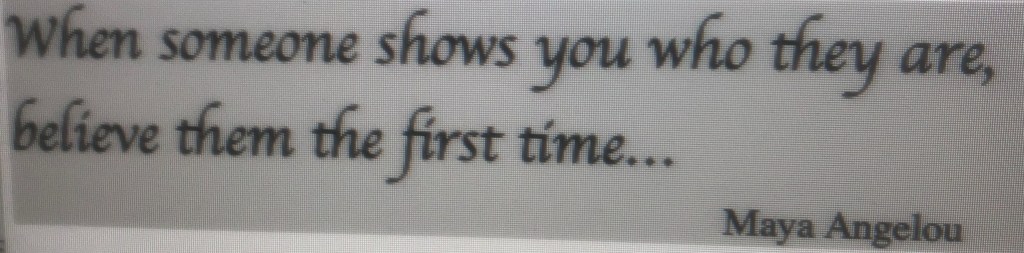
So, Ted wasn’t actually the guy his wife thought he was. But, he definitely turned out to be the guy I originally thought he was. And, as Maya Angelou has so insightfully phrased it: “When someone tells you who they are, believe them the first time.” Here’s another way of making that same point:
“But, there’s something else, some aspect of the person that is always seen early and will inevitably be seen again no matter how the seeing changes in between. The man who looks a rotter at first and then is seen to be charming will look the rotter again, that can be depended on. The scared person will look scared again, the lost one lost.”
Russell Hoban, The Turtle Diary, pgs. 50-51
When I began this blog in July of 2020, I assured potential readers that my essays would not be political in nature — as was my normal tendency, particularly on FB posts. Thus far, I think that I have been true to my word. However, the next example I’ll cite definitely wanders into the political. My intent here is not to proselytize or try to convince anyone to change their political, or philosophical, point of view. But, without the political context, what I’m describing will not be realistic, nor make sense.
So, after moving to a new home in Pennsylvania two years ago, I was (I thought) fortunate to meet up with three nearby neighbor guys in our townhouse community. Indeed, the beginnings of a decent “friendship” was struck up. They obviously knew each other before I arrived on the scene, so I was the new kid in town. We were all cigar smokers and eventually began sharing a smoke together three or four times a month. These three fellows, all younger than me (50, 60, 63) were fairly successful at their jobs. And, not that it was a big deal, but I was fairly certain that all three were much better off financially than I was. Again, no big deal, just an observation.
Though I probably didn’t reach anywhere near their level in the business world, I certainly had enjoyed a relatively successful career in my own right. And, having had considerable experience over the years dealing with large corporations, I had developed insights about business and people that I was able to distill down and share with my new cigar cohorts during our get-togethers. I suppose that I shared enough aphorisms and common sense that they playfully began to refer to me as the “senior advisor.” In addition to conversations about business, the other common topics were sports and family. Very rarely did we get into anything political, and when we did, it was only peripheral, just around the edges. There was a general understanding that I was of the liberal persuasion. And, it was obvious to me that three fourths of the cigar group was made up of three republicans, of varying degrees.
So, here I was at a potential, personal inflection point. Quite frankly, if truth be told, I really don’t have many friends who are republicans. I can actually count them on the fingers of one hand, and still have a few digits left over. And, the main reason that those few friendships are still intact is because politics is off the table. Not discussed at all. However, with the advent of the cigar group, I was conducting an interesting experiment in real time: could Frank actually co-exist on a continuing basis with known republicans? My initial thought, of course, would be that it was next to impossible to pull off. But, I was willing to let it play out.
I won’t give names or break down each guy individually. Suffice it to say that their beliefs tended towards everyone having to “pull themselves up by their bootstraps,” to “tax breaks for the 1% and big corporations will strengthen the economy,” to “it’s great to have a president who says what he thinks.” In my mind, that was bad enough. But, I mostly kept my powder dry. However, with the disastrous mishandling of the pandemic response (“it’s a Democrat-hoax, the flu is just as bad”), and all of the other misfeasance perpetrated by the commander-in-chief, I’d finally had enough. One day, I basically called out the group for their collective hypocrisy. During many of our conversations over the months, they’d often point to actions or decisions by someone in business that didn’t pass the “smell test.” How, I asked them, could any of the actions of their beloved president pass the proverbial smell test.
That just about did it. The experiment had come to an end. Over. Finished. I’ll admit that they turned out to be pretty much the people I first suspected them of being — which was not like me. All three were quite capable, business smart and had figured out a way to make money. Good for them. But, I’d been seeing over the time I had spent with them that they would never be the type to utter: “We’re all in this together.” So, are they bad guys? No, not really. Am I in any way, “better” than them? Nope. But, it turned out in the end that their values and mine didn’t align. They were who they were (and, most likely had always been), and eventually they were revealed for who they were.
When people reveal who they really are, it can often be quite upsetting, or at the very least, disappointing. Then, though, there is the other side of the coin. I’m talking about a person who at first blush seems almost too good to be true. Someone who immediately comes across as both honest and intelligent, with self-effacing confidence. And, that’s what I initially thought of the man who would eventually become my business partner.
It’s a very simple story, really, because Dominick Cirilli is as good a man as he seems; and, as good as they come. I joined Cummins, MacFail & Nutry, Inc. in March of 1992. CM&N was a mid-sized but fairly successful medical advertising agency. That’s where I met Dom. He was the VP of Advertising, as well as the Creative Director. I came in as an account executive. He and I worked on a number of projects and developed a strong working association. I could see at the very beginning of our relationship that he was not only an intelligent man, but his word meant something. And, of course, I soon found out that he loved his family as much as I loved mine. I think we both agreed early on that while we were willing to give 120% to the job and our clients, our families still always came first. Always.
In early 1994, after I had only been at CM&N for two years, we tragically lost the young man who was president of the agency, Gary. He came down with a case of bacterial meningitis and died within a few days. Dom and I met with Ralph, the owner of the agency, to discuss the future of our company and its leadership. Ralph was 65 at the time and definitely didn’t want to get back into the business on a day-to-day basis. Instead, he proposed two things:
• That Dom and I run the agency, with an option to purchase it;
• That I would become the new president, with Dom remaining a VP.
I was 15 years older than Dom, so a bit more seasoned in the business. And usually, the head of the agency tends to be a former account guy. So, Ralph’s proposal made sense. But, Dom had already been at CM&N for ten years at that point. Immediately, and instinctively, I responded to the proposal with: “That’s a great idea, as long as Dom is okay with it.” Some years later, Dom told me that was the best thing I could have said. I think it showed him right away that I respected him and that we’d be equals moving forward.
I’ve always believed that the emergency meeting with Ralph that day under stressful circumstances was the real start of my relationship with Dom. And, without going into a lot of detail, I’ll just say that as partners, we spent nearly a quarter of a century in business together. Through good times and bad; through many profitable years and a few very challenging ones, we had the best of working relationships. As time went on, I eventually began to do all of the copywriting myself, so that Dom and I spent even more of our day working closely. I can proudly say that during all of our years together, we never —never— had an argument. Or, even a cross word. That’s pretty much unheard of. I used to brag about this fact and joke that my wife and I typically had two arguments before I went to work each day. Certainly not true, but you get my point.
I’ve known guys who were friends, went into business together and ended up becoming enemies. But, in our case, we had mutual respect for each other, were unselfish and always thought of the other guy’s needs first. Sounds simple, but you have to work at it. So, to this day, there is no man I respect more than my business partner and friend. Did he turn out to be the person I thought he was back in 1992? Yes he did. And, while he certainly deserves most of the credit for being who he is, I’ll give myself some credit for recognizing who he is. And, always was.
I’ve always firmly believed that people are generally who they are; born predisposed to lean one way or the other. Certainly, while nurturing is a key element in a person’s growth, I come down more on the side of nature, since our genes determine so much of our identity. So, with that in mind, I tend to see that our identity, perhaps actually fixed at birth, is virtually the most important ingredient to what we are and will eventually become. I feel that this “identity” is what others can sometimes see in us when we come into contact with them.
There are those who might agree that we are simply who we are from the beginning, and that we will indeed reveal ourselves at some point. But, they might add, we may actually go through a series of iterations during the course of our lives — and eventually turn out to be someone different than who we had earlier seemed to be. So, in this view, it’s not that you don’t eventually reveal yourself to be who you really are, but that maybe it wasn’t so obvious to others who you were at first:
“If Ada had reached any sort of conclusion in this life, it was a little one. People,she used to think, do not change, they are merely revealed. This maxim she applied, with the flattest satisfaction, to turncoat politicians, and unfaithful spouses, and wild boys who turned right at the end.”
Anne Enright, The Gathering, pg. 252
In one of my earlier blogs, I discussed my relationship with “Joe Morrison,” who I had worked with in the ‘70s. Long story short, I never really liked him, not at all, from the first time I met him. While we were employed by the same company, he consistently treated me as more of an adversary than an ally. As some of you may recall if you read that earlier essay, I decided several months ago to google the real Joe. I found out that he had passed about a year and a half ago. His obituary contained nothing but praise for him and the “amazing full life” he had led. Indeed, how he had lived “every day of his life with a spirit, passion and enthusiasm that would not be denied. And all who crossed his path were the better for it.”
After reading that, I came away thinking that perhaps Joe had had a eureka moment later in life, an epiphany, that led him to turn his life around. Or, I thought, “maybe he was simply never the guy I judged him to be in the first place.” I’ll probably never know one way or the other. But, it’s certainly possible for every person to look at what they’ve done in their life, how they’ve lived that life and conducted themselves — and to make course corrections based on their own self-assessments. Because, in the final analysis, isn’t that the most important judgement we can ever make about anyone— the honest evaluation and harsh critical eye we focus on ourselves? In our own lives, each of us faces our own doubts, as well as our own demons. In this context, hopefully we will have the confidence and the imagination to admit who we really are:
“For although a man is judged by his actions, by what he has said and done, a man judges himself by what he is willing to do, by what he might have said, or might have done — a judgement that is necessarily hampered, not only by the scope and limits of his imagination, but by the ever-changing measure of his doubt and self-esteem.”
Eleanor Catton, The Luminaries, pg. 142
 Resonance
Well…..that gave me a lot to think about! I constantly need to remind myself of that famous passage from Matthew. As I age, I’m doing better, but I’m not there yet.
LikeLike
Catherine, thanks for reading my essay and for your comments. As I like to tell people: “I’m still a work in progress.” I’ll let you know when I get there!
LikeLike