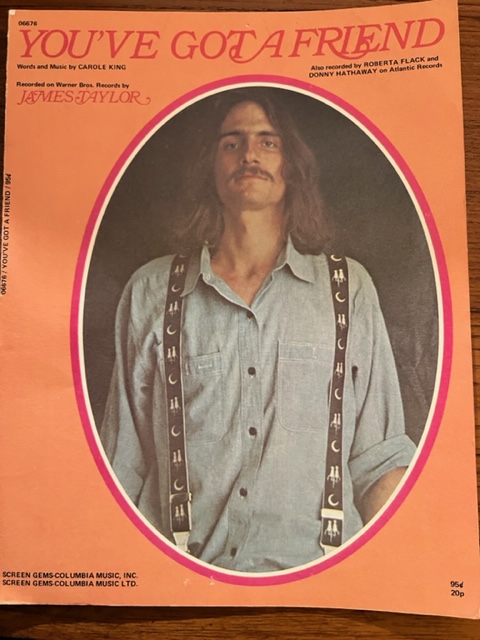
“A friend is someone who knows the song in your heart and can sing it back to you when you have forgotten the words.”
C.S. Lewis
“It is chance that makes us brothers, but hearts that make friends.”
Anonymous
“The only way to have a friend is to be one.”
Ralph Waldo Emerson, “Friendship,” Essays: First Series (1841)
“Your friend is the man who knows all about you, and still likes you.”
Elbert Hubbard, The Note Book (1927)
“My father always used to say that when you die, if you’ve got five real friends, you’ve had a great life.”
Lee Iacocca, Iacocca: An Autobiography (1984)
“The enemy of my enemy is my friend.”
Gabriel Manigault (1884)
“With such friends, one hardly needs enemies.”
Anonymous
“The friendship that can come to an end, never really began.”
Publius Syrus, Moral Sayings (1st century BC)
Interpersonal relationships are a key component in our healthy lives. From close and intimate to the more distant and challenging, “relationships help make up the social support network that is pivotal for both your physical and mental well being.” (Kendra Cherry, “6 Types of Relationships and Their Effect on Your Life,” verywell, 112/1/21) Indeed, quality friendships have a definite impact on our general happiness. A recent study found that strong friendships may actually be more indicative of overall health and happiness as we are getting older than even the involvement and support of family. Further:
“The benefits of friendship in general, however, are lifelong. Research has shown that people with good friends often feel happier, less stressed and more like they belong than those without. Having a strong network of buddies also increases self-confidence, plus they provide much-needed emotional support during trying times, like illness, loss of a loved one or divorce.”
Alia Hoyt and Molly Edmonds, “What is Friendship?”, How Stuff Works, 4/1/21
According to psychologist and friendship expert Suzanne Degges-White, there are essentially four core types of friendship: 1) acquaintance, 2) friend, 3) close friend and 4) best friend. And, “the level of friendship deepens as the level of reciprocity, mutual respect and affection grows.” Acquaintances, are typically the people you run into regularly at work, local sporting events or the coffee shop. While plain, old “standard-issue” friends are those that you actually try to run into or mix with. It’s these folks who you socialize with as part of your “crowd.” Then, there are those close friends that you know you can reach out to for help and support. There is a “strong level of trust between these friends,” as well as a “whole lot of unconditional regard and affinity.” (Hoyt & Edmonds)
At the top of the heap, of course are “best friends.” This is the “rarest type of friend that we all need to have in our lives.” It’s also the person who gets you and loves you no matter what. This kind of friendship will endure even if much time has passed without connecting and the vicissitudes of life have gotten in the way. They are the ones who are “soul friends” and with whom you can have heart-to-heart talks. Quite rare indeed. (Hoyt & Edmonds)
So, there is obviously a bit of a hierarchy to our friendships. Here is one way of describing it that was put forth by nineteenth centuryAmerican educator and college president William DeWitt Hyde:
“Friendship has as many planes as human life and human association. The men with whom we play
Willian DeWitt Hyde
golf and tennis, billiards and whist, are friends on
the lowest plane — that of common pleasures. Our professional and business associates are friends upon
a little higher plane — that of interests we share. The men who have the same social customs and intellectual tastes; the men with whom we read our favorite authors, and talk over our favorite topics, are friends upon still a higher plane — that of identity of aesthetic and
intellectual pursuits. The highest plane, the best friends,
are those with whom we consciously share the spiritual
purpose of our lives. This highest friendship is as precious
as it is rare. With such friends we drop at once into a matter-of-course intimacy and communion. Nothing is
held back, nothing is concealed; our aims are expressed
with the assurance of sympathy; even our shortcomings
are confessed with the certainty that they will be forgiven.
Such friendships last as long as the virtue which is its common bond.”
No matter the level of friendship, it seems to me that certain factors come into play:
• We need to understand that no friend is going to be “perfect.” Or, as the old proverb goes: “Who seeks a friend without a fault remains without one.”
• It’s important to be “intentional” in order to maintain a good friendship (Rosemary Blieszner, distinguished professor of human development & family science, Virginia Tech). It doesn’t just happen; you have to work at it. Or, as Samuel Johnson famously wrote: “A man must keep his friendships in constant repair.” Also, as the research sociologist Rebecca Adams concluded:
“Friends could very easily drift apart….Most people don’t end friendships. They just gradually stop seeing each other.”
• “In the hierarchy of relationships, friends are at the bottom. Romantic partners, parents, children — all these come first.” It has been said that friendships are susceptible to circumstances. With all the things that a person has to do in his or her life — job, kids, parents, etc — we often put our friends off at times, because we can. It’s also quite interesting that “the largest drop-off in friends in the life course occurs when people get married.” (William Rawlins, Stocker Professor of Interpersonal Communications, Ohio University)
• Successful friendships should be able to survive not being in contact for a period of time, as well as staying intact when friends reside in a different part of the country — or world. English poet Robert Southey, phrased it thusly: “No distance of place or lapse of time can lessen the friendship of those who are thoroughly persuaded of each other’s worth.”
• “Friendship requires reciprocity.” (Hoyt & Edmonds) A positive and rewarding friendship should be mutually beneficial to both parties. What we do for our friends: “Our friendship is really helpful to others, not when it makes things easy for them, gratifying their desires and yielding to their humours, but when it develops the best that is in them;…and spurs them to the acquirement of the strength which overcomes.” (Hamilton Wright Mabie) And, what our friends do for us: “The wise man seeks a friend in whom are those qualities which he himself may lack; for thus being united is their friendship the more completely defended against adversity.” (Jeremy Taylor)
• “People’s closest friends are their oldest friends.” (Blieszner)
• Social circles were shrinking even before COVID arrived on the scene: “For years, friendship in America has been in decline, a trend accelerated during the pandemic. Three decades ago, 3 percent of Americans told Gallup pollsters they had no close friends; in 2021, and online poll put it at 12 percent. About a year into the pandemic, 13 percent of women and 8 percent of men age 30 to 49 said they’d lost touch with most of their friends.” (Pearson)
Sometimes, a relationship turns sour. Perhaps it was never really as good as it seemed. But, at a certain point, a realization can set in that maybe this particular friendship is no longer worth fighting for. Or, as Degges-White has written: “When you feel like a relationship is holding you back or dragging you under, it is definitely okay to let that friendship go….The beautiful thing about friendships is that they are voluntary relationships — and if you’re no longer finding it worth the investment, you have the option to let the relationship go.” (Hoyt & Edmonds, from Degges-White)
I think most of us can relate to a situation where a seemingly good friendship has gone bad. Once again, this insight from Degges-White regarding common signs that a so-called friendship has deteriorated beyond saving:
• “You realize that hanging out with a particular friend leaves you feeling worse, not better.
• You begin to try and find reasons to avoid spending time with a friend or wanting to cancel plans once they’ve been made.
• Your friend only seems to ‘like you’ or want to spend time with you when he/she needs something from you.
• You find yourself trying to make excuses for your friend’s behavior or ‘defend’ your friend from other friends who are more able to see his/her shortcomings or poor treatment of you.
• While friendships are based on social exchange, ‘red flag’ friends typically draw more resources from the ‘friendship bank’ than they ever put in.”
I have definitely experienced the toxic end of an apparently good friendship myself. It involved a relative of mine — so, safe to say, this was someone I knew all of my life. About 30 years ago, we began to see each other more regularly. Though living in different states, we managed to keep up on a fairly regular basis. We visited each other once or twice a year and took several vacations together. I’ll come clean up front: the friendship was always a bit lopsided in one direction in terms of a truly reciprocal relationship. I really didn’t mind it all for a long time (I mean years, really). If I do say so, I’m a good listener, a damned good listener, an unselfish listener.
And seriously, I never thought, through the years, that the onesidedness was a problem. I sincerely felt as if I was helping and not only taking in my friend’s concerns and troubles, but giving back good advice when it was sought. And I was willing to continue doing that — out of love and family feeling. But, on several occasions, my “friend” employed such out-of-control invective, that was not only profoundly insulting, but an exchange that left me feeling physically ill. As I explained to this relative — or, tried to explain over the fusillade of non-stop nastiness — no one, NO ONE, had ever spoken to me that way. And, I would not accept it or allow it. Essentially, from that moment on, the friendship was over. Dead. Kaput.
As was stated previously in this piece, real friendships must be reciprocal, yielding something positive for both parties. Though I wasn’t so concerned about the lack of reciprocity in the friendship with my relative, ultimately the astonishing lack of respect made continuing the relationship untenable, unsustainable.
Of course, the pandemic has strongly affected all of our friendships. Obviously, it no longer allowed for much of the normal socialization with friends that we’ve come to take for granted. But, according to free-lance culture and lifestyle journalist Hannah Hickock, she noticed an immediate silver lining:
“I was having a lot more contact with my inner circle (mostly long-distance)…A year and a half later, the trend has continued. I talk more frequently with fewer people and have let weaker relationships fall away rather than working overtime to sustain them.”
Hannah Hickock, “The Upside of Losing Touch during the Pandemic,” Glamour, 10/7/21
She goes on:
“There’s no doubt that the pandemic has altered our social lives, changing the ways and frequency with which we connect. For many that has manifested as loneliness, isolation and anxiety; but for some it has offered a rare opportunity to review and reset our existing friendships. Much as COVID has accelerated changes to our work culture, it may have illuminated relationships we’ve outgrown, expediting natural shifts in our social circles.”
Hickock
Even with a potentially COVID-free future, Hickock suggests that we should continue to “carefully curate our social circles, backburnering less-fulfilling friendships without guilt and reserving our precious energy for those who help refill it.”
So, all of this may raise a question of exactly how many friends we really need. Fortunately, that topic has already been considered by Catherine Pearson, an experienced health reporter for the New York Times. She too notes the effect that the pandemic has had on friendship. But, she suggests that the effect may depend on one’s personality type. You might be more of an extrovert who needs lots of people in your life; or, perhaps you’re more of an introvert who is happy with just a few good friends.
Pearson goes on to consider the number of friendships that might be deemed appropriate for the average person. She first begins by introducing a theory put forth by British psychologist and anthropologist Robin Dunbar:
“What has come to be known as Dunbar’s Number contends that humans are only cognitively able to maintain about 150 connections at once(subsequent research has put the number higher). That includes an inner circle of about five close friends, followed by larger concentric circles of more casual types of friends.”
Pearson
Numerous experts and mental health professionals have offered different estimates of how many close friends are necessary to promote a positive attitude and healthy life. It would seem that you and I need in the range of three to six to accomplish that goal.
The process of considering friendship as a topic has led me to review the many friendships in my own life. And, like most of you, they run the gamut of each conceivable form of friendship out there. Starting with the first level of friendship — acquaintances — I’m sure there have been many, many individuals who have fallen into this category for each of us over the years. And though quite a few of these people were a part of our lives for a period of time, we might be hard pressed to come up with their names at this point, or their faces, if we even remember them at all.
“There’s an old saying that there are:
“three types of friends — friends for a reason (you lived next door to each other growing up), friends for a season(high school, college, new parenthood) and friends for a lifetime. Sometimes, the season of life passes and friends fall out of touch due to no particular problem.”
Hoyt & Edmonds
I tend to think that those first two categories — friends for a “reason” or a “season,” more or less come under the heading of “situational” relationships. Over the course of a lifetime, people come into our lives, stay for awhile and then exit from our lives. Think about who those people were for you. Was it someone you met in college, shared some of the same classes and hung out with for awhile? Maybe, a co-worker at your company who you used to each lunch with occasionally? Perhaps one of the other coaches in the Little League program who you ran into most Saturdays and who you seemed to be developing a casual friendship with? Or possibly, another young mother-to-be in lamaze classes at the local hospital? This particular category of friendship most likely consists of some folks who, if events were different, might have developed into more than just acquaintances.
As I refer in this essay to different friends of mine, I won’t use their actual names. I will not even use both initials. I’ll simply use the initial of their first name. This should give me some plausible deniability down the road. Lots of times, when authors are writing about actual persons, they will “change the names to protect the innocent.” I’ve also heard that perhaps they actually change the names to protect the guilty! However, the reason that I want to hide the actual identity of my various friends is this: In my own mind, I may have classified a person as simply a regular, standard-issue friend of mine; but what if they really believe that we are close friends. You can see how that might be rather awkward. So, I wouldn’t want there to be any hurt feelings or unfriendliness, particularly when the discussion is about the benefits of friendship.
Now, getting back to acquaintances. Over the years I’ve had good, solid, what I’d call “situational friendships” with a bunch of nice folks: J, the legal compliance guy who reviewed all of the advertising and promotional materials we did for his company. Or, L, the tech-savvy print salesman for one of my major vendors. Or B, the friendly and engaging banker for my business with whom I always enjoyed talking sports. Or, T, a product manager from one of my earliest jobs. Great sense of humor and a very intelligent man who always had something witty to say. Or, L, a marketing VP who I worked for at various companies over a number of years. We always got along, and she was responsible for awarding a lot of business to my agency. I always thought that we’d become better friends and remain in contact, but that, for some reason, has not happened.
There were also acquaintances of mine who have gone on to become friends. People who I really liked, who I shared interests with and who I enjoyed getting together with from time to time. They eventually became part of my general “crowd.” Within this group there is A, my long-time auto mechanic, who I met about 30 years ago. A fine automotive technician and an honest man who always told me what car repairs I really needed. In addition, we had great conversations about politics and other topics while I waited as my car was being worked on. We developed a real friendship. Also, J, a terrific copywriter who did some work for me over the years. Like A, we have seen J and his wife socially on a number of occasions. To this group, I’d add J and J, a couple we met from one of the local groups in the town where we formerly lived. And, there is P, a smart, cheerful neighbor in our community where we moved 3 ½ years ago. Met her while we were out for a morning walk and she was walking her dog. We liked her right away, and always stop to chat for awhile when we run into her. We’ve been out to dinner with her several times recently.
If we all sit back and consider the friends that we have in our lives, I think we’d be surprised at how many people are on that list. These would be folks who are more than just acquaintances and with whom you may have socialized at times. They can be people in your neighborhood, or church or other group. For most of us, that could be a difficult grouping of people to pin down, with individuals coming from all parts of our lives. So, I won’t even try to enumerate such a list for myself.
I’d like to move on to close friends. I’ll go back to a quote I shared earlier from Professor Blieszner, who opined that your closest friends were your oldest friends. Again, these are the ones who you know you can reach out to for help and support. These particular friendships exhibit “a strong level of trust,” as well as “a whole lot of unconditional regard and affinity.” (Hoyt and Edmonds)
In my own life, There are a finite number of those associations. And, let me state right now, that these friendships are not simply my connection with one other human being, but the relationship that both my wife and I have with other couples. With few exceptions, I’d have to say that for the most part, the close friendships that exist in my life are close couple friendships. (And here’s another point I’d like to make. When it comes to close couple friendships —or indeed, any couple friendships — the key here is how the women get along. If they do, then the men will figure out how to make it work — and, over time will probably develop a strong friendship. But, if the women don’t pretty much see eye to eye from the get-go, then forget about it. Right, fugeddaboutit.)
As far as our close couple friends, for instance there’s D and W. She was a college sorority buddy of Cathy’s from 53 years ago. He is her second husband who we’ve known and loved for a quarter of a century. Or, R and D. R was a neighbor we met in 1971. We’ve known his second wife, D, for about 35 years now. We have a great time with lots of laughs when we get together. Then there’s M and B. We’ve been friends since the late ‘70s, when our oldest boys were in nursery school together. Through ups and downs, highs and lows, we’ve been there for each other. And, of course, B and R, who we got to know in 1983, when our young sons were elementary school classmates. Our friendship has lasted, and thrived, all these years; and the thing that brought us together — the friendship of our sons —not only still exists, but the boys have continued to be best friends. Certainly, it’s been true for us that our oldest friends are our closest friends. Those alluded to here average 40-some years of friendship!
As discussed earlier, the pandemic did play some havoc with friendships. It seems as if one of our close couple friendships has at the very least been put on hold for awhile. We met this couple, C and J, after we joined a local community group. We’ve only known them for about ten years, but Cathy and I both felt that they were quickly in the close friend category. It’s not always an easy thing to make friends as you are getting older (we were in our 60s and they were in their 50s when we first met.) And, to become close friends at an advanced age is probably not the usual scenario. But, from the start with C and J, everything seemed to click. We shared similar views and enjoyed each other’s company. It was an easy, natural and enjoyable relationship. It was hard to believe that we had only known them for just a short time. I do believe when the pandemic is truly no longer a factor that we will resume that special friendship.
Of course, I’d be remiss if I didn’t mention our great friendship with D and E, that’s Dolores and Ed, my sister and brother-in-law. Not only are they close friends, but they’re family. These two are the most supportive and selfless people that I know. Over the years, when we’ve had good news to share about ourselves, our kids or our situation, the first people we want to call are D and E.
Having said this, I just want to state that we are blessed to actually have many, many close friendships within our family. I’m talking about siblings, cousins, etc. — on both sides of the family. It’s no exaggeration to say that whenever we get together —whether our annual beach retreat with Cathy’s siblings and cousins, or our Fasano family reunions over the years — there is always a feeling of friendship in the air. It is comfortable and comforting. And, everyone gets along. I think it works for us because we all simply want the best for our family members. These are proven, trusting relationships, developed and maintained for years. There is no jealousy, no pettiness, no selfishness. Sounds easy, but not every family can do that. We are quite fortunate and we all know it.
Before I move on to the best friend category, I’d like to address special relationships that may not fit into the typical categories I’ve outlined previously. I met Arlin in 2003 at a week-long work camp in the southwestern part of West Virginia. Organized through our former church, a group of about 25 of us, younger and older, descended upon local communities to offer help with repairs on roofs, siding, trailer underpinning, ramp-building, etc. On the first day, I was randomly assigned to work on Arlin’s crew.
Since the rest of the team were young high school kids, by seniority I rode up front in Arlin’s truck when we headed out to our work location each day. Before too many days, I got to be known as “Shotgun.” The two of us older guys — me in my late fifties and he in his early 60’s — hit it off immediately. We quickly found that we shared similar beliefs and values. We both were guitar players and we even got each other’s jokes. By the time we all left camp for home, my new-found buddy told me: “Frank, I feel closer to you in one week than I do with my older brother.” I continued to go to West Virginia for the next five summers, and was fortunate enough to see my new buddy each time. Though Arlin and I haven’t seen each other since 2007, we keep in touch via our writings — I have several books of his excellent, evocative poetry and he has read my blog essays and book.
I first met Dom, my eventual business partner, in 1992, when I started a new job at CM&N Advertising. He was VP of Advertising as well as the Creative Director. I came in as an account executive. He and I worked on a number of projects and developed a strong working association. I could see at the very beginning of our relationship that he was not only an intelligent man, but that his word meant something. And, of course, I soon found out that he loved his family as much as I loved mine. I think we both agreed early on that while we were willing to give 120% to the job and our clients, our families still always came first. Always.
In early 1994, after I had only been at CM&N for two years, we tragically lost the young man who was president of the agency; he came down with a case of bacterial meningitis and died within a few days. Dom and I were given an opportunity by the owner to buy the agency. The rest is history. We ended up being partners for the next quarter of a century. Through good times and bad, through many profitable years and a few challenging ones, we had the best of working relationships. I can proudly say that during all of our years together, we never — never — had an argument. Or, even a cross word. That’s pretty much unheard of. I used to brag about this fact, and joke that my wife and I typically had two arguments before I went to work each day. Certainly not true, but you get my point.
I’ve known guys who were friends, went into business together and ended up becoming enemies. But, in our case, we had mutual respect for each other, were unselfish and always thought of the other guy’s needs first. Doesn’t sound so difficult, but you have to work at it. To this day, there is no man I respect more than my former business partner and friend. So, while we’ve only occasionally spent time together socially, we worked together closely, effectively and harmoniously for 25 years. I consider him a very close friend, indeed.
There’s another special group of friends I’d like to mention. And, they are our good old high school buddies. You know who you are. We knew each other in high school and though some of us weren’t necessarily close friends then, it was apparent that we all liked and respected each other back in the day. As you get older, you sometimes find yourself reconnecting with friends from your youth. That’s what Cathy and I have been fortunate enough to do in recent years. And, you know what you find out? That your initial impressions of those long ago friends were pretty much on target. You thought they were in the “good people” category and that’s who they turned out to be all these years later. So, while this group of special people may not have all of the typical characteristics of close friends, they sure are a damned fine group of human beings. And, their friendship is valued and appreciated.
To close out the discussion of close friends, I’d like to share a poem by Edgar Guest, a British-born American poet who was popular in the first half of the 20th century. My cousin John recently made me aware of this very meaningful and relevant poem:
A Friend’s Greeting
I’d like to be the sort of friend you’ve always been to me;
I’d like to be the help you’ve been always glad to be;
I’d like to mean as much to you each minute of the day
As you have meant to me, old friend of mine to me along the way.
I’d like to do the big things and the splendid things for you,
To brush the gray out of your skies and leave them only blue;
I’d like to say the kindly things that I so oft have heard,
And feel that I could rouse your soul the way that mine you’ve stirred.
I’d like to give back the joy that you have given me,
Yet that were wishing you a need I hope will never be;
I’d like to make you feel as rich as I, who travel on
Undaunted in the darkest hours with you to lean upon.
I’m wishing at this Christmas time that I could but repay a portion of the gladness that you’ve strewn along the way;
And could I have one wish this year, this only it would be:
I’d like to be the sort of friend that you have been to me.
At the top of the friendship totem pole is the best friend. Though Cathy and I have a number of close friends, I feel that we both consider each other as our best friend. When I think of the five close friend couples that I cited earlier, I would daresay that if you questioned them, they would all confirm that their spouse is their best friend. I’d put money on that.
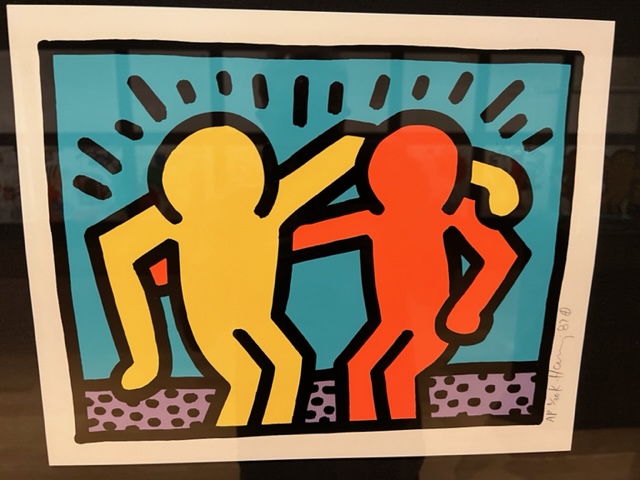
Keith Haring, one of the best-known contemporary artists in the world, created his final print series,
“Best Buddies,” in 1990, just ten days before dying from AIDS-related complications.
A long-running study in Britain (British Household Panel Study) of 30,000 people asked participants to quantify their “life satisfaction.” Generally speaking, married people expressed higher satisfaction. And, an entirely separate part of the study asked participants to name their best friend. Those who listed their spouse were twice as likely to have higher life satisfaction. Slightly more men than women made that choice, which makes sense, since men tend to have fewer friends than women. (Bruce Feller, “Should Your Spouse Be Your Best Friend?”, NYT, 10/12/17)
So, if being married seems to help couples to generally lead a happier, more satisfied life, then perhaps in most cases — particularly with successful marriages — doesn’t it seem logical that your spouse might also be your best friend? I think that if we go back to the best friend definition that I shared earlier in this piece, it seems apparent: “…that rarest type of friend that we all need to have in our lives.” It’s also the person who gets you and loves you unconditionally, no matter what. They are the ones who are “soul friends” and with whom you can have heart-to-heart talks.
There are certainly differences of opinion on the subject. For instance, Dr. Amir Levine, a psychiatrist and neuroscientist at Columbia University, disagrees to some extent. He feels that in a successful marriage, instead of using “friendship” to describe the relationship, perhaps they’re describing something else. Per Levine:
“The term ‘friendship’ is an underwhelming representation of what’s going on. What people basically mean is, ‘I’m in a secure relationship. Being close to my partner is very rewarding. I trust them. They’re there for me in such a profound way that it allows me to have courage to create, to explore, to imagine.’”
Of course, not every spouse provides all of this, so according to Levine, for those who do, he might refer to them as a “secure spouse,” rather than best friend.
Two other critics of the spouse-as-best-friend idea are Peter Pearson and Ellyn Bader, founders of Couples Institute in Menlo Park, CA. Both are psychologists and have been married to each other for more than 30 years. Dr. Bader feels that the often expressed notion that you shouldn’t get married with the intent of changing your partner is incorrect. She thinks that’s actually what marriage is about: “It’s where some of the juices come from, and it’s also how you get the best out of the person you marry.” She adds: “A good marriage is when people push each other, challenge each other, encourage each other and yes, change each other.” When asked if they themselves were best friends, Dr. Pearson said they were good friends. And Dr. Bader said they were really good friends. Dr. Bader continued: “He’s lots of things that my best friend isn’t, but my best friend is lots of things he’s not.” (Bruce Feller, “Should Your Spouse Be Your Best Friend?”, NYT, 10/12/17)
I really disagree with Bader and Person on this. Evidently, they’ve run a successful marriage counseling services business for 40 years. I’ll give them that. And, they’ve probably provided some good guidance over the years for marriages that have hit a rough patch. However, I think their belief that one cannot simultaneously be a spouse and a best friend is incorrect; I don’t feel they are mutually exclusive. Perhaps every marriage is not perfect. Actually, probably most aren’t. And, maybe many couples don’t necessarily feel that their spouse is also their best friend. It doesn’t mean that the marriage is not successful. But, as the marriage continues and evolves, it would seem to me that a best friendship with your mate is to be sought after and worked toward.
Bruce Feller, the author of the article I’ve been citing, ends his piece with this question: “If your spouse is your best friend, then whom do you complain to about your spouse?” My answer to that would be that if you’re both honest, then you have to “complain” to each other. That’s how you work things out. And, to go back to Dr. Bader, if you want to get the best out of the person you marry, then you need to “push each other, challenge each other, encourage each other and yes, change each other.”
So, that’s my take on friendship. Hopefully, you’ll agree with some of my statements. But, more than that, I hope that this discussion will cause you to look more closely at your own friendships. And, to appreciate them for the gifts that they are. And, perhaps if you’ve unintentionally “neglected” some of your good friends, then maybe this will spur you on to re-connect. Meanwhile, I’ll leave you with these opening lines from a classic song by Andrew Gold in 1978:
“Thank you for being a friend,
Traveled down a road and back again.
Your heart is true,
You’re a friend and a confidant.”
————————————————————————————————————-
 Resonance
“The friendship that can come to an end, never really began.”
I so agree with this!
That was a very well-written post about friendship. Thank you for sharing your thoughts as well as some research behind it!
LikeLike