Listen to a recording of this essay
“One ever feels his twoness — an American, a Negro; two souls, two thoughts, two unreconciled strivings, two warring ideals in one dark body, whose strength alone keeps it from being torn asunder.”
(W. E. B. DuBois, The Souls of Black Folk)
“When I discover who I am, I will be free.”
(Ralph Ellison, Invisible Man)
“The problem of the twentieth century is the problem of the color line.”
(W.E.B. DuBois, The Souls of the Black Folk)
“Early in the morning of Parents’ Weekend, (1969)11 fire alarms rang out across Cornell campus. At 3 am, a burning cross was discovered outside Wari House, a cooperative for black women students. The following morning, members of the Afro-American Society (AAS) occupied Willard Straight Hall to protest Cornell’s perceived racism, its judicial system and its slow progress in establishing a black studies program.”
(Cornell Chronicle, “A Campus Takeover that Symbolized an Era of Change.” April 16, 2009)
“If there is an injustice, we have to right it. When there is justice, then we need to promulgate it. … We have to understand the impact of the impact so we can be true and contributive citizens. There needs to be movement of knowledge. That’s what I’ve done.”
(Homer Lee Meade II, PhD)
“I am an invisible man. No, I am not a spook like those who haunted Edgar Allen Poe; nor am I one of your Hollywood movie ectoplasms. I am a man of substance, of flesh and bone, fiber and liquids, and I might even be said to possess a mind. I am invisible, simply because people refuse to see me.”
(Ralph Ellison, Invisible Man)
It was the early sixties. The Civil Rights Act had been passed in 1963, followed by the Voting Rights Act a year later. Both were positive steps in furthering the cause of freedom and opportunity for blacks, but nobody was kidding themselves that these two congressional acts would quickly put an end to the racism that existed in our country. It was, at best, a dicey and unpredictable time period in the U.S. as far as race relations were concerned; not to mention the beginning of an unpopular war in southeast Asia.
That was when I became friends with a young black man, a guy already quite impressive at a tender age. You could tell — I think I knew it instinctively — that here was a person with talent and ability who would certainly amount to something in the future. Even at the age of 14 or 15, Homer Lee (Skip) Meade II seemed to have the ability to connect with each and every one of us. And, from the early days on, through the rest of his life, he was able to touch the lives of so many people in positive ways. Despite what was going on politically and socially at the time, it never seemed to be an issue as far as our friendship. I’m not saying that I was totally color blind, but it honestly never occurred to me that there was any reason Homer and I couldn’t be, or shouldn’t be, friends.
Actually, everyone wanted to have him for a friend. And, it was easy to be his friend, because he made it easy. For yet another reason too; I don’t mean this in a critical or judgmental way at all. Homer was so traditional, so carefree, so relatable that half the time he almost seemed white. And, as I look back at those days and our high school years, I can recall many instances of Homer acting in a way that allowed him to “fit in.” Not only with his school mates, but also with their parents and other adults in the community. He was well known because, among other things, he was president of our class, a starting halfback on the very successful Madison High football team, as well as one of the “popular” kids in town. We had even put together a folk-singing group with another classmate, John Piana, and performed at parties and high school functions. It was at the time of hootenannies and famous folk groups like The Kingston Trio, The Brothers Four, Peter, Paul & Mary, etc.
Knowing that Homer later went on to become an impactful advocate for civil rights, I have often wondered where he stood as far as his objectives in those high school years. Had he not yet arrived at the strong beliefs that later propelled him into action in the fight for human rights? Were there strong feelings about what needed to be done that were beginning to stir just beneath the surface, waiting for the right moment to be made public and then acted upon? Or had Homer simply not reached that point just yet because until then he had enjoyed a very comfortable, stable life in the friendly confines of Madison, NJ.
In my own mind, I feel that he had not yet evolved to become the person he would someday be. And then, something happened senior year that I believe led to a change of heart and a change in Homer’s mind about his status and how those in the community viewed him. That was when he started to date a white girl — who also happened to be a minister’s daughter. It is reminiscent of “Guess Who’s Coming to Dinner?”
I can’t really tell you much about their relationship as a couple, but it became obvious how Homer’s relationship with the good folks of Madison began to change a bit. Many of those who had been happy to know this smart, charming, intelligent young man now had reservations about him. And, I suspect, he had some doubts about them as well. At that point, perhaps Homer began to have some misgivings, and maybe question his always reliable eagerness previously to please classmates, friends and those in the community.
Did he find himself thinking what the invisible man in Ralph Ellison’s novel expressed? “What and how much had I lost by trying to do only what was expected of me instead of what I myself had wished to do?” And, by now doing what he wished to do — and dating a white girl — he received a good deal of blowback from those who had previously found his actions, his conduct, his life more than appropriate.
Homer went off to college in the fall of 1965, as did I. Initially, it appeared that he would be going to West Point. He had secured an appointment via a New Jersey congressman, but he did not pass the physical due to a lingering and perhaps chronic knee injury from football. In light of later events and his growing political and social inclinations, one wonders how that would have gone.
So, he never went to the Military Academy but instead attended Cornell University. I ran into him in town during the summer of ’66, after we each had completed our first year of college. We chatted for a while. He sounded different, even looked different. He had always been smart and focused, but there was a seriousness about him that I hadn’t seen before. He had been spending the summer working with young blacks in Newark. He passionately described what he was doing, and its importance. He strongly suggested that I come to Newark and work with him. He was issuing a challenge to me to show him if I truly believed in the cause he was working toward — and, if we really shared the same values. I assured him that I honestly supported his work, but that I needed to have a summer job to help pay my college tuition. Though he knew I didn’t have the luxury to join him that summer, I think that he was still disappointed in me. That’s how fierce he was becoming about advancing the prospects of all black people, particularly those vulnerable and most in need.
I’m thinking back to the message I had written in Homer’s yearbook when we graduated. I wish that I could provide the exact wording, but I will share the basic message:
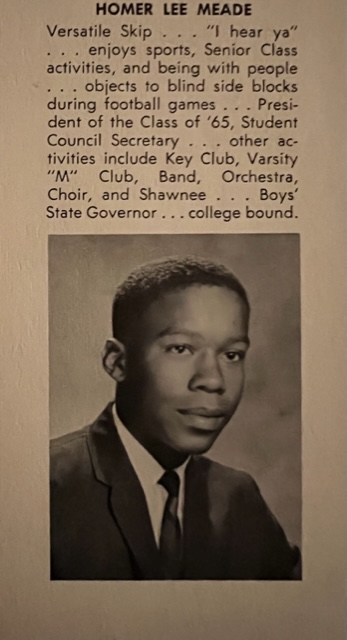
“Homer, I am your friend, I support you and I only want what’s best for you — but I hope that the choices you’ve made don’t cause trouble for you. I’m not telling you what to do, but only asking you to be careful.” *
*(A footnote: In 1985, at our 20th Madison High School Reunion, Homer was the master of ceremonies. He began with some pleasantries and then he said that he’d like to read something to us. As he got into the text, the words seemed familiar to me; and then I realized that they were my words and they were from the yearbook message I had written to him 20 years earlier. He didn’t tell those in attendance that it was from me, but simply from a classmate. Without saying it aloud or directly to me, I realized that Skip understood what I had attempted to express years before and that all was forgiven. I was grateful for that.)
Again, that was the gist of my message to Homer. In looking back, I guess he could have taken it differently from the way I had intended it. And, it seems that, for a while, he did. As far as what he wrote in my yearbook:
Frank, We’ve come down a long road with a lot to be thankful for. I’m thankful that I had your friendship even though we’ve had misunderstandings. I firmly believe I’m a much better person by our friendship and I hope I may always be remembered the same. …The best of luck at Seton Hall and if you get a chance to think of MHS maybe part of it will remind you of me. I’ve really tried not to get a big head and if I haven’t always succeeded — please forgive!!? Good luck to a close friend. Always, Homer”
Interesting comments; we certainly had seemed to reach some points of disagreement, but the guy had no need to apologize to me or ask for my forgiveness. He was in the midst, I believe, of determining where he would go with his life and what he hoped to accomplish, which in the end, was even much bigger than he was. He would be a part of history, and join the legion of resilient and untiring “soldiers” who were in the long-term fight for civil rights; rights that needed to be a part of every American’s — every person’s — moral entitlement. So, perhaps our relationship was strained for a while after high school. And, maybe that’s why he was testing me about joining him in Newark. I think he really wanted to see if I truly was on his side and supported him.
While in his senior year at Cornell, Skip would go on to be involved in the historic takeover of Willard Straight Hall, the campus administration building. In response to a fire that was believed to have been set at Wari House, a cooperative for black women students, members of the Afro-American Society (AAS) — a group that included Homer — occupied Willard Straight to protest the University’s perceived racism. A group of white fraternity brothers entered the “Straight” and fought with AAS students before being ejected.
Concerned about future attacks, the black students brought guns into the building to defend themselves. After a few days of negotiations with Cornell officials, the AAS students emerged from the Straight carrying rifles and wearing bandoleers. That image was captured by an AP photographer and was a Pulitzer Prize-winning photo that appeared in newspapers across the country, as well as on the cover of Newsweek. (Cornell Chronicle)
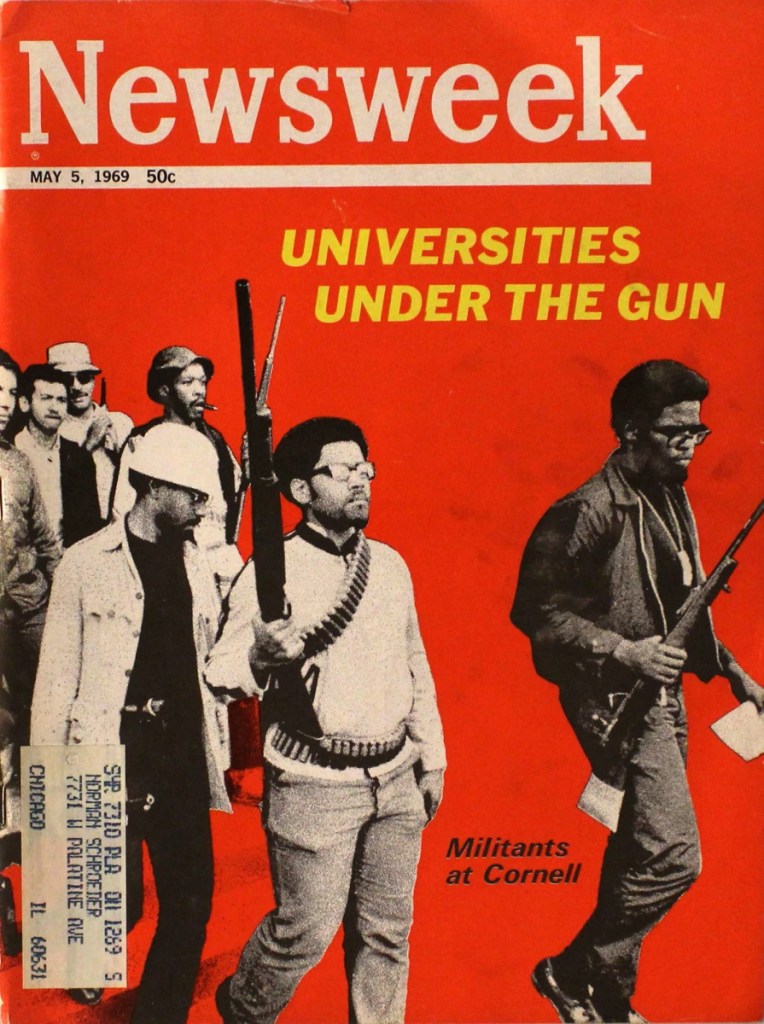
Let’s face it — that time in America was very unsettled and tension-filled:
“There were multiple issues firing the national social cauldron in 1969, in addition to the anti-Vietnam War, civil rights, women’s rights and Black Power movements: calls for Cornell to divest itself of investments in South Africa because of apartheid; starvation in Biafra; youth culture; drug culture; the sexual revolution; and, above all, the specter of the draft.”
(Cornell Chronicle)
A year before the Straight takeover, and right around the time of the MLK assassination, 150 Columbia students were injured when NYC police put an end to black and radical students taking control of five campus buildings; Daniel Berrigan, a Jesuit who had been a director of religious work at Cornell was arrested as part of a group known as the Catonsville Nine after entering a selective service office in Maryland and burning dozens of draft records with napalm; just days before the Straight takeover, 300 Harvard students (members of SDS) seized the administration building; in California, National Guard helicopters sprayed skin-stinging powder on anti -war protestors; within weeks of the Straight takeover, student uprisings occurred on the campuses of Dartmouth College, Princeton, Tulane and Howard universities
So, it was at Cornell where Homer Lee Meade II became a part of the civil rights movement. It can be argued that he initially got involved while working with black youth in Newark a few years earlier. But, the Straight takeover meant that Homer had jumped into the cause with both feet, and there was no turning back.
While the Straight situation showed Homer’s “commitment to being an agent of change,” he also spent a lifetime as a passionate educator making a difference with young students, both black and white. After receiving a B.A. from Cornell University, he went on to earn a Masters in Education from North Adams State College and a PhD in Education from the University of Massachusetts. He served as a member of the W.E.B. DuBois Department of African-American Studies at UMass, as well as a DuBois scholar.
In 1979, Dr. Meade celebrated a crowning achievement when he served as program director for the W.E.B. DuBois Memorial Committee that created the National Historic Landmark designation of Dr. DuBois’ home in Great Barrington, MA. Homer had long been inspired by the work of the sociologist and historian DuBois, and had researched him while working on his doctoral dissertation at UMass Amherst. DuBois, by the way, had been one of the founders of the NAACP in 1909. In 2019, Homer received an NAACP Change Maker Award due to his work in crafting curriculum and teaching standards for a new generation of Americans.
The last time I saw Homer was at the October, 2000 Madison High School Reunion. We actually got the old folk group together (after 35 years!) and though a bit rusty, we performed a few of the old favorites. I had always hoped that he and I could get together for a visit; however, for some reason, it just never happened. Life is like that. Then, out of the blue, about 15 years ago, Skip emailed me and said that he was working on an autobiography. He asked if I would like to read some of the chapters as he was finishing them. Obviously, I was honored that he even wanted my opinion about a project that I knew he considered so important. We had been very close in high school; and perhaps he felt that I could offer some insight or perspective on those years.
The book was to deal with his boyhood, the influence of both his father and paternal grandfather, his high school years during the turbulent 60s, his college days at Cornell, including of course the consequential standoff in Willard Straight Hall. I very much enjoyed reading his always well-expressed thoughts and the feeling he had about his life as one where he believed in contributing to “the movement of knowledge.”
Over a period of a year or less, on an irregular basis, a chapter would pop up in my email. I was certainly pleased that he trusted me enough to seek my opinion. I was particularly interested in how he read the high school years, especially looking back at them some 40 odd years later. I don’t want to put words in his mouth, or to in any way mischaracterize what he communicated to me, but I always had the feeling that he’d felt like he had played a certain role in the community during that time. He was after all, a young, black man who could be counted on consistently to “do the right thing.” He was a guy who “knew his place,” and did not “step out of line.” He obviously understood what it took — what was required — in those days to “fit in.” Let’s face it, Homer was a model for a bunch of us guys, black and white. He was smart, he was talented, he was charming, he was funny — what was not to like? It seemed then that he knew everyone and everyone in town knew him.
In one of our exchanges regarding the autobiography, I suggested that perhaps the Skip Meade of the 1960s was not unlike Ralph Ellison’s Invisible Man. Homer did not disagree. I am reminded of a comment by the main character in Ellison’s book: “I was praised by the most lily-white men in town. I was considered an example of desirable conduct.”
And, Homer was praised, that is, until he began to date a white girl. And, he then he started to receive some negative blowback from those who had previously supported him. I’m sure that Homer felt betrayed. After all, had he not up until then been one of the most responsible young men in town?. Also, as a black man in the 60s, couldn’t he always be counted on to do the right thing in every situation? By his nature, and by what his fellow students and the community had come to expect from him, it was no wonder that he was able to maintain his outward composure and equanimity during that time. For, we must also suspect that just beneath the surface there were probably many competing thoughts and considerations on his mind. Was he beginning to feel like the invisible man? Consider these utterings from Ellison’s Invisible Man:
“I was never more hated than when I tried to be honest, or when ever, as just now, I’ve tried to articulate a truth. No one was satisfied.”
Or,
“And my problem was that I tried to go everyone’s way but my own.”
Or,
“Whence all of this passion for conformity anyway? …Why, if they follow this conformity business, they’ll end up forcing me, an invisible man to become white …”
I believe that Homer did fill the “role” of an invisible man perfectly. And, he was gladly accepted by the Madison community as such. But, it was when he attempted to shed his invisibility, and to be truthful about his new relationship, that things began to change. I think that Homer was in the process of discovering, of becoming, who he was meant to be: “When I discover who I am, I will be free.” (Ellison)
Though Homer got along so well in a white world by assuming just enough “whiteness,” I don’t believe that he was trying to trick anyone or that he was being purposely deceitful in any way. Knowing the Homer of that time, I always felt, and still do, that he found joy in life and in being a positive force. He liked people, and people liked him. And, if along the way, he found opportunities to make himself more accepted, I don’t think he was trying to hoodwink anyone. That’s who he really was.
I don’t feel that the Homer I knew in those days would’ve agreed with these following statements about how Ellison’s invisible man saw himself getting along in a white world:
“All it takes to get along in this man’s town is a little shit, grit and mother-wit.”
Or
“Play the game, but don’t believe in it; play the game, but raise the ante, my boy, learn how it operates, learn how you can operate.”
No, the quotes just cited above do not represent the young Homer Meade. They are, in fact, antithetical to what he stood for. He was a sincere, young black man on the road to who he was to become, but imho, he had not gotten there yet. He was in no way “shuckin’ and jivin’”to try and fool the white folks. Nor do I think he was simply lying low, keeping his powder dry and waiting to spring forward at some considered time to use what he had learned from a white world to fight racism (“A hibernation is covert preparation for a more overt action”) (Ellison)
So, I don’t think this was a secret, orchestrated plan. Rather, I feel that circumstances (beginning in his senior year in high school) caused him to reassess what his life had been up to that point, and what he now deemed it needed to be in the future. I think it was a maturation and an evolvement of his thinking to meet the moment. And, once he saw what needed to be done, particularly in terms of race relations in this country, he moved forward with conviction, and commitment.
A key turning point in Homer’s thinking and in his life occurred on April 4,1968, during his junior year at Cornell. That was the day that Martin Luther King was shot and killed in Memphis. Skip’s best friend at the University was Thomas Jones, and he recalled that moment in time: “Skip Meade felt a moral and historical obligation to fight on the side of black liberation.” (Thomas Jones, “Dr. Homer L. Meade II Memorial Service eulogy, 8/28/21)
And, after the Willard Straight takeover: “Skip was calm and committed. (He) knew that we were caught in an historic moment we had not asked for, but that we had to have the courage to face whatever came our way.” (Jones)
After a photo of Homer, Thomas and their fellow AAS members at the Straight confrontation appeared on the cover of Newsweek, Jones spoke of the pride they felt in the solidarity and courage of the nascent movement, and its
“explicit repudiation of hundreds of years of American history of blacks cowering in subjugation and fear. Skip understood that one reason blacks had suffered 400 years of oppression in America was that not enough had been willing to fight and die for respect and equality. Skip Meade showed no fear when the random wheel of history brought us to that unforeseeable crossroads where we faced that challenge.”
(Jones)
And, when challenged by both circumstances and history, Homer knew what he must do. In an essay that he had written (in the third person) about what happened at the Straight, Homer put it this way:
“He thought that we each decided to accept the responsibility of being one of ‘the chosen.’ He had decided for himself that he was called to give, even his life if necessary, in the struggle to establish justice and right. …Martin said it best ‘…a man has not lived until he has found that something for which he will die; and until that decision is made, though he may live to 95 years old, the mere cessation of life is only a belated announcement of an earlier death of spirit.’ ”
(Jones)
As an admirer of Dr. DuBois, perhaps Homer considered these thoughts from the great man:
“Now is the accepted time, not tomorrow, not some more convenient season. It is today that our best work can be done and not some future day or future year. It is today that we fit ourselves for the greater usefulness of tomorrow. Today is the seed time, now are the hours of work, and tomorrow comes the harvest…”
And, even though there was risk, danger and uncertainty in what the black activists of Homer’s day were hoping to achieve, inherently they knew that they must proceed — and stir things up — if they wanted to improve the lives of black people in this country. As the great civil rights leader, congressman John Lewis of Georgia had said:
“Speak up, speak up, get in the way. Get in good trouble, necessary trouble, and help redeem the soul of America.”
Again, as DuBois wrote:
“For education among all kinds of men has had and always will have, an element of danger and revolution, of dissatisfaction and discontent.”
I was fortunate to have met Homer Lee Meade in middle school in the early 60s. I was privileged to be his friend. And I am inspired by what he worked to achieve during his lifetime. As he wrote: “There needs to be a movement of knowledge. That’s what I’ve done.”
Dr. Meade was an invisible man who became visible when the time was right, leaving an imprint on history…
{Dr. Homer L. “Skip” Meade, a passionate educator who spent his life making a difference and being an agent of change, passed away on July 2, 2021 from complications of dementia.}
Click below to listen to an audio recording of this essay
 Resonance