“Our prime purpose in this life is to help others. And if you can’t help them, at least don’t hurt them.”
The Dalai Lama
“I am of the opinion that my life belongs to the community, and as long as I live, it is my privilege to do for it whatever I can.”
George Bernard Shaw
“I feel the capacity to care is the thing which gives life its deepest significance.
Pablo Casals
“The true meaning of life is to plant trees, under whose shade you do not expect to sit.”
Nelson Henderson
“The meaning of life is whatever you ascribe it to be. Being alive is the meaning.”
Joseph Campbell
“Whatever we are, whatever we make of ourselves, is all we have — and that, in its profound simplicity, is the meaning of life.”
Philip Appleman
“A wise man was asked: ‘What is the meaning of life?’ He replied: ‘Life itself has no meaning. Life is an opportunity to create meaning.”
Unknown
“There is not one big cosmic meaning for all; there is only the meaning we each give to our life, an individual meaning, an individual plot, like an individual novel, a book for each person.”
Anais Nin
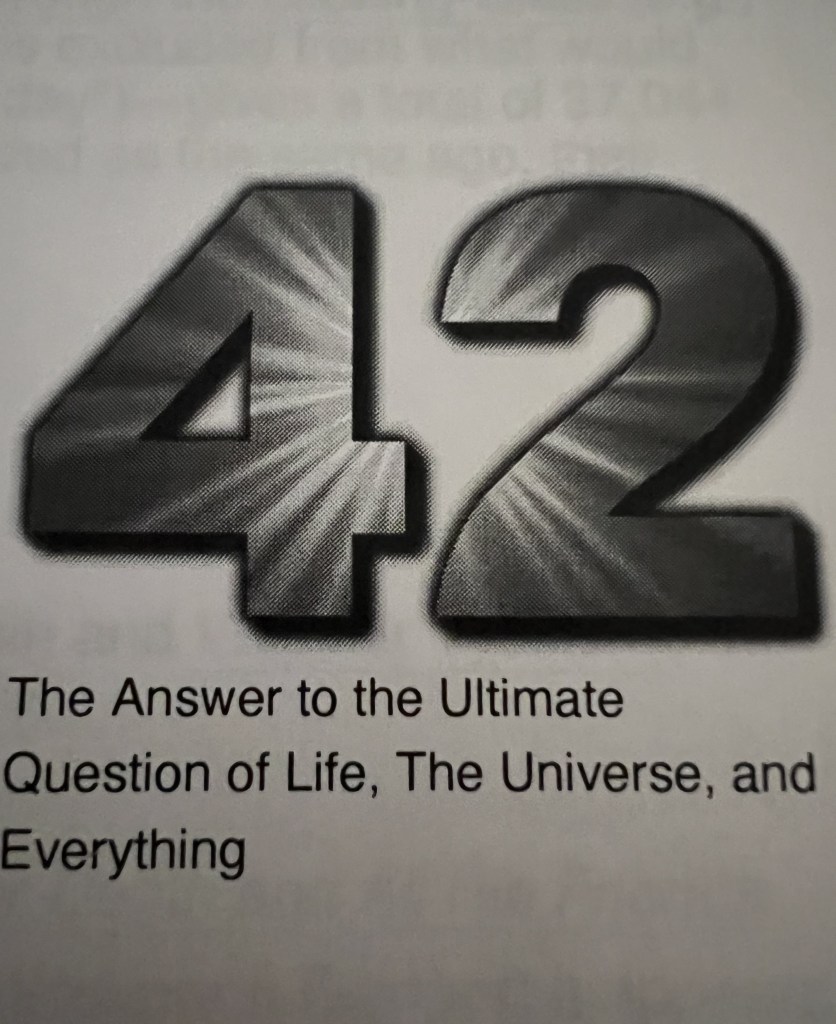
“The number 42 is, in The Hitchhiker’s Guide to the Galaxy by Douglas Adams, the ‘Answer to the Ultimate Question of Life, the Universe and Everything,’ calculated by an enormous supercomputer named Deep Thought over a period of 7.5 million years. Unfortunately, no one knows what the question is…”
Wikipedia, “The Hitchhiker’s Guide to the Galaxy”
“It is impossible to define the meaning of life in a general way. Questions about the meaning of life can never be answered by sweeping statements.‘Life’ does not mean something vague, but something very real and concrete, just as life’s tasks are also very real and concrete. They form man’s destiny, which is different and unique for each individual.”
Viktor Frankl, Man’s Search for Meaning, pg. 77
“There is a difference between asking what is the meaning of life and how to live a meaningful life. The former is a more abstract, metaphysical question that may not have a clear answer, while the latter is more pragmatic and focuses on how we can find purpose and fulfillment in our day-to-day lives.”
Chris Ferrie, “The Meaning of Life, According to Science”
Over the last three years I have ruminated on, considered deeply and then expressed — sometimes with intense passion — my feelings about topics both simple and complex. The complex subjects have included: time, chaos theory, age, memory, courage, etc. All very weighty issues, for sure. And, I took their weightiness quite seriously. What I have sought to do in all of my essays was to introduce common topics that we’re all aware of and to offer my own thoughts about the meaning of those terms — as they were generally understood by most thoughtful people, in addition to what they meant specifically for me.
This current essay that you’ve begun to read deals with — wait for it — What is The Meaning of Life? Some of you may be pulled up short by what I’ve just stated. So, not only have I offered my two cents worth on serious topics over the last several years, but now Frank thinks he’s going to let us all in on the meaning of life — the very meaning of life? Really? Seriously? What excessive confidence, what overweening pride, what amazing arrogance. What hubris!
Hey, I know what this looks like (and, if we were talking about anyone but yours truly, I’d be put off by the utter superciliousness of someone expressing such pretentious thoughts.) Sure, I can understand how this makes me appear. But, I can explain, I think. As I made very clear when I began my blog (during the pandemic) in 2020, I was not an expert on any of the topics that I decided to write about. My essays simply represented the overly-considered, highly-researched and much thought-about meanderings of one, ordinary human being. My objective, and my hope, was to perhaps offer one more way to look at things that we’ve all been looking at for a very, long time. And maybe, if I got lucky enough and had a spark of insight, to perhaps, in some, small way, introduce a sliver of additional knowledge or understanding to the information data base that exists.
And, bottom line, my intent in publishing these essays (27 and counting) has been to strike a chord with the reader: To offer a thought, an insight, an opinion that would resonate with you, dear reader, on some level. Hence, why my site is called resonance.blog. And, if I were able to make that connection with you, then great — “Mission Accomplished” — as George W. once proclaimed. But, if I didn’t inspire you at all, then no harm, no foul. All it cost you was reading an essay of mine that you didn’t much care for.
But, enough about all of this. Let’s scramble from this preamble. We — you and I — have bigger fish to fry. So, on to the meaning of life! Now, be honest with me. I’m serious. Don’t tell me that you haven’t thought about it a lot over the years. I’m sure you’ve asked yourself the following questions: Why am I here? What’s the point of it all? What’s it all about, Alfie? And, oh yes, behind the veneer of a busy and challenging existence, what exactly is the meaning of life?
Well, I intend to deal with all of that for you, but I’ll need a little time. However, right off the bat I’ll tell you that as humans we all have a tendency to attach some kind of meaning to the events of our lives. There are some who feel that our brains kind of invent meaning as needed — sort of making it up as we go along — to help us figure out what’s going on in the world around us. As Mark Manson, self-help author and blogger, has written: “Let’s be real: meaning is an arbitrary mental construct.” (Mark Manson, “How to Find Meaning in Life,” The Breakthrough Newsletter)
Think about it: without the ability or the inclination for humans to attach meaning to needs or events, life would come to a virtual standstill. Early humans needed to
“remember where certain food could be found, how various animals would respond when hunted, how weather patterns change and how to read terrain. They also needed to know what would gain acceptance within their tribe, what would curry favor with friends…”
(Manson)
Manson goes on to say that “meaning is nature’s tool for motivation.” It derives all of our actions. And, when we attach great meaning to something:
“…like our child is sick and starving, we will go to insane lengths to make things right. People will often go so far as giving up their lives for some grand sense of meaning (see: religion, every war ever). Meaning is that effective at moving people.
(Manson)
Many people are able to find some meaning in their lives by setting “goals.” Often these goals involve successful careers: a big job with a great salary, and all the perks that go with that.; or, having celebrity status; or, being a professional athlete; or, becoming a successful, millionaire investor. As Mark Manson writes:
“Goals are dangerous because the meaning they provide when you’re working towards them is the meaning that is taken away once you achieve them. …Goals are a double-edged sword. You have to be careful. Goals are good tools for building motivation. The problem is, by themselves, they are arbitrary and empty.”
Much like the statement from James 2:26 —”For as the body without the spirit is dead, so faith without works is dead also.”
If we look at the way that psychologists have dealt with the meaning of life over the years, there has arisen a consensus that there are three ways to understand the concept:
“Coherence, Purpose and Significance. Coherence means a sense of comprehensibility and one’s life making sense. Purpose means a sense of core goals, aims and direction in life. Significance is about a sense of life’s inherent value and having a life worth living.”
(F. Martela/M. Steiger, “The Three Meanings of Meaning of Life; Distinguishing Coherence, Purpose and Significance.” The Journal of Positive Psychology Vol. II, 2016, Issue 5)
Though I’m sure the above explanations are clinically right on, they don’t do much in terms of inspiring me about the ultimate meaning of life. In fact, the descriptions cited by our psychologist friends are quite dry and unappealing. I myself tend to look at matters such as this, though serious, in a more compassionate, caring and humanistic way.
Now I’d like to turn to a classic,Man’s Search for Meaning, by the psychologist Viktor E. Frankl, a survivor of the Nazi concentration camps. In the foreword, author Harold Kushner writes:
“Terrible as it was, his experience in Auschwitz reinforced what was already one of his key ideas: Life is not primarily a quest for pleasure, as Freud believed, or a quest for power, as Alfred Adler taught, but a quest for meaning. The greatest task for any person is to find meaning in his or her life.”
(Frankl, page X)
Further,
“Frankl saw three possible sources for meaning: in work (doing something significant), in love (caring for another person), and in courage during difficult times. Suffering in and of itself is meaningless; we give our suffering meaning by the way in which we respond to it.”
(Frankl, page X)
Experiencing the death camp, and surviving it, while attempting to guide, inspire and console his fellow prisoners — Frankl came to this realization:
“What was really needed was a fundamental change in our attitude toward life. We had to learn ourselves and, furthermore, we had to teach the despairing men, that it did not really matter what we expected from life, but rather what life expected from us. …Life ultimately means taking the responsibility to find the right answer to its problems and to fulfill the tasks which it constantly set for each individual.” (Frankl, pg. 76)
Looking at death — head-on, and on a daily basis — can clarify things for you very quickly. It is the ultimate moment of truth. Where the rubber meets the road. The point at which the theory, or your faith, is put into practice. Fortunately, most of us will never have to face what Frankl and his co-prisoners faced. But, yet, he asks each and every one of us to take the challenges, obstacles and tasks that life sets before us and work to solve them in the “right” way — in such a way that is appropriate to the moment and that will help to define the very meaning of our life.
Chris Ferries, a Canadian physicist, mathematician and researcher, wrote a piece in which he had this to say about doing things and living life in the right way:
“Rather than providing a definitive answer to the question of the meaning of life, even since ancient times, most philosophers immediately shift the focus to how to live a meaningful life. The emphasis is on the individual’s actions, values and responsibilities as guided by various philosophical, cultural and religious traditions. In this way, the meaning of life is the pursuit of living the “correct” way.
(Chris Ferrie, “The Meaning of Life, According to Science,” 5/20/23)
Ferrie goes on to cite key beliefs of a number of traditions:
• HINDUISM: to lead a meaningful life involved “fulfilling one’s duty and moral obligations.” It also included “recognizing one’ place within (the) interconnected web and striving to maintain balance and harmony with oneself and with the world around them.”
• STOICISM: the meaning of life is more about the recognition that many things are beyond our control, so we must “focus instead on cultivating inner virtue.” There is also a relation to interconnectedness, and our place within “the grander cosmic web (and) developing the virtues of empathy, compassion and commitment to the common good. All of these virtues allow the individual to ‘align’ with the natural order of things.” (Ferrie)
• DAOISM: has a deep appreciation for the interconnectedness of all phenomena. And, it “encourages individuals to embrace simplicity, spontaneity and balance, allowing them to find meaning by attuning themselves to the natural rhythms of the world.” (Ferrie)
• NIETZSCHE:“…urges individuals to discover meaning within the world they presently inhabit and to forge their own values and aspirations. Central to Nietzsche’s perspective are the notions of genuineness, intellectual honesty, moral accountability and aesthetic engagement, all of which contribute to shaping a life imbued with significance.” (Ferrie)
• LIBERTARIANSM:“…champions the idea that individuals should have the freedom to pursue their own goals and live according to their own values as long as they respect the equal rights of others. …Within the context of meaningful living, libertarianism aligns with the notion that individuals should have the agency to shape their own lives and make choices that reflect their values and aspirations.” (Ferrie)
• EXISTENTIALISM: “explores the individual’s freedom, responsibility and subjective experience. It emphasizes that humans create their own meaning and purpose through their choices and actions. … Living a meaningful life within an existentialist framework involves embracing personal freedom, taking responsibility for one’s choices and engaging in a sincere exploration of one’s values and passions.” (Ferrie)
It’s easy to spot some common threads among these various philosophical, cultural and religious traditions. Namely, they all share a sense of duty, moral obligation, responsibility, maintaining balance and harmony, cultivating inner virtue, contributing to the common good, respecting the rights of others…
So, through the ages, human beings from many varied backgrounds and belief systems have seemed to come to a consensus that a major factor contributing to the meaning of life has to do with what we find meaningful in life. And, there appears to be agreement it should include living a life that both has value and contributes to the common good. That’s kind of what I was thinking all along. And, I suppose you were, too.
When we were young and life seemed like it was endless and almost infinite, most of us probably gave little or no thought to what our existence meant, or stood for. But, eventually, if we were thoughtful enough about assessing why and how we were responding to life’s daily challenges and expectations — then we most likely began to attach some meaning to the way in which we were living our life; and eventually, to think about what was seriously important in determining who we were. In effect, I think that such an assessment eventually morphed into what makes up the majority of our personal identity — not only what we stood for as an individuals, but ultimately what we’d be willing to fight for and go to the mat for. Essentially, that which provided the most meaning to our life.
As you noticed, I entitled this essay “What’s It All About, Alfie?” Of course, I borrowed the question from the 1966 movie of the same name that starred Michael Caine and Shelley Winters. Cathy and I actually took that film in, probably at the Community Theater in Morristown, NJ. We were both in our sophomore year at college. Yes, at the ripe, young age of 19, I’m not sure I really got the full meaning of the movie’s message. But, over the years, I’ve spouted that question, particularly when my thoughts ran deeper and I, yes, considered what the true meaning of life might be.
So, in the grand scheme of things, what does it all mean? What is the ultimate significance of this thing we call life? What’s it all about, Alfie? Well, if we go back to the lyrics of the movie’s theme song, they raise some issues we should be aware of, and concerned about:
“Is it just for the moment we live?
What’s it all about, when you sort it out, Alfie?
Are we meant to take more than we give?”
Alfie, a chronic womanizer who seemed to “have it all,” has taken so much from others and given nothing in return. In the end, he has no fulfillment in his life and no peace of mind. So, these are the questions that he keeps asking himself, and questions that tease him and haunt him.
Of course, there have been many others over the years, who have sought to define the meaning of life. You’d probably agree that those four English chaps who comprised Monty Python might have such an opinion. In a song the Pythons performed in 1983 they have questions:
“Why are we here, what’s life about?
Is God really real, or is there some doubt?
… What’s the point of all this hoax?
Is it the chicken and egg time, are we just yolks?
Or perhaps we’re just one of God’s little jokes.”
(Neil Innes, “The Meaning of Life,” lyrics, 1983)
By song’s end, they appear to be no closer to an answer: “So just why, why are we here? And just what, what do we fear?”
In The Meaning of Life movie, also released in 1983, there are a series of sketches. In one of the last sketches entitled “Middle of the Film,” the hostess opens an envelope and “blandly” reveals the meaning of life:
“Try and be nice to people, avoid eating fat, read a good book every now an then, get some walking in, try and live together in peace and harmony with people of all creeds and nations.”
Good, solid advice, to which I’ll add Ralph Waldo Emerson’s take. The great American essayist calls it “success,” but to me it is the basis for a wonderful description of the important things in life, the meaningful things in life — that come from doing things in the right way:
“What is success? To laugh often and much; to win the respect of intelligent people and the affection of children; to earn the appreciation of honest critics and endure the betrayal of false friends; to appreciate the beauty; to find the best in others; to leave the world a bit better, whether by a healthy child, a garden patch or a redeemed social condition; to know even one life has breathed easier because you lived. This is to have succeeded!”
Even before I began to work on this essay, I had my own definite and long-held beliefs about what constitutes life’s meaning, at least for me. Certainly, it started with being able to make some sense of my existence; having a philosophy to live by; believing in the value of my own life. And, in my view, at the center of it all is love, for family, friends — and for mankind. Finally, I believe that there is a moral component: giving back in honor of what those who came before provided for us. Kind of like social security, in a way.
In addition, I’ve always found myself going back to that simple phrase from Emerson: “To leave the world a bit better.” To improve things when and where you can. To make it stronger than you found it. There was a line that I quoted at the very beginning of this piece which basically said that the true meaning of life is to plant trees, under whose shade you do not expect to sit. You know, it shouldn’t be all about quid pro quo. Maybe paying it forward is a better idea, for yourself and for humankind. Or, as the motivational speaker (and long-term survivor of pancreatic cancer) Lorrie McCaskill has written: “Yes, life is an echo. What you send out, you get back. What you give, you receive.”
As I wrap this up, I’d like to go back to a few of those lyrics from the Alfie theme song:
“What will you lend on an old golden rule?
As sure as I believe there’s a heaven above, Alfie,
I know there’s something much more,
Something even non-believers can believe in.
I believe in love, Alfie.
So, after all of the investigations, and all of the considerations and all of the proclamations, maybe it all just comes down to love? And, as that other famous English quartet advised: “All you need is love, love is all you need…”
————————————————————————————————–
 Resonance